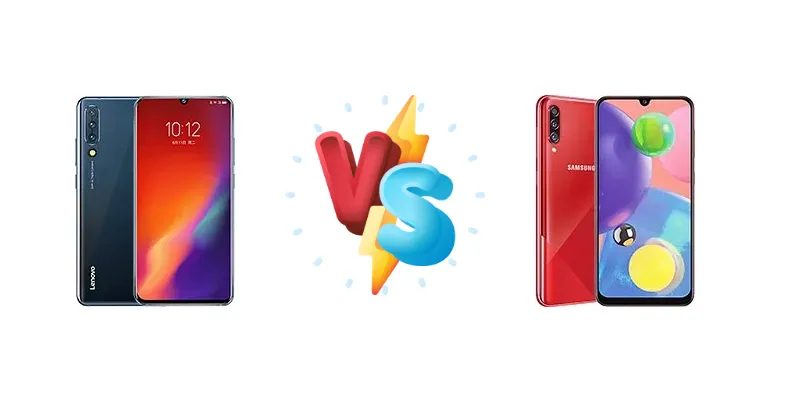
The Lenovo Z6 and Samsung Galaxy A70s represent compelling options in the mid-range smartphone market, but cater to slightly different priorities. The Z6, powered by the Snapdragon 730, aims for a balance of performance and efficiency, while the A70s leverages the Snapdragon 675 and prioritizes faster charging speeds. This comparison dissects the key differences to help you choose the right device.
🏆 Quick Verdict
For users prioritizing raw performance and a more modern chipset, the Lenovo Z6 is the better choice. Its Snapdragon 730 offers a noticeable step up in processing power. However, the Samsung Galaxy A70s wins for those who value faster 25W charging and are less demanding on their phone's processing capabilities.
| Network |
|---|
| 2G bands | GSM 850 / 900 / 1800 / 1900 | GSM 850 / 900 / 1800 / 1900 |
| 3G bands | HSDPA 850 / 900 / 1900 / 2100 | HSDPA 850 / 900 / 1900 / 2100 |
| 4G bands | 1, 2, 3, 5, 7, 8, 20, 34, 38, 39, 40, 41 | 1, 3, 5, 7, 8, 20, 38, 40, 41 |
| Speed | HSPA, LTE | HSPA, LTE |
| Technology | GSM / CDMA / HSPA / LTE | GSM / HSPA / LTE |
| | CDMA 800 & TD-SCDMA | HSDPA 850 / 900 / 1700(AWS) / 1900 / 2100 |
| Launch |
|---|
| Announced | 2019, July 04. Released 2019, July 09 | 2019, September. Released 2019, September |
| Status | Discontinued | Discontinued |
| Body |
|---|
| Build | Glass front (Gorilla Glass), glass back, aluminum frame | Glass front (Gorilla Glass 3), plastic back, plastic frame |
| Dimensions | 157 x 74.5 x 8 mm (6.18 x 2.93 x 0.31 in) | 164.3 x 76.7 x 7.9 mm (6.47 x 3.02 x 0.31 in) |
| SIM | Nano-SIM + Nano-SIM | · Nano-SIM· Nano-SIM + Nano-SIM |
| Weight | 159 g (5.61 oz) | 187 g (6.60 oz) |
| Display |
|---|
| Protection | Corning Gorilla Glass (unspecified) | Corning Gorilla Glass (unspecified) |
| Resolution | 1080 x 2340 pixels, 19.5:9 ratio (~403 ppi density) | 1080 x 2400 pixels, 20:9 ratio (~393 ppi density) |
| Size | 6.39 inches, 100.2 cm2 (~85.7% screen-to-body ratio) | 6.7 inches, 108.4 cm2 (~86.0% screen-to-body ratio) |
| Type | Super AMOLED, 120Hz, HDR10 | Super AMOLED |
| Platform |
|---|
| CPU | Octa-core (2x2.2 GHz Kryo 470 Gold & 6x1.8 GHz Kryo 470 Silver) | Octa-core (2x2.0 GHz Kryo 460 Gold & 6x1.7 GHz Kryo 460 Silver) |
| Chipset | Qualcomm SDM730 Snapdragon 730 (8 nm) | Qualcomm SDM675 Snapdragon 675 (11 nm) |
| GPU | Adreno 618 | Adreno 612 |
| OS | Android 9.0 (Pie), ZUI 11 | Android 9.0 (Pie), upgradable to Android 11, One UI 3.1 |
| Memory |
|---|
| Card slot | microSDXC (uses shared SIM slot) | microSDXC (dedicated slot) |
| Internal | 64GB 6GB RAM, 128GB 6GB RAM, 128GB 8GB RAM | 128GB 6GB RAM, 128GB 8GB RAM |
| | UFS 2.1 | UFS 2.0 |
| Main Camera |
|---|
| Features | Dual-LED flash, panorama, HDR | LED flash, panorama, HDR |
| Triple | 24 MP, f/1.8, (wide), 1/2.8", 0.9µm, PDAF
8 MP, f/2.4, (telephoto), PDAF, 2x optical zoom
Auxiliary lens | 64 MP, f/1.8, 26mm (wide), 1/1.72", 0.8µm, PDAF
8 MP, f/2.2, 12mm (ultrawide), 1/4.0", 1.12µm
Auxiliary lens |
| Video | 4K@30fps, 1080p@30fps | 4K@30fps, 1080p@30/240fps |
| Selfie camera |
|---|
| Features | HDR | HDR |
| Single | 16 MP, f/2.0, 26mm (wide), 1/3.06", 1.0µm | 32 MP, f/2.0, 25mm (wide), 1/2.8", 0.8µm |
| Video | 1080p@30fps | 1080p@30fps |
| Sound |
|---|
| 3.5mm jack | Yes | Yes |
| 35mm jack | Yes | Yes |
| Loudspeaker | Yes | Yes |
| Comms |
|---|
| Bluetooth | 5.0, A2DP, EDR, LE, aptX HD | 5.0, A2DP, LE |
| NFC | No | Yes |
| Positioning | GPS, GLONASS, BDS | GPS, GLONASS, GALILEO, BDS |
| Radio | No | FM radio |
| USB | USB Type-C 2.0, OTG | USB Type-C 2.0 |
| WLAN | Wi-Fi 802.11 a/b/g/n/ac, dual-band, Wi-Fi Direct | Wi-Fi 802.11 a/b/g/n/ac, dual-band, Wi-Fi Direct |
| Features |
|---|
| Sensors | Fingerprint (under display, optical), accelerometer, proximity, compass | Fingerprint (under display, optical), accelerometer, gyro, proximity, compass |
| | - | ANT+ |
| Battery |
|---|
| Charging | 15W wired | 25W wired |
| Type | Li-Po 4000 mAh, non-removable | Li-Po 4500 mAh, non-removable |
| Misc |
|---|
| Colors | Blue | Prism Crush Red, Prism Crush White, Prism Crush Black |
| Models | L78121 | SM-A707F, SM-A707FN, SM-A707GM, SM-A707MN, SM-A7070, SM-A707W |
| Price | About 250 EUR | About 380 EUR |
| SAR EU | - | 0.42 W/kg (head) 1.48 W/kg (body) |
Lenovo Z6
- More powerful Snapdragon 730 chipset
- Greater processing efficiency (8nm process)
- Potentially better camera image processing
- Slower 15W charging
- Potentially smaller display size
Samsung Galaxy A70s
- Faster 25W wired charging
- Likely larger display
- Potentially longer battery life due to charging convenience
- Less powerful Snapdragon 675 chipset
- Less efficient 11nm process
- Potentially slower app loading and multitasking
Display Comparison
Neither device's display specifications are provided, so a direct comparison is limited. However, given the A70s' positioning, it likely features a larger display. The Z6, being a more compact offering, may prioritize a higher pixel density. Color accuracy and brightness will likely be similar, typical of the mid-range segment. Without specific data, it's reasonable to assume both utilize AMOLED panels, common for this price bracket.
Camera Comparison
Without detailed camera specifications, a precise comparison is difficult. However, the Snapdragon 730 in the Z6 generally offers superior image signal processing (ISP) capabilities compared to the 675 in the A70s. This translates to better dynamic range, noise reduction, and overall image quality, particularly in challenging lighting conditions. It's likely the Z6 can handle more complex computational photography tasks. The absence of information on sensor sizes and lens apertures prevents a more granular analysis, but the chipset advantage favors the Z6.
Performance
The Lenovo Z6’s Qualcomm Snapdragon 730 (8nm) demonstrably outperforms the Samsung Galaxy A70s’ Snapdragon 675 (11nm). The 730’s smaller 8nm process allows for greater transistor density and improved power efficiency, translating to sustained performance under load. The CPU configuration – 2x2.2 GHz Kryo 470 Gold & 6x1.8 GHz Kryo 470 Silver in the Z6 versus 2x2.0 GHz Kryo 460 Gold & 6x1.7 GHz Kryo 460 Silver in the A70s – further reinforces this advantage. The Z6 will exhibit quicker app launch times and smoother multitasking. While both are octa-core, the 730’s architecture is a generation newer and more refined.
Battery Life
The Samsung Galaxy A70s’ 25W wired charging is a significant advantage over the Lenovo Z6’s 15W charging. This means the A70s can replenish its battery much faster, reducing downtime. While battery capacity isn’t specified, the faster charging speed is a tangible benefit for users who prioritize convenience. The Z6’s more efficient Snapdragon 730 might offset a smaller battery capacity to some extent, but the A70s will still likely offer quicker top-ups.
Buying Guide
Buy the Lenovo Z6 if you need a phone capable of handling demanding apps and moderate gaming with a more efficient processor. It's ideal for users who value performance-per-dollar. Buy the Samsung Galaxy A70s if you prefer a phone with significantly faster charging, even if it means sacrificing some processing power. This is a good fit for users who frequently top up their battery and don't engage in heavy gaming or multitasking.
Frequently Asked Questions
❓ Will the Snapdragon 675 in the Galaxy A70s struggle with graphically intensive games like PUBG or Call of Duty?
The Snapdragon 675 is capable of running PUBG and Call of Duty, but you'll likely need to lower graphics settings to achieve a consistently smooth frame rate. The Z6’s Snapdragon 730 will provide a noticeably better gaming experience with higher settings and more stable performance.
❓ How much faster is the 25W charging on the Galaxy A70s compared to the 15W charging on the Lenovo Z6 in real-world use?
The 25W charging on the A70s can potentially reduce a full charge time by 30-50% compared to the Z6’s 15W charging. This means a full charge could take around an hour on the A70s versus potentially 1.5-2 hours on the Z6, depending on battery capacity.
❓ Is the difference in chipset performance between the Snapdragon 730 and 675 noticeable for everyday tasks like browsing and social media?
For basic tasks like browsing and social media, the difference won't be dramatically noticeable. However, the Z6 will feel snappier when switching between apps or opening multiple tabs. The 730’s extra processing power becomes more apparent with heavier multitasking.