
Lenovo Z6 Pro 5G vs vivo iQOO 3 5G: A Detailed Comparison of Two 5G Contenders
| Phones Images | |||||
|---|---|---|---|---|---|
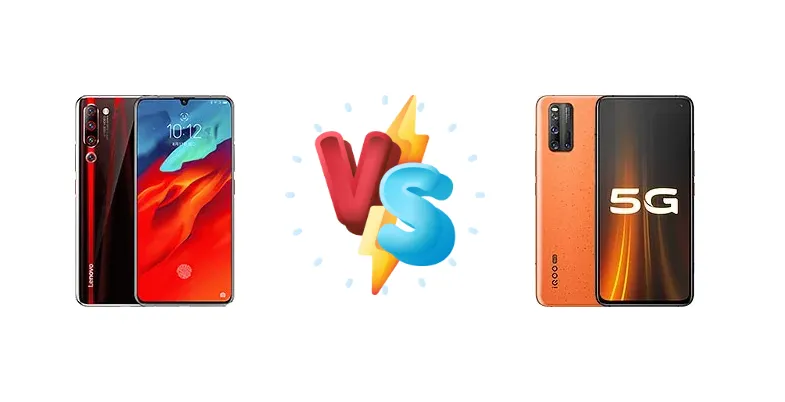
|
🏆 Quick Verdict
For most users, the vivo iQOO 3 5G is the superior choice. Its Snapdragon 865 chipset provides a noticeable performance uplift over the Z6 Pro’s Snapdragon 855, and the 55W fast charging is a game-changer. While both offer similar battery endurance ratings, the iQOO 3’s faster charging mitigates any potential concerns.
| PHONES | ||
|---|---|---|
| Phone Names | Lenovo Z6 Pro 5G | vivo iQOO 3 5G |
| Network | ||
|---|---|---|
| 2G bands | GSM 850 / 900 / 1800 / 1900 | GSM 850 / 900 / 1800 / 1900 |
| 3G bands | HSDPA 850 / 900 / 1900 / 2100 | HSDPA 850 / 900 / 1700(AWS) / 1900 / 2100 |
| 4G bands | 1, 3, 5, 7, 8, 20, 34, 38, 39, 40, 41 | 1, 2, 3, 4, 5, 7, 8, 12, 17, 18, 19, 20, 25, 26, 34, 38, 39, 40, 41 |
| 5G bands | 41, 78 NSA/Sub6 | 1, 3, 41, 77, 78, 79 SA/NSA - China |
| Speed | HSPA 42.2/5.76 Mbps, LTE (5CA) Cat18 1200/150 Mbps, 5G (2+ Gbps DL) | HSPA, LTE, 5G (3.3 Gbps DL) |
| Technology | GSM / CDMA / HSPA / LTE / 5G | GSM / CDMA / HSPA / LTE / 5G |
| CDMA 800 & TD-SCDMA | 41, 77, 78 - India | |
| Launch | ||
|---|---|---|
| Announced | 2019, June 26. Released 2019, November 15 | 2020, February 25. Released 2020, March 04 |
| Status | Discontinued | Discontinued |
| Body | ||
|---|---|---|
| Build | - | Glass front (Gorilla Glass 6), glass back (Gorilla Glass 6), aluminum frame |
| Dimensions | 157.5 x 74.6 x 8.7 mm (6.20 x 2.94 x 0.34 in) | 158.5 x 74.9 x 9.2 mm (6.24 x 2.95 x 0.36 in) |
| SIM | Nano-SIM + Nano-SIM | Nano-SIM + Nano-SIM |
| Weight | 185 g (6.53 oz) | 214.5 g (7.58 oz) |
| Display | ||
|---|---|---|
| Protection | - | Corning Gorilla Glass 6 |
| Resolution | 1080 x 2340 pixels, 19.5:9 ratio (~403 ppi density) | 1080 x 2400 pixels, 20:9 ratio (~409 ppi density) |
| Size | 6.39 inches, 100.2 cm2 (~85.3% screen-to-body ratio) | 6.44 inches, 100.1 cm2 (~84.3% screen-to-body ratio) |
| Type | Super AMOLED, HDR10 | Super AMOLED, HDR10+, 800 nits (typ) |
| Platform | ||
|---|---|---|
| CPU | Octa-core (1x2.84 GHz Kryo 485 & 3x2.42 GHz Kryo 485 & 4x1.78 GHz Kryo 485) | Octa-core (1x2.84 GHz Cortex-A77 & 3x2.42 GHz Cortex-A77 & 4x1.80 GHz Cortex-A55) |
| Chipset | Qualcomm SM8150 Snapdragon 855 (7 nm) | Qualcomm SM8250 Snapdragon 865 5G (7 nm+) |
| GPU | Adreno 640 | Adreno 650 |
| OS | Android 9.0 (Pie), ZUI 11 | Android 10, iQOO UI 1.0 |
| Memory | ||
|---|---|---|
| Card slot | microSDXC (uses shared SIM slot) | No |
| Internal | 128GB 6GB RAM, 128GB 8GB RAM, 256GB 8GB RAM, 512GB 12GB RAM | 128GB 6GB RAM, 128GB 8GB RAM, 128GB 12GB RAM, 256GB 8GB RAM, 256GB 12GB RAM |
| UFS 2.1 | UFS 3.1 | |
| Main Camera | ||
|---|---|---|
| Features | Dual-LED flash, panorama, HDR | LED flash, HDR, panorama |
| Quad | 48 MP, f/1.8, (wide), 1/2.0", 0.8µm, PDAF 8 MP, f/2.4, (telephoto), PDAF 16 MP, f/2.2, 12mm (ultrawide) 2 MP, f/1.8, 2.9µm, PDAF, OIS (dedicated video camera) TOF 3D, (depth) | 48 MP, f/1.8, (wide), 1/2.0", 0.8µm, PDAF 13 MP, f/2.5, 50mm (telephoto), PDAF, 2x optical zoom 13 MP, f/2.2, 120˚, 16mm (ultrawide), AF Auxiliary lens |
| Video | 4K@30fps, 1080p@120fps, gyro-EIS | 4K@30/60fps, 1080p@30fps; gyro-EIS |
| Selfie camera | ||
|---|---|---|
| Features | HDR | HDR |
| Single | 32 MP, f/2.0, 26mm (wide), 1/2.8", 0.8µm | 16 MP, f/2.5, (wide) |
| Video | 1080p@30fps | 1080p@30fps |
| Sound | ||
|---|---|---|
| 3.5mm jack | Yes | Yes |
| 35mm jack | Yes | Yes |
| Loudspeaker | Yes | Yes |
| - | 32-bit/192kHz audio | |
| Comms | ||
|---|---|---|
| Bluetooth | 5.0, A2DP, EDR, LE, aptX HD | 5.1, A2DP, LE, aptX HD |
| NFC | Yes | Yes (market/region dependent) |
| Positioning | GPS, GLONASS, BDS | GPS, GLONASS, BDS, GALILEO |
| Radio | No | No |
| USB | USB Type-C 2.0, OTG | USB Type-C 2.0, OTG |
| WLAN | Wi-Fi 802.11 a/b/g/n/ac, dual-band, Wi-Fi Direct | Wi-Fi 802.11 a/b/g/n/ac/6, dual-band, Wi-Fi Direct |
| Features | ||
|---|---|---|
| Sensors | Fingerprint (under display, optical), accelerometer, gyro, proximity, compass | Fingerprint (under display, optical), accelerometer, gyro, proximity, compass |
| Battery | ||
|---|---|---|
| Charging | 18W wired | 55W wired, 50% in 15 min |
| Type | Li-Po 4000 mAh, non-removable | 4400 mAh |
| Misc | ||
|---|---|---|
| Colors | Red, Blue | Volcano Orange, Tornado Black, Quantum Silver |
| Models | - | V1955A, I1927, I1928 |
| Price | About 400 EUR | About 480 EUR |
| SAR | - | 1.19 W/kg (head) 0.59 W/kg (body) |
| Tests | ||
|---|---|---|
| Battery life | - | Endurance rating 118h |
| Camera | - | Photo / Video |
| Display | - | Contrast ratio: Infinite (nominal) |
| Loudspeaker | - | -26.3 LUFS (Good) |
| Performance | - | AnTuTu: 575601 (v8) GeekBench: 13325 (v4.4), 3402 (v5.1) GFXBench: 42fps (ES 3.1 onscreen) |
Lenovo Z6 Pro 5G
- Potentially lower price point
- Decent performance for everyday tasks
- 5G connectivity
- Older Snapdragon 855 chipset
- Slow 18W charging
- Limited display brightness information
vivo iQOO 3 5G
- Faster Snapdragon 865 chipset
- Ultra-fast 55W charging
- Brighter display (848 nits)
- Potentially higher price
- Camera details are sparse
- Similar battery endurance to Z6 Pro
Display Comparison
The vivo iQOO 3 5G boasts a significantly brighter display, reaching a measured 848 nits, compared to the Z6 Pro 5G (brightness data unavailable). This higher peak brightness translates to better visibility outdoors under direct sunlight. While both displays have an infinite (nominal) contrast ratio, the iQOO 3’s superior brightness is a clear advantage. Details regarding panel technology (e.g., AMOLED, refresh rate) are missing for both, but the iQOO 3’s brightness suggests a higher-quality panel overall.
Camera Comparison
Both devices are listed as having Photo/Video capabilities, but specific details are lacking. Without sensor size, aperture, or image processing information, a direct comparison is difficult. However, the iQOO 3’s higher overall processing power from the Snapdragon 865 likely translates to faster image processing and potentially better low-light performance. The absence of details suggests neither phone is positioned as a camera-centric flagship.
Performance
The core difference lies in the chipsets: the Lenovo Z6 Pro 5G utilizes the Qualcomm Snapdragon 855 (7nm), while the iQOO 3 5G features the Snapdragon 865 5G (7nm+). The Snapdragon 865’s Cortex-A77 CPU cores represent an architectural improvement over the Kryo 485 cores in the 855, resulting in faster single-core and multi-core performance. The 7nm+ process node further enhances efficiency. While both CPUs share a 2.84 GHz peak clock speed, the iQOO 3 will handle demanding tasks and sustained workloads more effectively. The iQOO 3’s superior GPU will also deliver a better gaming experience.
Battery Life
Interestingly, both phones share an endurance rating of 118 hours, suggesting similar real-world battery life despite the iQOO 3’s more powerful chipset. This indicates efficient power management on the iQOO 3. However, the iQOO 3’s 55W wired charging is a massive advantage, capable of charging to 50% in just 15 minutes, while the Z6 Pro 5G is limited to 18W charging. This difference in charging speed significantly impacts usability and convenience.
Buying Guide
Buy the Lenovo Z6 Pro 5G if you prioritize a lower initial cost and are comfortable with a slightly older chipset. It’s a viable option for everyday tasks and light gaming. Buy the vivo iQOO 3 5G if you demand smoother performance for demanding apps and games, and value the convenience of incredibly fast charging. It’s the better choice for power users and gamers.