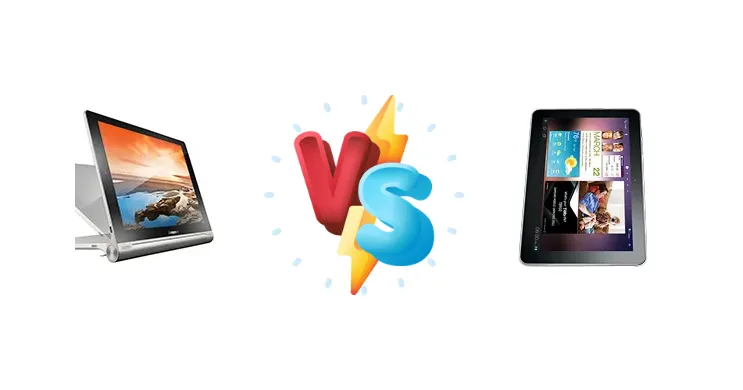
Released in different eras of tablet development, the Lenovo Yoga Tablet 10 HD+ and the Samsung Galaxy Tab 10.1 (P7510) represent distinct approaches to the 10-inch Android tablet. The Samsung, launched in 2011, relied on the then-cutting-edge Nvidia Tegra 2, while the Lenovo, arriving later, utilized the Qualcomm Snapdragon 400. This comparison dissects the architectural differences and real-world implications of these chipsets, helping you understand which tablet holds up better today.
🏆 Quick Verdict
For the average user in 2024, the Lenovo Yoga Tablet 10 HD+ is the better choice. While both tablets are aging, the Snapdragon 400’s Cortex-A7 architecture, built on a 28nm process, offers a more efficient and generally smoother experience than the older, dual-core Tegra 2, despite the lower clock speed.
| Network |
|---|
| 2G bands | GSM 900 / 1800 / 1900 | N/A |
| 3G bands | HSDPA 900 / 2100 | HSDPA 850 / 900 / 1900 / 2100 |
| EDGE | - | No |
| GPRS | - | No |
| Speed | HSPA | HSPA 21.1/5.76 Mbps |
| Technology | GSM / HSPA | No cellular connectivity |
| Launch |
|---|
| Announced | 2014, February. Released 2014, May | 2011, March. Released 2011, July |
| Status | Discontinued | Discontinued |
| Body |
|---|
| Dimensions | 261 x 180 x 8.1 mm (10.28 x 7.09 x 0.32 in) | 256.7 x 175.3 x 8.6 mm (10.11 x 6.90 x 0.34 in) |
| SIM | Micro-SIM | No |
| Weight | 615 g (1.36 lb) | 560 g (1.23 lb) |
| Display |
|---|
| Protection | - | Corning Gorilla Glass |
| Resolution | 1200 x 1920 pixels, 16:10 ratio (~224 ppi density) | 800 x 1280 pixels, 16:10 ratio (~149 ppi density) |
| Size | 10.1 inches, 295.8 cm2 (~63.0% screen-to-body ratio) | 10.1 inches, 295.8 cm2 (~65.7% screen-to-body ratio) |
| Type | IPS LCD | PLS LCD |
| Platform |
|---|
| CPU | Quad-core 1.6 GHz Cortex-A7 | Dual-core 1.0 GHz Cortex-A9 |
| Chipset | Qualcomm MSM8228 Snapdragon 400 (28 nm) (3G)/ APQ8028 (Wi-Fi only) | Nvidia Tegra 2 T20 |
| GPU | Adreno 305 | ULP GeForce |
| OS | Android 4.3 (Jelly Bean), upgradable to 4.4 (KitKat) | Android 3.0 (Honeycomb), upgradable to 4.0 (Ice Cream Sandwich), TouchWiz UX UI |
| Memory |
|---|
| Card slot | microSDXC (dedicated slot) | No |
| Internal | 16GB 2GB RAM, 32GB 2GB RAM | 16GB 1GB RAM, 32GB 1GB RAM, 64GB 1GB RAM |
| Main Camera |
|---|
| Features | - | LED flash |
| Single | 8 MP | 3.15 MP, AF |
| Video | Yes | 720p |
| Selfie camera |
|---|
| Features | - | LED flash |
| Single | 1.6 MP | 2 MP |
| Video | - | |
| Sound |
|---|
| 3.5mm jack | - | Yes |
| 35mm jack | Yes | Yes |
| Loudspeaker | Yes, with stereo speakers | Yes, with stereo speakers |
| Comms |
|---|
| Bluetooth | 4.0, A2DP | 3.0, A2DP |
| NFC | No | No |
| Positioning | GPS | GPS |
| Radio | No | No |
| USB | microUSB 2.0, OTG | 2.0 |
| WLAN | Wi-Fi 802.11 b/g/n | Wi-Fi 802.11 a/b/g/n, dual-band, Wi-Fi Direct, hotspot |
| Features |
|---|
| Browser | - | HTML, Adobe Flash |
| Sensors | Accelerometer, compass | Accelerometer, gyro, compass |
| | - | TV-out |
| Battery |
|---|
| Music play | - | Up to 72 h |
| Talk time | Up to 18 h (3G) | Up to 9 h (multimedia) |
| Type | Li-Ion 9000 mAh, non-removable | Non-removable Li-Po 7000 mAh battery |
| Misc |
|---|
| Colors | Gray | Black |
| Price | About 260 EUR | About 310 EUR |
| SAR | - | 0.97 W/kg (body) |
Lenovo Yoga Tablet 10 HD+
- More modern chipset architecture (Cortex-A7)
- Improved power efficiency due to 28nm process
- Better multi-tasking capabilities
- Potentially longer battery life
- Still a budget-oriented chipset
- Limited gaming performance
Samsung Galaxy Tab 10.1 P7510
- Nvidia Tegra 2 offered good graphics performance *at the time of release*
- Vintage appeal for collectors
- May have specific app compatibility for older Tegra-optimized software
- Outdated dual-core processor
- Less efficient Cortex-A9 architecture
- Limited multi-tasking capabilities
- Shorter battery life
- Likely slower performance with modern apps
Display Comparison
Neither device boasts a particularly advanced display by today’s standards. Specifics regarding panel type (IPS, TFT) and resolution are missing, but both are 10.1-inch tablets. The Samsung Tab 10.1’s age likely means a lower peak brightness and wider viewing angles compared to what was achievable with the Yoga Tablet. Bezels are substantial on both, typical for tablets of this generation. Color accuracy is likely to be moderate on both devices, prioritizing cost over color fidelity.
Camera Comparison
Camera performance on both tablets is likely to be underwhelming by modern standards. Details regarding sensor size and aperture are unavailable, but given the era, expect low-resolution images with limited dynamic range. The focus here isn't photography; these tablets were not designed as camera replacements. Any differences in image quality would likely be minimal and attributable to software processing rather than hardware capabilities.
Performance
The core difference lies in the chipsets. The Lenovo Yoga Tablet 10 HD+ utilizes the Qualcomm MSM8228 Snapdragon 400 (or APQ8028 for Wi-Fi only), featuring a quad-core 1.6 GHz Cortex-A7 CPU. The Samsung Galaxy Tab 10.1 P7510 is powered by the Nvidia Tegra 2 T20, a dual-core 1.0 GHz Cortex-A9 processor. While the Tegra 2 was innovative for its time with its integrated GeForce GPU, the Cortex-A7 in the Snapdragon 400 benefits from architectural improvements and a more efficient 28nm manufacturing process. This translates to better multi-tasking and sustained performance in the Lenovo, despite the lower clock speed. The Snapdragon 400’s Adreno 305 GPU also offers a more modern graphics pipeline, though neither tablet is suited for demanding 3D games.
Battery Life
Battery capacity details are missing for both devices. However, the Snapdragon 400’s improved power efficiency gives the Lenovo Yoga Tablet 10 HD+ an advantage in battery life. The 28nm process node allows for lower voltage operation, reducing power consumption during typical usage. While charging wattage is unknown for both, the Lenovo’s more efficient chipset will likely result in faster overall charge times and longer usage between charges.
Buying Guide
Buy the Lenovo Yoga Tablet 10 HD+ if you need a tablet capable of handling modern, albeit light, Android applications and streaming services with reasonable performance. Its more modern chipset provides a better foundation for compatibility and efficiency. Buy the Samsung Galaxy Tab 10.1 P7510 if you are a collector of vintage technology or specifically require compatibility with older Tegra-optimized games and applications, understanding its performance limitations.
Frequently Asked Questions
❓ Will the Samsung Galaxy Tab 10.1 P7510 struggle with modern Android apps?
Yes, the Samsung Galaxy Tab 10.1 P7510’s Nvidia Tegra 2 processor and limited RAM will likely result in significant performance issues with many modern Android applications. Apps designed for newer architectures may run slowly, crash frequently, or not run at all. The Lenovo Yoga Tablet 10 HD+ will handle them better, though still not flawlessly.
❓ Is the Nvidia Tegra 2 GPU still capable of playing any modern games?
While the Tegra 2 GPU was impressive for its time, it is now severely outdated. It may be able to run some older or less demanding 2D games, but most modern 3D games will be unplayable or experience extremely low frame rates. The Adreno 305 in the Lenovo Yoga Tablet 10 HD+ offers a slight advantage, but neither tablet is a gaming powerhouse.
❓ Does the Lenovo Yoga Tablet 10 HD+ support software updates?
Given the age of both devices, official software updates are highly unlikely. However, the Snapdragon 400 chipset may have a slightly larger community of custom ROM developers, potentially offering extended software support and newer Android versions.