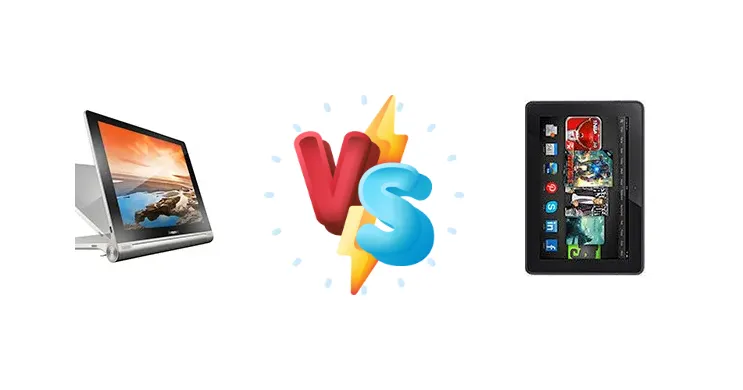
Released in different eras and targeting slightly different niches, the Lenovo Yoga Tablet 10 HD+ and the Amazon Kindle Fire HDX 8.9 represent distinct approaches to the Android tablet market. The Fire HDX 8.9, with its flagship Snapdragon 800, aimed for a premium experience, while the Yoga Tablet 10 HD+ offered a larger screen and broader functionality at a more accessible price point, powered by the Snapdragon 400. This comparison dissects the core differences to determine which tablet holds up better today.
🏆 Quick Verdict
For the average user prioritizing performance and responsiveness, the Amazon Kindle Fire HDX 8.9 is the clear winner. Its Snapdragon 800 chipset delivers significantly faster processing speeds than the Yoga Tablet 10 HD+'s Snapdragon 400, making it better suited for demanding tasks and modern applications. However, the Yoga Tablet's larger screen may appeal to those prioritizing media consumption.
| Network |
|---|
| 2G bands | GSM 900 / 1800 / 1900 | GSM 850 / 900 / 1800 / 1900 |
| 3G bands | HSDPA 900 / 2100 | HSDPA |
| 4G bands | - | LTE |
| EDGE | - | Yes |
| GPRS | - | Yes |
| Speed | HSPA | HSPA, LTE - cellular model only |
| Technology | GSM / HSPA | GSM / HSPA / EVDO / LTE |
| | - | CDMA2000 1xEV-DO |
| Launch |
|---|
| Announced | 2014, February. Released 2014, May | 2013, September. Released 2013, November |
| Status | Discontinued | Discontinued |
| Body |
|---|
| Dimensions | 261 x 180 x 8.1 mm (10.28 x 7.09 x 0.32 in) | 231 x 158 x 7.8 mm (9.09 x 6.22 x 0.31 in) |
| SIM | Micro-SIM | Nano-SIM (cellular model only) |
| Weight | 615 g (1.36 lb) | 374 g (Wi-Fi)/ 384 g (4G) (13.19 oz) |
| Display |
|---|
| Resolution | 1200 x 1920 pixels, 16:10 ratio (~224 ppi density) | 2560 x 1600 pixels, 16:10 ratio (~339 ppi density) |
| Size | 10.1 inches, 295.8 cm2 (~63.0% screen-to-body ratio) | 8.9 inches, 229.7 cm2 (~62.9% screen-to-body ratio) |
| Type | IPS LCD | IPS LCD |
| Platform |
|---|
| CPU | Quad-core 1.6 GHz Cortex-A7 | Quad-core 2.2 GHz Krait 400 |
| Chipset | Qualcomm MSM8228 Snapdragon 400 (28 nm) (3G)/ APQ8028 (Wi-Fi only) | Qualcomm Snapdragon 800 (28 nm) |
| GPU | Adreno 305 | Adreno 330 |
| OS | Android 4.3 (Jelly Bean), upgradable to 4.4 (KitKat) | Android OS (Jelly Bean - customized), Fire 3 |
| Memory |
|---|
| Card slot | microSDXC (dedicated slot) | No |
| Internal | 16GB 2GB RAM, 32GB 2GB RAM | 16GB 2GB RAM, 32GB 2GB RAM, 64GB 2GB RAM |
| | - | eMMC 4.5 |
| Main Camera |
|---|
| Features | - | LED flash |
| Single | 8 MP | 8 MP, AF |
| Video | Yes | Yes |
| Selfie camera |
|---|
| Single | 1.6 MP | - |
| Sound |
|---|
| 3.5mm jack | - | Yes |
| 35mm jack | Yes | Yes |
| Loudspeaker | Yes, with stereo speakers | Yes, with stereo speakers |
| Comms |
|---|
| Bluetooth | 4.0, A2DP | Yes |
| NFC | No | No |
| Positioning | GPS | GPS - cellular model only |
| Radio | No | No |
| USB | microUSB 2.0, OTG | microUSB 2.0 |
| WLAN | Wi-Fi 802.11 b/g/n | Wi-Fi 802.11 a/b/g/n, dual-band |
| Features |
|---|
| Sensors | Accelerometer, compass | Accelerometer, gyro |
| | - | Text-to-Speech English-language content reader |
| Battery |
|---|
| Talk time | Up to 18 h (3G) | Up to 12 h |
| Type | Li-Ion 9000 mAh, non-removable | Li-Ion, non-removable |
| Misc |
|---|
| Colors | Gray | Black |
| Price | About 260 EUR | About 280 EUR |
Lenovo Yoga Tablet 10 HD+
- Larger 10.1-inch display for immersive viewing.
- Potentially lower price point (depending on current market availability).
- More versatile for basic productivity tasks.
- Significantly slower performance due to Snapdragon 400.
- Struggles with demanding applications and modern games.
- Likely outdated software support.
Amazon Kindle Fire HDX 8.9
- Much faster performance thanks to the Snapdragon 800.
- Smoother user experience and faster app loading times.
- Superior gaming capabilities.
- Smaller 8.9-inch display.
- Amazon's Fire OS may not appeal to all users.
- Potentially higher price (depending on current market availability).
Display Comparison
While both tablets utilize 28nm chipsets, the display experience differs. The Yoga Tablet 10 HD+ boasts a larger 10.1-inch screen, potentially offering a more immersive viewing experience. However, the Fire HDX 8.9’s 8.9-inch display, while smaller, likely benefits from the higher processing power to deliver smoother animations and potentially better color accuracy. Specifics like panel type (IPS vs TFT) and resolution are missing, but the Fire HDX 8.9’s overall system performance suggests a more refined visual experience. Bezels are likely comparable given the era of both devices.
Camera Comparison
Given the age and market positioning of these tablets, camera quality isn't a primary focus. Details on camera sensors are scarce, but it's safe to assume both feature modest camera setups. The Fire HDX 8.9 likely benefits from the more powerful ISP (Image Signal Processor) within the Snapdragon 800, potentially resulting in slightly better image processing and low-light performance. However, neither tablet is likely to compete with modern smartphone cameras.
Performance
The core difference lies in the chipsets. The Amazon Kindle Fire HDX 8.9’s Snapdragon 800, with its quad-core 2.2 GHz Krait 400 CPU, represents a significant leap in performance over the Lenovo Yoga Tablet 10 HD+'s Snapdragon 400 (1.6 GHz Cortex-A7). The Krait 400 architecture is substantially more efficient and powerful than the Cortex-A7. This translates to faster app launches, smoother multitasking, and a more responsive user interface on the Fire HDX 8.9. The Snapdragon 800 also features a more capable Adreno 330 GPU, providing a superior gaming experience. The Yoga Tablet 10 HD+ will struggle with graphically intensive games and modern applications.
Battery Life
Battery capacity details are missing for both devices. However, the Snapdragon 800 in the Fire HDX 8.9, despite its higher performance, is fabricated on the same 28nm process as the Snapdragon 400. While it consumes more power under load, its efficiency gains could offset some of the difference during lighter use. Charging wattage is also unknown, making a direct comparison difficult. The Fire HDX 8.9’s superior processing power may allow for faster encoding/decoding of video, potentially impacting battery life during media playback.
Buying Guide
Buy the Lenovo Yoga Tablet 10 HD+ if you need a larger 10-inch display for comfortable media viewing and casual multitasking, and are willing to accept slower performance. Buy the Amazon Kindle Fire HDX 8.9 if you prioritize a smoother, more responsive user experience, faster app loading times, and better overall performance for gaming and demanding applications, even with a slightly smaller 8.9-inch screen.
Frequently Asked Questions
❓ Will the Lenovo Yoga Tablet 10 HD+ be able to run modern Android games like Genshin Impact?
Unfortunately, the Snapdragon 400 processor in the Yoga Tablet 10 HD+ is unlikely to provide a playable experience with demanding games like Genshin Impact. The game's requirements significantly exceed the capabilities of the Adreno 305 GPU and the Cortex-A7 CPU, resulting in low frame rates and frequent stuttering.
❓ Does the Amazon Kindle Fire HDX 8.9 have access to the full Google Play Store?
No, the Kindle Fire HDX 8.9 runs Amazon's Fire OS, which is based on Android but does not include the Google Play Store. Instead, it utilizes the Amazon Appstore. While many popular apps are available, some may be missing or require sideloading.
❓ Is the performance difference between the Snapdragon 800 and 400 noticeable in everyday tasks like browsing and email?
Yes, the difference is quite noticeable. The Snapdragon 800's faster CPU and GPU result in snappier app launches, smoother scrolling, and a more responsive overall experience, even in basic tasks. The Yoga Tablet 10 HD+ may exhibit noticeable lag or slowdowns during multitasking.
❓ What is the likely software support situation for both tablets in 2024?
Software support for both tablets is likely limited. The Lenovo Yoga Tablet 10 HD+ may have received its last major Android update several years ago. The Kindle Fire HDX 8.9, while receiving updates through Amazon, is also likely running an older version of Fire OS based on an older Android version. Expect limited security patches and compatibility issues with newer apps.