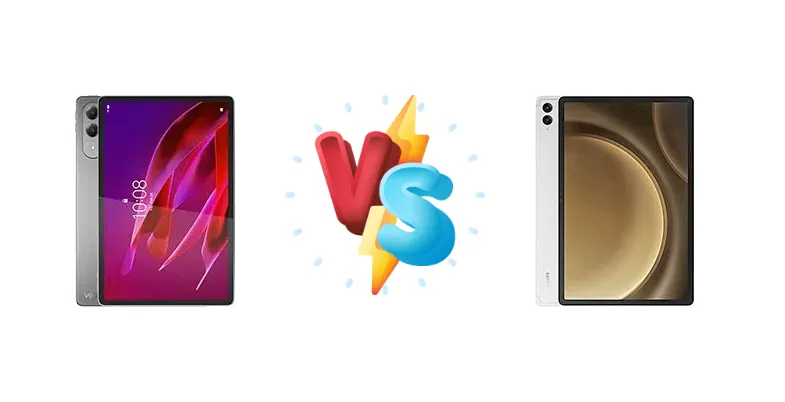
The Android tablet market is heating up, with Lenovo and Samsung offering compelling options at different price points and with distinct philosophies. The Lenovo Yoga Tab aims for flagship-level performance with the latest Snapdragon silicon, while the Samsung Galaxy Tab S9 FE+ prioritizes a balance of features and affordability. This comparison dissects their core components to determine which tablet best suits your needs.
🏆 Quick Verdict
For users prioritizing raw performance and sustained gaming, the Lenovo Yoga Tab is the clear winner thanks to its Snapdragon 8 Gen 3 chipset. However, the Samsung Galaxy Tab S9 FE+ offers a more balanced experience with respectable performance and potentially better efficiency for everyday tasks, making it ideal for casual users.
| Network |
|---|
| 2G bands | N/A | GSM 850 / 900 / 1800 / 1900 |
| 3G bands | N/A | HSDPA 850 / 900 / 1700(AWS) / 1900 / 2100 |
| 4G bands | N/A | 1, 2, 3, 4, 5, 7, 8, 12, 13, 17, 20, 26, 28, 32, 38, 40, 41, 66 |
| 5G bands | - | 1, 3, 5, 7, 8, 20, 28, 38, 40, 41, 66, 77, 78 SA/NSA/Sub6 |
| EDGE | No | - |
| GPRS | No | - |
| Speed | - | HSPA, LTE, 5G - cellular model only |
| Technology | No cellular connectivity | GSM / HSPA / LTE / 5G |
| Launch |
|---|
| Announced | 2025, September 05 | 2023, October 04 |
| Status | Available. Released 2025, September | Available. Released 2023, October 16 |
| Body |
|---|
| Build | Glass front (Gorilla Glass 7i), aluminum frame, aluminum back | Glass front, aluminum back, aluminum frame |
| Dimensions | 255.5 x 165.8 x 8.3 mm (10.06 x 6.53 x 0.33 in) | 285.4 x 185.4 x 6.5 mm (11.24 x 7.30 x 0.26 in) |
| SIM | No | Nano-SIM + eSIM (cellular model only) |
| Weight | 458 g (1.01 lb) | 627 g or 628 g (1.38 lb) |
| Display |
|---|
| Protection | Corning Gorilla Glass 7i, Mohs level 5 | - |
| Resolution | 3200 x 2000 pixels, 16:10 ratio (~340 ppi density) | 1600 x 2560 pixels, 16:10 ratio (~243 ppi density) |
| Size | 11.1 inches, 357.3 cm2 (~84.3% screen-to-body ratio) | 12.4 inches, 445.8 cm2 (~84.3% screen-to-body ratio) |
| Type | IPS LCD, 144Hz, Dolby Vision, 650 nits (typ), 800 nits (peak) | IPS LCD, 90Hz |
| Platform |
|---|
| CPU | Octa-core (1x3.3 GHz Cortex-X4 & 3x3.2 GHz Cortex-A720 & 2x3.0 GHz Cortex-A720 & 2x2.3 GHz Cortex-A520) | Octa-core (4x2.4 GHz Cortex-A78 & 4x2.0 GHz Cortex-A55) |
| Chipset | Qualcomm SM8650-AB Snapdragon 8 Gen 3 (4 nm) | Exynos 1380 (5 nm) |
| GPU | Adreno 750 | Mali-G68 MP5 |
| OS | Android 15, up to 3 major Android upgrades | Android 13, up to 4 major Android upgrades, One UI 6 |
| Memory |
|---|
| Card slot | No | microSDXC (dedicated slot) |
| Internal | 256GB 8GB RAM, 256GB 12GB RAM | 128GB 6GB RAM, 128GB 8GB RAM, 256GB 8GB RAM, 256GB 12GB RAM |
| Main Camera |
|---|
| Dual | 13 MP, f/2.2, (wide), AF
2 MP (macro) | 8 MP, (wide)
8 MP, (ultrawide) |
| Features | LED flash | - |
| Video | Yes | 4K@30fps, 1080p@30fps |
| Selfie camera |
|---|
| Single | 13 MP, f/2.2, 101˚ (ultrawide) | 12 MP, (ultrawide) |
| Video | 1080p@30fps | Yes |
| Sound |
|---|
| 35mm jack | No | No |
| Loudspeaker | Yes, with stereo speakers, Dolby Atmos (4 speakers) | Yes, with stereo speakers |
| Comms |
|---|
| Bluetooth | 5.4, A2DP, LE | 5.3, A2DP, LE |
| NFC | No | No |
| Positioning | No | GPS, GALILEO, GLONASS, BDS, QZSS - cellular model only |
| Radio | No | No |
| USB | USB Type-C 3.1, DisplayPort, magnetic accessory connector | USB Type-C 2.0, magnetic connector |
| WLAN | Wi-Fi 802.11 a/b/g/n/ac/6/7, dual-band, Wi-Fi Direct | Wi-Fi 802.11 a/b/g/n/ac/6, dual-band, Wi-Fi Direct |
| Features |
|---|
| Sensors | Fingerprint (side-mounted), accelerometer, gyro, proximity (accessories only) | Fingerprint (side-mounted), accelerometer, gyro, compass, proximity (accessories only) |
| Battery |
|---|
| Charging | 45W wired | 45W wired, QC2.0 |
| Type | Si/C Li-Ion 8860 mAh | Li-Po 10090 mAh |
| Misc |
|---|
| Colors | Luna Grey, Seashell | Mint, Silver, Gray, Lavender |
| Models | ZAG60266US, TB710FU | SM-X610, SM-X616B |
| Price | $ 449.99 | About 770 EUR |
| SAR | - | 0.77 W/kg (body) |
| SAR EU | - | 0.50 W/kg (body) |
| EU LABEL |
|---|
| Battery | 101:55h endurance, 1000 cycles | - |
| Energy | Class F | - |
| Free fall | Class E (7 falls) | - |
| Repairability | Class A | - |
Lenovo Yoga Tab
- Significantly more powerful Snapdragon 8 Gen 3 processor
- Potentially better thermal management due to 4nm process
- Exceptional battery lifespan with 1000 charge cycles
- Potentially shorter battery life during heavy use due to power-hungry processor
- Display specifications are currently unknown
Samsung Galaxy Tab S9 FE+
- More efficient Exynos 1380 processor for everyday tasks
- QC2.0 support for potentially faster charging
- Samsung ecosystem integration
- Less powerful processor compared to the Snapdragon 8 Gen 3
- May experience throttling during prolonged demanding tasks
Display Comparison
While display specifications are missing for the Lenovo Yoga Tab, the Samsung Galaxy Tab S9 FE+ is expected to feature an LCD panel. The Lenovo's use of a potentially higher-end panel (OLED or high-refresh-rate LCD) would be a significant advantage. The Exynos 1380 in the S9 FE+ is capable of driving high-resolution displays, but the Lenovo's Snapdragon 8 Gen 3 has a more powerful GPU, potentially enabling smoother visuals in graphically intensive applications. Bezels and color accuracy are unknown for the Lenovo, but the S9 FE+ is known for its relatively thin bezels and accurate color reproduction.
Camera Comparison
Camera details are sparse for both devices. However, given the market segment, neither tablet is likely to excel in photography. The absence of detailed camera specs suggests both are geared towards video conferencing and casual snapshots rather than serious photography. The S9 FE+ may benefit from Samsung’s image processing algorithms, but without knowing the sensor sizes or lens apertures, it’s difficult to assess the actual image quality difference. We can assume both will have adequate cameras for video calls.
Performance
The Lenovo Yoga Tab’s Qualcomm Snapdragon 8 Gen 3 (4nm) chipset represents a substantial leap in performance over the Samsung Galaxy Tab S9 FE+'s Exynos 1380 (5nm). The Snapdragon 8 Gen 3’s octa-core configuration, featuring a Cortex-X4 prime core clocked at 3.3 GHz, is designed for peak performance, while the Exynos 1380 relies on Cortex-A78 cores at 2.4 GHz. The 4nm process node of the Snapdragon 8 Gen 3 offers superior thermal efficiency compared to the 5nm Exynos, suggesting less throttling during prolonged, demanding tasks. This translates to a smoother experience for gamers and power users. The Yoga Tab’s architecture is geared towards sustained performance, while the S9 FE+ prioritizes efficiency.
Battery Life
The Lenovo Yoga Tab boasts an impressive 101:55h endurance rating and a 1000-cycle battery lifespan, suggesting a focus on longevity. While the Samsung Galaxy Tab S9 FE+’s battery capacity is unknown, both tablets support 45W wired charging. The S9 FE+ also supports QC2.0, potentially allowing for faster charging with compatible chargers. However, the Snapdragon 8 Gen 3 in the Yoga Tab is more power-hungry, meaning it may drain the battery faster during intensive use, despite the larger endurance rating. The 1000 cycle lifespan of the Yoga Tab is a significant advantage, promising years of reliable use.
Buying Guide
Buy the Lenovo Yoga Tab if you need uncompromising processing power for demanding applications, gaming, or content creation, and are willing to trade some potential battery life for that performance. Buy the Samsung Galaxy Tab S9 FE+ if you prefer a more efficient tablet for everyday tasks like browsing, streaming, and light productivity, and value a potentially longer-lasting battery and broader ecosystem integration.
Frequently Asked Questions
❓ Will the Exynos 1380 in the Galaxy Tab S9 FE+ overheat during extended gaming sessions?
The Exynos 1380 is a capable chip, but it's likely to throttle under sustained heavy load, such as prolonged gaming. While it won't necessarily overheat to the point of being unusable, you may experience frame rate drops and reduced performance over time. The Lenovo Yoga Tab's Snapdragon 8 Gen 3, with its more efficient 4nm process, is better equipped to handle sustained workloads.
❓ How does the Snapdragon 8 Gen 3's power consumption impact the Lenovo Yoga Tab's real-world battery life?
Despite the Lenovo Yoga Tab's impressive 101:55h endurance rating, the Snapdragon 8 Gen 3 is a power-hungry processor. While the battery is likely to last a full day with moderate use, demanding tasks like gaming or video editing will significantly reduce battery life. The Samsung Galaxy Tab S9 FE+'s Exynos 1380 will likely offer longer battery life during similar usage scenarios.
❓ Is the 45W charging on both tablets equally fast in practice?
While both support 45W charging, the Samsung Galaxy Tab S9 FE+ also supports Quick Charge 2.0 (QC2.0). This means that with a compatible QC2.0 charger, it *may* charge slightly faster than the Lenovo Yoga Tab, even though both are rated for 45W. However, the difference is likely to be marginal.