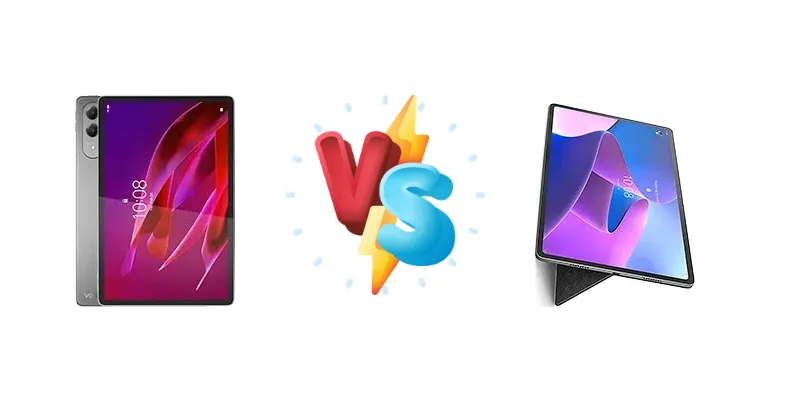
Lenovo's tablet lineup offers compelling options across price points. The Yoga Tab, powered by the latest Snapdragon 8 Gen 3, represents a leap in processing power. However, the Tab P12 Pro, with its Snapdragon 870, remains a strong contender, particularly for users prioritizing efficiency and a proven track record. This comparison dissects the key differences to help you choose the right tablet for your needs.
🏆 Quick Verdict
For users demanding the absolute best performance and future-proofing, the Lenovo Yoga Tab is the clear winner thanks to its Snapdragon 8 Gen 3. However, the Tab P12 Pro offers a compelling balance of performance and efficiency, making it a better choice for everyday tasks and extended battery life.
| Network |
|---|
| 2G bands | N/A | GSM 850 / 900 / 1800 / 1900 |
| 3G bands | N/A | HSDPA 850 / 900 / 1900 / 2100 |
| 4G bands | N/A | 1, 2, 3, 4, 5, 7, 8, 19, 20, 26, 28, 34, 38, 39, 40, 41 |
| 5G bands | - | 1, 3, 7, 8, 20, 28, 38, 41, 77, 78 SA/NSA/Sub6 |
| EDGE | No | - |
| GPRS | No | - |
| Speed | - | HSPA, LTE, 5G - cellular model only |
| Technology | No cellular connectivity | GSM / HSPA / LTE / 5G |
| Launch |
|---|
| Announced | 2025, September 05 | 2021, September 08 |
| Status | Available. Released 2025, September | Available. Released 2021, November 19 |
| Body |
|---|
| Build | Glass front (Gorilla Glass 7i), aluminum frame, aluminum back | - |
| Dimensions | 255.5 x 165.8 x 8.3 mm (10.06 x 6.53 x 0.33 in) | 285.6 x 184.5 x 5.6 mm (11.24 x 7.26 x 0.22 in) |
| SIM | No | Nano-SIM (cellular model only) |
| Weight | 458 g (1.01 lb) | 565 g (1.25 lb) |
| | - | Stylus support |
| Display |
|---|
| Protection | Corning Gorilla Glass 7i, Mohs level 5 | - |
| Resolution | 3200 x 2000 pixels, 16:10 ratio (~340 ppi density) | 1600 x 2560 pixels, 16:10 ratio (~240 ppi density) |
| Size | 11.1 inches, 357.3 cm2 (~84.3% screen-to-body ratio) | 12.6 inches, 460.3 cm2 (~87.4% screen-to-body ratio) |
| Type | IPS LCD, 144Hz, Dolby Vision, 650 nits (typ), 800 nits (peak) | AMOLED, 120Hz, HDR10+, Dolby Vision, 600 nits (HBM) |
| Platform |
|---|
| CPU | Octa-core (1x3.3 GHz Cortex-X4 & 3x3.2 GHz Cortex-A720 & 2x3.0 GHz Cortex-A720 & 2x2.3 GHz Cortex-A520) | Octa-core (1x3.2 GHz Kryo 585 & 3x2.42 GHz Kryo 585 & 4x1.80 GHz Kryo 585) |
| Chipset | Qualcomm SM8650-AB Snapdragon 8 Gen 3 (4 nm) | Qualcomm SM8250-AC Snapdragon 870 5G (7 nm) |
| GPU | Adreno 750 | Adreno 650 |
| OS | Android 15, up to 3 major Android upgrades | Android 11 |
| Memory |
|---|
| Card slot | No | microSDXC (dedicated slot) |
| Internal | 256GB 8GB RAM, 256GB 12GB RAM | 128GB 6GB RAM, 256GB 8GB RAM |
| Main Camera |
|---|
| Dual | 13 MP, f/2.2, (wide), AF
2 MP (macro) | 13 MP, (wide), AF
5 MP, (ultrawide) |
| Features | LED flash | - |
| Video | Yes | 4K@30fps, 1080p@30fps |
| Selfie camera |
|---|
| Single | 13 MP, f/2.2, 101˚ (ultrawide) | 8 MP, (wide)
8 MP, IR TOF 3D, (biometrics sensor only) |
| Video | 1080p@30fps | 1080p@30fps |
| Sound |
|---|
| 3.5mm jack | - | No |
| 35mm jack | No | No |
| Loudspeaker | Yes, with stereo speakers, Dolby Atmos (4 speakers) | Yes, with stereo speakers (4 speakers) |
| | - | JBL speakers |
| Comms |
|---|
| Bluetooth | 5.4, A2DP, LE | 5.2, A2DP, LE |
| NFC | No | Yes (wireless charging and data transfer only) |
| Positioning | No | GPS, GLONASS, BDS - cellular model only |
| Radio | No | Unspecified |
| USB | USB Type-C 3.1, DisplayPort, magnetic accessory connector | USB Type-C 3.1 |
| WLAN | Wi-Fi 802.11 a/b/g/n/ac/6/7, dual-band, Wi-Fi Direct | Wi-Fi 802.11 a/b/g/n/ac/6, dual-band, Wi-Fi Direct |
| Features |
|---|
| Sensors | Fingerprint (side-mounted), accelerometer, gyro, proximity (accessories only) | Fingerprint (side-mounted), accelerometer, gyro, proximity |
| Battery |
|---|
| Charging | 45W wired | 45W wired, QC4 |
| Type | Si/C Li-Ion 8860 mAh | Li-Po 10200 mAh |
| Misc |
|---|
| Colors | Luna Grey, Seashell | Storm Grey |
| Models | ZAG60266US, TB710FU | TB-Q706Z, TB-Q706F |
| Price | $ 449.99 | About 520 EUR |
| EU LABEL |
|---|
| Battery | 101:55h endurance, 1000 cycles | - |
| Energy | Class F | - |
| Free fall | Class E (7 falls) | - |
| Repairability | Class A | - |
Lenovo Yoga Tab
- Significantly faster processor with Snapdragon 8 Gen 3
- Improved power efficiency with 4nm process
- Longer battery lifespan with 1000 charge cycles
- Potentially higher price point
- May run hotter under sustained load
Lenovo Tab P12 Pro
- Proven Snapdragon 870 performance
- QC4 support for potentially faster charging
- Likely more refined software experience
- Older chipset architecture
- Less future-proof compared to the 8 Gen 3
Display Comparison
While display specifications are missing, the Yoga Tab's target market suggests a focus on performance over display extravagance. The Tab P12 Pro, positioned as a premium device, likely features a higher-resolution panel with potentially LTPO technology for adaptive refresh rates. The Snapdragon 8 Gen 3's increased processing power will be better utilized by a higher-resolution display, but the P12 Pro's panel is likely more color accurate and power efficient.
Camera Comparison
Camera details are absent, but given the focus of these tablets, we can assume the differences are moderate. The Yoga Tab, being the newer model, likely benefits from improved image signal processing (ISP) capabilities within the Snapdragon 8 Gen 3, potentially leading to better dynamic range and low-light performance. However, without sensor size or aperture information, a definitive judgment is impossible. The P12 Pro likely prioritizes a balanced camera experience for video calls and casual photography.
Performance
The core difference lies in the chipsets. The Yoga Tab's Snapdragon 8 Gen 3 (4nm) boasts a significantly more modern architecture than the Tab P12 Pro's Snapdragon 870 (7nm). The 8 Gen 3's Cortex-X4 prime core clocked at 3.3 GHz provides a substantial performance uplift over the Kryo 585 in the 870. The 8 Gen 3's newer Cortex-A720 cores also offer improved efficiency and performance. This translates to faster app loading, smoother multitasking, and superior gaming performance for the Yoga Tab. However, the 870 remains a capable performer, and its 7nm process offers good thermal efficiency.
Battery Life
The Yoga Tab boasts 101:55h endurance and 1000 charge cycles, indicating a focus on longevity. Both tablets support 45W wired charging. While the Tab P12 Pro includes Quick Charge 4 (QC4), the Yoga Tab's endurance suggests optimized power management despite the more powerful processor. The Snapdragon 8 Gen 3's 4nm process contributes to better thermal efficiency, potentially mitigating battery drain during intensive tasks. The 1000 charge cycle claim for the Yoga Tab is a significant advantage, promising a longer lifespan.
Buying Guide
Buy the Lenovo Yoga Tab if you need uncompromising performance for demanding tasks like video editing, high-end gaming, or running multiple applications simultaneously. Buy the Lenovo Tab P12 Pro if you prioritize a smooth, efficient experience for everyday use, long battery life, and a more established platform with proven stability.
Frequently Asked Questions
❓ Will the Snapdragon 8 Gen 3 in the Yoga Tab experience thermal throttling during extended gaming sessions?
While the Snapdragon 8 Gen 3 is powerful, its thermal performance will depend on Lenovo's cooling solution. The 4nm process helps mitigate heat, but sustained high loads could still lead to some throttling. However, the Yoga Tab is likely to maintain higher sustained performance than the Tab P12 Pro.
❓ Does the Tab P12 Pro's Quick Charge 4 support offer a noticeable charging speed advantage over the Yoga Tab's 45W charging?
The difference in charging speed is likely to be minimal. While QC4 is a fast charging standard, the Yoga Tab's 45W charging is also substantial. The Tab P12 Pro might gain a few minutes, but the Yoga Tab's superior battery endurance is a more significant advantage.
❓ Is the Snapdragon 870 in the Tab P12 Pro still capable of handling demanding applications like video editing?
Yes, the Snapdragon 870 is a very capable chip and can handle video editing and other demanding tasks. However, it will be slower than the Yoga Tab's Snapdragon 8 Gen 3, especially with larger projects or more complex edits. Expect longer rendering times.