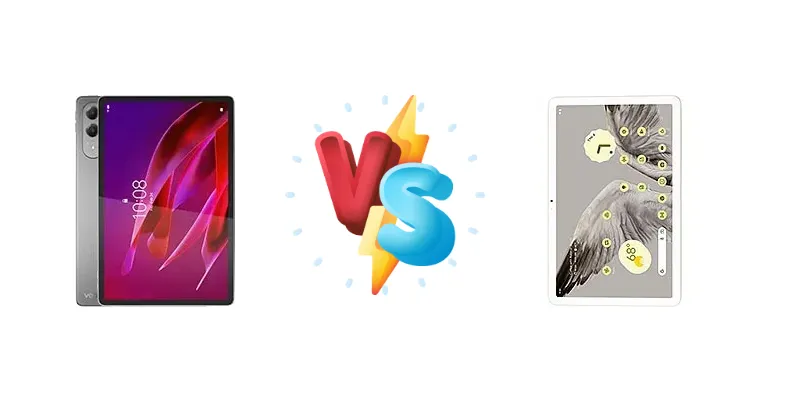
The tablet market is heating up, with the Lenovo Yoga Tab and Google Pixel Tablet representing distinct approaches. The Yoga Tab leverages Qualcomm's flagship Snapdragon 8 Gen 3, promising raw power, while the Pixel Tablet relies on Google's Tensor G2, optimized for AI and integration with the Google ecosystem. This comparison dives deep into the architectural differences and real-world implications of these choices.
🏆 Quick Verdict
For users prioritizing peak performance and extended battery life, the Lenovo Yoga Tab emerges as the winner. Its Snapdragon 8 Gen 3 chipset and 45W charging significantly outperform the Pixel Tablet's Tensor G2, making it ideal for demanding tasks and gaming. However, the Pixel Tablet's software integration and smart home features are compelling for Google ecosystem users.
| Network |
|---|
| 2G bands | N/A | N/A |
| 3G bands | N/A | N/A |
| 4G bands | N/A | N/A |
| EDGE | No | No |
| GPRS | No | No |
| Technology | No cellular connectivity | No cellular connectivity |
| Launch |
|---|
| Announced | 2025, September 05 | 2023, May 10 |
| Status | Available. Released 2025, September | Available. Released 2023, June 20 |
| Body |
|---|
| Build | Glass front (Gorilla Glass 7i), aluminum frame, aluminum back | Glass front, aluminum frame, aluminum back |
| Dimensions | 255.5 x 165.8 x 8.3 mm (10.06 x 6.53 x 0.33 in) | 258 x 169 x 8.1 mm (10.16 x 6.65 x 0.32 in) |
| SIM | No | No |
| Weight | 458 g (1.01 lb) | 493 g (1.09 lb) |
| | - | Stylus support |
| Display |
|---|
| Protection | Corning Gorilla Glass 7i, Mohs level 5 | - |
| Resolution | 3200 x 2000 pixels, 16:10 ratio (~340 ppi density) | 1600 x 2560 pixels, 16:10 ratio (~276 ppi density) |
| Size | 11.1 inches, 357.3 cm2 (~84.3% screen-to-body ratio) | 10.95 inches, 347.7 cm2 (~79.7% screen-to-body ratio) |
| Type | IPS LCD, 144Hz, Dolby Vision, 650 nits (typ), 800 nits (peak) | IPS LCD |
| Platform |
|---|
| CPU | Octa-core (1x3.3 GHz Cortex-X4 & 3x3.2 GHz Cortex-A720 & 2x3.0 GHz Cortex-A720 & 2x2.3 GHz Cortex-A520) | Octa-core (2x2.85 GHz Cortex-X1 & 2x2.35 GHz Cortex-A78 & 4x1.80 GHz Cortex-A55) |
| Chipset | Qualcomm SM8650-AB Snapdragon 8 Gen 3 (4 nm) | Google Tensor G2 (5 nm) |
| GPU | Adreno 750 | Mali-G710 MP7 |
| OS | Android 15, up to 3 major Android upgrades | Android 13, upgradable to Android 15 |
| Memory |
|---|
| Card slot | No | No |
| Internal | 256GB 8GB RAM, 256GB 12GB RAM | 128GB 8GB RAM, 256GB 8GB RAM |
| | - | UFS 3.1 |
| Main Camera |
|---|
| Dual | 13 MP, f/2.2, (wide), AF
2 MP (macro) | - |
| Features | LED flash | HDR, panorama |
| Single | - | 8 MP, f/2.0, 24mm (wide), 1/4.0", 1.12µm |
| Video | Yes | 1080p@30fps |
| Selfie camera |
|---|
| Features | - | HDR, panorama |
| Single | 13 MP, f/2.2, 101˚ (ultrawide) | 8 MP, f/2.0, 24mm (wide), 1/4.0", 1.12µm |
| Video | 1080p@30fps | 1080p@30fps |
| Sound |
|---|
| 3.5mm jack | - | No |
| 35mm jack | No | No |
| Loudspeaker | Yes, with stereo speakers, Dolby Atmos (4 speakers) | Yes, with stereo speakers (4 speakers) |
| Comms |
|---|
| Bluetooth | 5.4, A2DP, LE | 5.2, A2DP, LE |
| NFC | No | No |
| Positioning | No | No |
| Radio | No | No |
| USB | USB Type-C 3.1, DisplayPort, magnetic accessory connector | USB Type-C 3.2 (Gen 1), magnetic connector |
| WLAN | Wi-Fi 802.11 a/b/g/n/ac/6/7, dual-band, Wi-Fi Direct | Wi-Fi 802.11 a/b/g/n/ac/6, dual-band |
| Features |
|---|
| Sensors | Fingerprint (side-mounted), accelerometer, gyro, proximity (accessories only) | Accelerometer, gyro, compass, proximity (accessories only) |
| | - | Ultra Wideband (UWB) support |
| Battery |
|---|
| Charging | 45W wired | 15W wired |
| Type | Si/C Li-Ion 8860 mAh | Li-Po 7020 mAh (27 Wh) |
| Misc |
|---|
| Colors | Luna Grey, Seashell | Porcelain, Hazel, Rose |
| Models | ZAG60266US, TB710FU | GA06156-EU, GA06157-EU, GA06158-EU |
| Price | $ 449.99 | About 670 EUR |
| EU LABEL |
|---|
| Battery | 101:55h endurance, 1000 cycles | - |
| Energy | Class F | - |
| Free fall | Class E (7 falls) | - |
| Repairability | Class A | - |
Lenovo Yoga Tab
- Superior processing power with Snapdragon 8 Gen 3
- Exceptional battery life (101:55h endurance)
- Fast 45W wired charging
- Potential for higher price point
- Software experience may not be as tightly integrated as Pixel Tablet
Google Pixel Tablet
- Seamless Google ecosystem integration
- Optimized for AI and smart home control
- Potentially superior camera software processing
- Slower Tensor G2 chipset
- Slow 15W wired charging
- Likely shorter battery life
Display Comparison
While display specs are missing, the Yoga Tab's target market suggests a focus on performance over display fidelity. The Pixel Tablet, given Google's history, likely prioritizes color accuracy and viewing angles. However, without specific data on panel type (OLED vs LCD), resolution, and refresh rate, a definitive comparison is impossible. The Yoga Tab's higher processing power could potentially drive higher-resolution content more smoothly if both devices share a similar panel.
Camera Comparison
Camera specifications are absent for both devices. However, given the Pixel Tablet's branding, it's reasonable to expect Google's renowned computational photography prowess. The Yoga Tab, positioned as a performance-focused device, may prioritize camera functionality less, potentially resulting in a more standard camera experience. Without sensor details, it's difficult to assess image quality, but Google's software algorithms often compensate for hardware limitations.
Performance
The Lenovo Yoga Tab's Qualcomm Snapdragon 8 Gen 3 (4nm) is a clear architectural advantage over the Google Pixel Tablet's Tensor G2 (5nm). The Snapdragon 8 Gen 3 utilizes a more advanced CPU core configuration – a 1x3.3 GHz Cortex-X4, 3x3.2 GHz Cortex-A720, 2x3.0 GHz Cortex-A720, and 2x2.3 GHz Cortex-A520 – compared to the Pixel Tablet’s 2x2.85 GHz Cortex-X1, 2x2.35 GHz Cortex-A78, and 4x1.80 GHz Cortex-A55. The newer Cortex-X4 core in the Snapdragon offers significant performance gains. The 4nm process node further enhances efficiency, reducing heat and improving sustained performance. This translates to faster app loading, smoother multitasking, and superior gaming performance for the Yoga Tab.
Battery Life
The Lenovo Yoga Tab boasts a remarkable 101:55h endurance rating, suggesting exceptional battery life. Coupled with 45W wired charging, it offers a rapid recharge time. In contrast, the Google Pixel Tablet's 15W charging is significantly slower. While battery capacity isn't specified, the Snapdragon 8 Gen 3's 4nm efficiency likely contributes to the Yoga Tab's extended runtime. The 1000 charge cycle rating on the Yoga Tab also indicates a longer lifespan for the battery itself.
Buying Guide
Buy the Lenovo Yoga Tab if you need a tablet capable of handling intensive tasks like video editing, demanding games, or running multiple applications simultaneously, and value long battery endurance. Buy the Google Pixel Tablet if you prioritize seamless integration with Google Assistant, smart home control, and a streamlined software experience, even if it means sacrificing some raw processing power.
Frequently Asked Questions
❓ Will the Snapdragon 8 Gen 3 in the Lenovo Yoga Tab handle demanding games like Genshin Impact at max settings?
Yes, the Snapdragon 8 Gen 3 is a flagship-level chipset designed to handle the most demanding mobile games. Its advanced CPU and GPU architecture, combined with the 4nm process, will provide a smooth and consistent gaming experience even at maximum settings. The Yoga Tab's thermal management will be crucial, but the chipset itself is more than capable.
❓ How does the Tensor G2's AI capabilities benefit everyday use on the Google Pixel Tablet?
The Tensor G2 excels in AI-powered features like voice recognition with Google Assistant, real-time translation, and enhanced image processing. This translates to faster and more accurate voice commands, improved camera performance, and features like Magic Eraser in Google Photos. It also enhances the tablet's integration with smart home devices.
❓ Is the 15W charging on the Pixel Tablet noticeably slow compared to the Yoga Tab's 45W charging?
Yes, the difference is substantial. 15W charging will take significantly longer to fully charge the Pixel Tablet compared to the Yoga Tab's 45W charging. Expect a much slower 0-100% charge time on the Pixel Tablet, potentially taking over 3 hours, while the Yoga Tab could achieve a full charge in under 90 minutes.