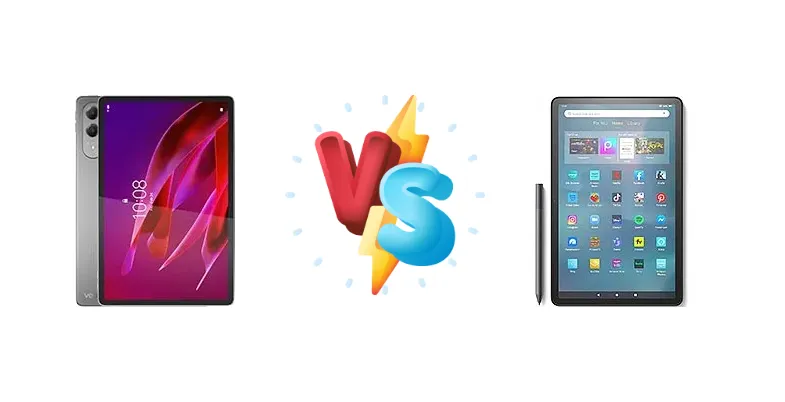
The tablet market offers a spectrum of choices, from budget-friendly media consumption devices to powerful productivity tools. The Lenovo Yoga Tab, equipped with the flagship Qualcomm Snapdragon 8 Gen 3, aims for the latter, while the Amazon Fire Max 11, powered by the MediaTek MT8188J, targets a more accessible price point. This comparison dissects the core differences to help you determine which tablet best suits your needs.
🏆 Quick Verdict
For users prioritizing performance and longevity, the Lenovo Yoga Tab is the clear winner. Its Snapdragon 8 Gen 3 chipset delivers significantly faster processing speeds and superior graphics capabilities. However, the Amazon Fire Max 11 presents a compelling value proposition for casual users focused on media consumption and basic tasks.
| Network |
|---|
| 2G bands | N/A | N/A |
| 3G bands | N/A | - |
| 4G bands | N/A | - |
| EDGE | No | No |
| GPRS | No | No |
| Technology | No cellular connectivity | No cellular connectivity |
| Launch |
|---|
| Announced | 2025, September 05 | 2023, May 23 |
| Status | Available. Released 2025, September | Available. Released 2023, May 23 |
| Body |
|---|
| Build | Glass front (Gorilla Glass 7i), aluminum frame, aluminum back | - |
| Dimensions | 255.5 x 165.8 x 8.3 mm (10.06 x 6.53 x 0.33 in) | 259.1 x 163.7 x 7.5 mm (10.20 x 6.44 x 0.30 in) |
| SIM | No | No |
| Weight | 458 g (1.01 lb) | 490 g (1.08 lb) |
| Display |
|---|
| Protection | Corning Gorilla Glass 7i, Mohs level 5 | - |
| Resolution | 3200 x 2000 pixels, 16:10 ratio (~340 ppi density) | 2000 x 1200 pixels, 5:3 ratio (~212 ppi density) |
| Size | 11.1 inches, 357.3 cm2 (~84.3% screen-to-body ratio) | 11.0 inches, 344.4 cm2 (~81.2% screen-to-body ratio) |
| Type | IPS LCD, 144Hz, Dolby Vision, 650 nits (typ), 800 nits (peak) | IPS LCD |
| Platform |
|---|
| CPU | Octa-core (1x3.3 GHz Cortex-X4 & 3x3.2 GHz Cortex-A720 & 2x3.0 GHz Cortex-A720 & 2x2.3 GHz Cortex-A520) | Octa-core (2x2.2 GHz Cortex-A78 & 6x2.0 GHz Cortex-A55) |
| Chipset | Qualcomm SM8650-AB Snapdragon 8 Gen 3 (4 nm) | Mediatek MT8188J |
| GPU | Adreno 750 | Mali-G57 MC2 |
| OS | Android 15, up to 3 major Android upgrades | Android 11, Fire OS 8 |
| Memory |
|---|
| Card slot | No | microSDXC (dedicated slot) |
| Internal | 256GB 8GB RAM, 256GB 12GB RAM | 64GB 4GB RAM, 128GB 4GB RAM |
| Main Camera |
|---|
| Dual | 13 MP, f/2.2, (wide), AF
2 MP (macro) | - |
| Features | LED flash | - |
| Single | - | 8 MP, AF |
| Video | Yes | 1080p |
| Selfie camera |
|---|
| Single | 13 MP, f/2.2, 101˚ (ultrawide) | 8 MP |
| Video | 1080p@30fps | 1080p |
| Sound |
|---|
| 35mm jack | No | No |
| Loudspeaker | Yes, with stereo speakers, Dolby Atmos (4 speakers) | Yes, with stereo speakers |
| Comms |
|---|
| Bluetooth | 5.4, A2DP, LE | 5.3, A2DP, LE |
| NFC | No | No |
| Positioning | No | No |
| Radio | No | No |
| USB | USB Type-C 3.1, DisplayPort, magnetic accessory connector | USB Type-C 2.0, OTG, magnetic accessory connector |
| WLAN | Wi-Fi 802.11 a/b/g/n/ac/6/7, dual-band, Wi-Fi Direct | Wi-Fi 802.11 a/b/g/n/ac/6, dual-band |
| Features |
|---|
| Sensors | Fingerprint (side-mounted), accelerometer, gyro, proximity (accessories only) | Fingerprint (side-mounted), accelerometer, proximity (accessories only) |
| Battery |
|---|
| Charging | 45W wired | 15W wired |
| Type | Si/C Li-Ion 8860 mAh | Li-Ion |
| Misc |
|---|
| Colors | Luna Grey, Seashell | Gray |
| Models | ZAG60266US, TB710FU | KFSNWI |
| Price | $ 449.99 | About 270 EUR |
| EU LABEL |
|---|
| Battery | 101:55h endurance, 1000 cycles | - |
| Energy | Class F | - |
| Free fall | Class E (7 falls) | - |
| Repairability | Class A | - |
Lenovo Yoga Tab
- Exceptional performance with Snapdragon 8 Gen 3
- Fast 45W charging for quick top-ups
- Long battery life (101:55h endurance)
- Likely higher price point
- May run hotter under sustained load
Amazon Fire Max 11
- More affordable price
- Suitable for basic tasks and media consumption
- Lightweight and portable
- Significantly slower performance
- Slow 15W charging
- Limited multitasking capabilities
Display Comparison
While display specifications are missing for the Fire Max 11, the Yoga Tab’s performance is heavily influenced by its processor. The Snapdragon 8 Gen 3’s integrated Adreno GPU will deliver a smoother visual experience, especially in graphically intensive applications. The Yoga Tab’s chipset also allows for faster refresh rates, potentially offering a more fluid user interface. The Fire Max 11’s MediaTek chipset is likely to offer adequate display performance for basic tasks, but will struggle with demanding games or video editing.
Camera Comparison
Camera details are absent for both devices. Given the Fire Max 11’s positioning, it’s unlikely to feature a high-end camera system. The Yoga Tab, while not explicitly marketed as a camera-focused device, benefits from the image signal processor (ISP) within the Snapdragon 8 Gen 3, which offers advanced image processing capabilities. This suggests the Yoga Tab will likely deliver superior image quality, even without specific sensor details.
Performance
The core difference lies in the chipsets. The Lenovo Yoga Tab’s Qualcomm SM8650-AB Snapdragon 8 Gen 3 (4nm) is a flagship processor featuring an octa-core configuration with a high-clocked Cortex-X4 prime core at 3.3 GHz. This architecture, combined with the 4nm process node, delivers exceptional performance and power efficiency. In contrast, the Amazon Fire Max 11 utilizes the MediaTek MT8188J, an octa-core processor with a more modest configuration (2x2.2 GHz Cortex-A78 & 6x2.0 GHz Cortex-A55). The Snapdragon 8 Gen 3’s superior architecture and process node translate to significantly faster CPU and GPU performance, making the Yoga Tab ideal for multitasking, gaming, and demanding applications. The Yoga Tab will also benefit from faster RAM speeds (likely LPDDR5x) compared to the Fire Max 11, further enhancing performance.
Battery Life
The Lenovo Yoga Tab boasts a 101:55h endurance rating and supports 45W wired charging. This combination suggests a long-lasting battery and rapid recharge times. While the Fire Max 11’s battery capacity is unknown, its 15W charging is significantly slower. The Yoga Tab’s 45W charging will allow users to quickly top up the battery, minimizing downtime. The 1000 cycle rating for the Yoga Tab also indicates a longer lifespan for the battery itself, retaining capacity over extended use.
Buying Guide
Buy the Lenovo Yoga Tab if you need a tablet capable of handling demanding applications, gaming, or content creation. Its powerful processor and fast charging will keep you productive on the go. Buy the Amazon Fire Max 11 if you prioritize affordability and a simple, streamlined experience for streaming video, reading, and light web browsing. It’s ideal for families or users new to tablets.
Frequently Asked Questions
❓ Will the Snapdragon 8 Gen 3 in the Lenovo Yoga Tab overheat during extended gaming sessions?
The Snapdragon 8 Gen 3 is designed with thermal efficiency in mind, utilizing a 4nm process. However, sustained high loads will inevitably generate heat. The Yoga Tab’s thermal management system will likely mitigate throttling, but some performance reduction may occur during prolonged gaming. The larger chassis provides more surface area for heat dissipation compared to smaller tablets.
❓ Is the MediaTek MT8188J in the Amazon Fire Max 11 sufficient for streaming video and web browsing?
Yes, the MediaTek MT8188J is perfectly adequate for streaming video (Netflix, YouTube, etc.) and web browsing. It’s designed for efficient performance in everyday tasks. However, it will struggle with demanding applications or multitasking with numerous apps open simultaneously.
❓ How long will it take to fully charge the Lenovo Yoga Tab with the 45W charger?
While a precise time isn't available, a 45W charger should fully charge the Lenovo Yoga Tab in approximately 1.5 to 2 hours, depending on the battery's initial state. This is significantly faster than the Amazon Fire Max 11's 15W charging.