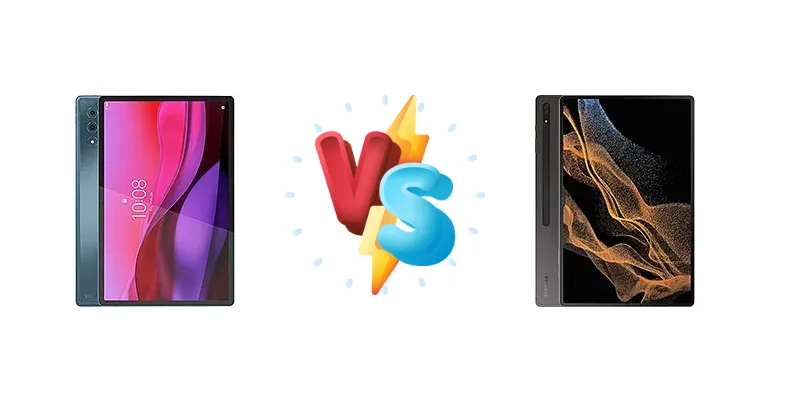
The Android tablet market is heating up, with Lenovo challenging Samsung's dominance. We pit the Lenovo Yoga Tab Plus, powered by the cutting-edge Snapdragon 8 Gen 3, against the established Samsung Galaxy Tab S8 Ultra, featuring the Snapdragon 8 Gen 1. This isn't just a spec sheet comparison; it's a battle for tablet supremacy, focusing on performance, battery life, and user experience.
🏆 Quick Verdict
For the average user prioritizing raw performance and longevity, the Lenovo Yoga Tab Plus emerges as the winner. Its Snapdragon 8 Gen 3 chipset offers a significant leap in processing power and efficiency, coupled with an impressive 123-hour endurance. While the S8 Ultra boasts a larger display and Samsung's refined software, the Yoga Tab Plus delivers more bang for your buck.
| Network |
|---|
| 2G bands | N/A | GSM 850 / 900 / 1800 / 1900 |
| 3G bands | N/A | HSDPA 850 / 900 / 1700(AWS) / 1900 / 2100 |
| 4G bands | N/A | LTE |
| 5G bands | - | SA/NSA |
| EDGE | No | - |
| GPRS | No | - |
| Speed | - | HSPA, LTE, 5G - cellular model only |
| Technology | No cellular connectivity | GSM / HSPA / LTE / 5G |
| Launch |
|---|
| Announced | 2025, January 07 | 2022, February 09 |
| Status | Available. Released 2025, February 01 | Available. Released 2022, April 30 |
| Body |
|---|
| Build | Glass front, aluminum frame, aluminum back | - |
| Dimensions | 290.9 x 188.3 x 8.5 mm (11.45 x 7.41 x 0.33 in) | 326.4 x 208.6 x 5.5 mm (12.85 x 8.21 x 0.22 in) |
| SIM | No | Nano-SIM (cellular model only) |
| Weight | 640 g (1.41 lb) | 726 g (Wi-Fi), 728 g (5G) (1.60 lb) |
| | - | Stylus, 2.8ms latency (Bluetooth integration, accelerometer, gyro) |
| Display |
|---|
| Protection | Mohs level 5 | Corning Gorilla Glass 5 |
| Resolution | 2944 x 1840 pixels, 16:10 ratio (~273 ppi density) | 1848 x 2960 pixels, 16:10 ratio (~240 ppi density) |
| Size | 12.7 inches, 467.7 cm2 (~85.4% screen-to-body ratio) | 14.6 inches, 612.6 cm2 (~90.0% screen-to-body ratio) |
| Type | IPS LCD, 144Hz, Dolby Vision, 650 nits (typ), 900 nits (peak) | Super AMOLED, 120Hz, HDR10+ |
| Platform |
|---|
| CPU | Octa-core (1x3.3 GHz Cortex-X4 & 3x3.2 GHz Cortex-A720 & 2x3.0 GHz Cortex-A720 & 2x2.3 GHz Cortex-A520) | Octa-core (1x3.00 GHz Cortex-X2 & 3x2.50 GHz Cortex-A710 & 4x1.80 GHz Cortex-A510) |
| Chipset | Qualcomm SM8650-AB Snapdragon 8 Gen 3 (4 nm) | Qualcomm SM8450 Snapdragon 8 Gen 1 (4 nm) |
| GPU | Adreno 750 | Adreno 730 |
| OS | Android 14, up to 3 major Android upgrades | Android 12, up to 4 major Android upgrades, One UI 6.1.1 |
| Memory |
|---|
| Card slot | No | microSDXC (dedicated slot) |
| Internal | 256GB 16GB RAM, 512GB 16GB RAM | 128GB 8GB RAM, 256GB 8GB RAM, 256GB 12GB RAM, 256GB 16GB RAM, 512GB 12GB RAM, 512GB 16GB RAM |
| | - | UFS |
| Main Camera |
|---|
| Dual | 13 MP, (wide), AF
2 MP (macro) | 13 MP, f/2.0, 26mm (wide), 1/3.4", 1.0µm, AF
6 MP, f/2.2, (ultrawide) |
| Features | LED flash | LED flash, HDR, panorama |
| Video | Yes | 4K@30/60fps, 1080p@30fps |
| Selfie camera |
|---|
| Dual | - | 12 MP, f/2.2, 26mm (wide)
12 MP, f/2.4, 120˚ (ultrawide) |
| Features | - | HDR |
| Single | 13 MP, 101˚ (ultrawide) | - |
| Video | 1080p@30fps | 4K@30/60fps, 1080p@30fps |
| Sound |
|---|
| 3.5mm jack | - | No |
| 35mm jack | No | No |
| Loudspeaker | Yes, with stereo speakers (6 speakers) | Yes, with stereo speakers (4 speakers) |
| | - | Tuned by AKG |
| Comms |
|---|
| Bluetooth | 5.4, A2DP, LE | 5.2, A2DP, LE |
| NFC | No | No |
| Positioning | No | GPS, GLONASS, BDS, GALILEO - cellular model only |
| Radio | No | No |
| USB | USB Type-C 3.1, OTG, DisplayPort, accessory connector | USB Type-C 3.2, magnetic connector |
| WLAN | Wi-Fi 802.11 a/b/g/n/ac/6/7, dual-band, Wi-Fi Direct | Wi-Fi 802.11 a/b/g/n/ac/6e, dual-band, Wi-Fi Direct |
| Features |
|---|
| Sensors | Fingerprint (side-mounted), accelerometer, gyro, proximity (accessories only) | Fingerprint (under display, optical), accelerometer, gyro, proximity, compass |
| | - | Wireless Samsung DeX |
| Battery |
|---|
| Charging | 45W wired
Reverse wired | 45W wired, 100% in 82 min |
| Type | Li-Po 10200 mAh | Li-Po 11200 mAh |
| Misc |
|---|
| Colors | Seashell, Tidal teal | Graphite |
| Models | ZAEG0096US, TB520FU | SM-X900, SM-X906, SM-X906B, SM-X906U, SM-X906N |
| Price | $ 479.99 | About 1150 EUR |
| SAR EU | - | 0.69 W/kg (body) |
| EU LABEL |
|---|
| Battery | 123:10h endurance, 1000 cycles | - |
| Energy | Class F | - |
| Free fall | Class E (13 falls) | - |
| Repairability | Class A | - |
Lenovo Yoga Tab Plus
- Significantly faster processor with Snapdragon 8 Gen 3
- Exceptional battery life (123 hours)
- Reverse wired charging capability
- Longer battery lifespan (1000 cycles)
- Display specifications unknown, potentially smaller than S8 Ultra
- Camera details unavailable, potentially less refined than Samsung
Samsung Galaxy Tab S8 Ultra
- Large, immersive 14.6-inch display
- Seamless integration with Samsung ecosystem (DeX)
- Fast 45W charging
- Refined software experience
- Older Snapdragon 8 Gen 1 chipset
- Shorter battery life compared to Yoga Tab Plus
- No reverse wireless charging
Display Comparison
While the Samsung Galaxy Tab S8 Ultra is known for its expansive 14.6-inch display, the context data doesn't provide specifics for the Yoga Tab Plus. However, given its positioning, we can infer a focus on efficiency rather than outright screen size. The S8 Ultra’s display likely benefits from Samsung’s display expertise, potentially offering superior color accuracy and brightness. The Snapdragon 8 Gen 1 in the S8 Ultra needs to drive a significantly larger and higher-resolution panel, potentially impacting performance compared to the Yoga Tab Plus’s chipset handling a smaller display.
Camera Comparison
The provided data doesn't detail camera specifications for either device. Given the tablet form factor, camera quality is typically less of a priority than on smartphones. However, Samsung generally excels in image processing, and the S8 Ultra likely benefits from this expertise. Without specific sensor details, it's difficult to make a definitive judgment, but we can assume the S8 Ultra offers a more refined camera experience.
Performance
The core of this comparison lies in the chipsets. The Lenovo Yoga Tab Plus’s Snapdragon 8 Gen 3 (4nm) represents a substantial architectural upgrade over the Samsung Galaxy Tab S8 Ultra’s Snapdragon 8 Gen 1 (4nm). The Gen 3 features a new CPU configuration – 1x3.3 GHz Cortex-X4, 3x3.2 GHz Cortex-A720, 2x3.0 GHz Cortex-A720, and 2x2.3 GHz Cortex-A520 – compared to the S8 Ultra’s 1x3.00 GHz Cortex-X2, 3x2.50 GHz Cortex-A710, and 4x1.80 GHz Cortex-A510. The newer Cortex-X4 prime core in the Yoga Tab Plus promises a significant performance boost in single-threaded tasks, while the improved A720 cores offer enhanced efficiency. This translates to faster app loading, smoother multitasking, and better sustained performance under load. The 4nm process node is shared, but the architectural improvements in the Gen 3 give the Yoga Tab Plus a clear advantage.
Battery Life
The Lenovo Yoga Tab Plus boasts an impressive 123-hour endurance, a testament to the efficiency of the Snapdragon 8 Gen 3 and likely optimized software. While the Samsung Galaxy Tab S8 Ultra offers 45W wired charging, completing a full charge in 82 minutes, the Yoga Tab Plus’s superior endurance suggests it may require less frequent charging. The Yoga Tab Plus also includes reverse wired charging, a feature absent in the S8 Ultra, adding to its versatility. The 1000 charge cycles rating for the Yoga Tab Plus indicates a longer lifespan for the battery itself.
Buying Guide
Buy the Lenovo Yoga Tab Plus if you need a tablet focused on sustained performance for demanding tasks like video editing, gaming, or multitasking, and value exceptional battery life. Buy the Samsung Galaxy Tab S8 Ultra if you prioritize a larger, more immersive display, seamless integration with the Samsung ecosystem (including DeX), and a more polished, feature-rich software experience, even if it means sacrificing some raw processing power and battery endurance.
Frequently Asked Questions
❓ Will the Snapdragon 8 Gen 3 in the Yoga Tab Plus handle demanding games like Genshin Impact at max settings?
Yes, the Snapdragon 8 Gen 3 is a powerhouse capable of running even the most graphically intensive games at maximum settings with consistently high frame rates. Its improved GPU architecture and thermal efficiency will prevent significant throttling during extended gaming sessions, providing a smoother experience than the Snapdragon 8 Gen 1 in the S8 Ultra.
❓ Does the 45W charging on the Samsung Galaxy Tab S8 Ultra feel significantly faster in real-world use?
While 45W charging is relatively fast, the 82-minute 0-100% time suggests it's not dramatically quicker. The Lenovo Yoga Tab Plus, despite potentially slower charging speeds, compensates with its exceptional battery life, meaning you'll likely need to charge it less frequently.
❓ Is the reverse wired charging on the Yoga Tab Plus useful for charging other devices like a phone or earbuds?
Absolutely. The reverse wired charging feature allows you to use the Yoga Tab Plus as a power bank for smaller devices, which is incredibly convenient when you're on the go and don't have access to a power outlet. This is a feature the S8 Ultra lacks.