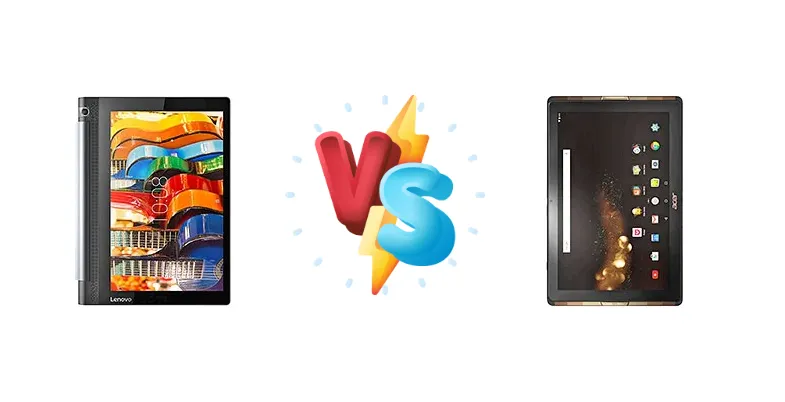
The Lenovo Yoga Tab 3 10 and Acer Iconia Tab 10 A3-A40 represent a segment of the tablet market focused on affordability. Both devices aim to provide a functional Android experience without breaking the bank, but they achieve this with different underlying hardware. This comparison dissects the key differences between the Qualcomm-powered Lenovo and the Mediatek-equipped Acer, helping you determine which tablet best suits your needs.
🏆 Quick Verdict
For the average user prioritizing a slightly more modern CPU architecture and potentially better software support, the Acer Iconia Tab 10 A3-A40 edges out the Lenovo Yoga Tab 3 10. While both offer similar performance levels, the Cortex-A53 cores in the Acer provide a small architectural advantage, and the Mediatek chipset may receive longer software updates.
| Network |
|---|
| 2G bands | GSM 850 / 900 / 1800 / 1900 | N/A |
| 3G bands | HSDPA 850 / 900 / 1700(AWS) / 1900 / 2100 - EMEA | - |
| 4G bands | 1, 3, 4, 5, 7, 8, 19, 20, 38, 40 - EMEA | - |
| EDGE | - | No |
| GPRS | - | No |
| Speed | HSPA, LTE | - |
| Technology | GSM / HSPA / LTE | No cellular connectivity |
| Launch |
|---|
| Announced | 2016. Released 2016 | 2016, April. Released 2016, June |
| Status | Discontinued | Discontinued |
| Body |
|---|
| Dimensions | 253 x 185 x 9.5 mm (9.96 x 7.28 x 0.37 in) | 259 x 167 x 8.9 mm (10.20 x 6.57 x 0.35 in) |
| SIM | Micro-SIM | No |
| Weight | 655 g (Wi-Fi)/ 665 g (3G/LTE) (1.40 lb) | - |
| | Built-in 3-stage kickstand
Splash and dust resistant | - |
| Display |
|---|
| Resolution | 800 x 1280 pixels, 16:10 ratio (~149 ppi density) | 1920 x 1200 pixels, 16:10 ratio (~224 ppi density) |
| Size | 10.1 inches, 295.8 cm2 (~63.2% screen-to-body ratio) | 10.1 inches, 295.8 cm2 (~68.4% screen-to-body ratio) |
| Type | IPS LCD | IPS LCD |
| Platform |
|---|
| CPU | Quad-core 1.3 GHz Cortex-A7 | Quad-core 1.3 GHz Cortex-A53 |
| Chipset | Qualcomm MSM8909 Snapdragon 210 (28 nm) - 3G/LTE modelQualcomm APQ8009 (28 nm) - Wi-Fi model | Mediatek MT8163A |
| GPU | Adreno 304 | Mali-T720 MP2 |
| OS | Android 6.0 (Marshmallow) | Android 6.0 (Marshmallow) |
| Memory |
|---|
| Card slot | microSDXC (dedicated slot) | microSDXC (dedicated slot) |
| Internal | 16GB 2GB RAM | 16GB 2GB RAM, 32GB 2GB RAM, 64GB 2GB RAM |
| | eMMC 4.5 | - |
| Main Camera |
|---|
| Single | 8 MP, AF | 5 MP |
| Video | 720p@30fps | 1080p@30fps |
| Selfie camera |
|---|
| Single | Rotating main camera module | 2 MP |
| Video | 720p@30fps | - |
| Sound |
|---|
| 3.5mm jack | Yes | Yes |
| 35mm jack | Yes | Yes |
| Loudspeaker | Yes, with stereo speakers | Yes, with stereo speakers (4 speakers) |
| Comms |
|---|
| Bluetooth | 4.0, A2DP | 4.0, A2DP |
| NFC | No | No |
| Positioning | GPS, GLONASS | - |
| Radio | No | No |
| USB | microUSB 2.0 | microUSB 2.0 |
| WLAN | Wi-Fi 802.11 b/g/n | Wi-Fi 802.11 a/b/g/n/ac, dual-band |
| Features |
|---|
| Sensors | Accelerometer | Accelerometer |
| | - | HDMI |
| Battery |
|---|
| Type | Li-Ion 8400 mAh, non-removable | Li-Ion 6100 mAh, non-removable |
| Misc |
|---|
| Colors | Black | Black |
| Models | YT3-X50M, YT3-X50F | - |
| Price | About 180 EUR | About 230 EUR |
Lenovo Yoga Tab 3 10
- Optional 3G/LTE connectivity for on-the-go access.
- Established brand reputation (Lenovo).
- Potentially wider availability of accessories.
- Older Cortex-A7 CPU architecture.
- Snapdragon 210 is a less efficient processor.
- Potentially shorter software support lifecycle.
Acer Iconia Tab 10 A3-A40
- More modern Cortex-A53 CPU architecture.
- Potentially better energy efficiency.
- Likely longer software support from Mediatek.
- Lacks 3G/LTE connectivity.
- Acer's tablet software support can be inconsistent.
- May be less readily available in some regions.
Display Comparison
Neither Lenovo nor Acer provide detailed display specifications in the provided data. However, given the target market, both tablets likely utilize IPS LCD panels with resolutions around 1280x800. The absence of information regarding brightness, color gamut coverage, or refresh rates suggests neither device prioritizes display quality. Bezels are likely substantial on both, typical of tablets in this price range. Without further data, a direct comparison is impossible, but users shouldn't expect vibrant or color-accurate displays on either model.
Camera Comparison
Camera performance is unlikely to be a deciding factor for either tablet. The provided data doesn't specify camera resolutions, but budget tablets typically feature low-resolution sensors. Focusing on the processors, the image signal processor (ISP) within the Snapdragon 210 and Mediatek MT8163A are both basic, and image quality will be limited, especially in low-light conditions. Expect acceptable results for casual snapshots, but neither tablet is designed for serious photography.
Performance
The core difference lies in the chipsets: the Lenovo Yoga Tab 3 10 utilizes either the Qualcomm MSM8909 Snapdragon 210 (for 3G/LTE models) or the APQ8009 (Wi-Fi only), both built on a 28nm process, paired with a quad-core 1.3 GHz Cortex-A7 CPU. The Acer Iconia Tab 10 A3-A40 features the Mediatek MT8163A with a similar quad-core 1.3 GHz configuration, but employing Cortex-A53 cores. While clock speeds are identical, the Cortex-A53 architecture is a significant improvement over the Cortex-A7, offering better instructions per clock (IPC) and improved energy efficiency. This translates to slightly snappier performance in everyday tasks and potentially better multi-tasking capabilities on the Acer, despite both being entry-level processors. The 28nm process node is shared, meaning thermal performance will be comparable, but the A53's efficiency could lead to slightly longer battery life under load.
Battery Life
Battery capacity isn't specified for either device. However, given their similar size and target market, they likely feature batteries in the 6000-7000 mAh range. The Mediatek MT8163A's more efficient Cortex-A53 cores could translate to slightly longer battery life for the Acer Iconia Tab 10 A3-A40, even with a similar battery capacity. Charging wattage is also unknown, but both tablets likely support standard 5W charging, resulting in relatively slow charging times.
Buying Guide
Buy the Lenovo Yoga Tab 3 10 if you specifically need 3G/LTE connectivity in a budget tablet and are comfortable with the older Snapdragon 210 chipset. Buy the Acer Iconia Tab 10 A3-A40 if you primarily need Wi-Fi connectivity, value a slightly more efficient CPU architecture, and anticipate potentially longer software support from Acer.
Frequently Asked Questions
❓ Will the Snapdragon 210 in the Lenovo Yoga Tab 3 10 struggle with modern Android apps?
The Snapdragon 210 is an entry-level processor and will likely exhibit slowdowns with demanding apps or heavy multitasking. While it can handle basic tasks like web browsing and video playback, expect limited performance with graphically intensive games or complex applications. The Acer's Cortex-A53 offers a slight advantage, but neither tablet is a performance powerhouse.
❓ How long can I expect software updates to be supported on the Acer Iconia Tab 10 A3-A40?
Acer's software support for budget tablets can be inconsistent. While the Mediatek MT8163A may receive updates for a longer period than the older Snapdragon 210, don't expect major Android version upgrades beyond the version it ships with. Security patches may be provided for a limited time, but long-term support is not guaranteed.
❓ Is the lack of LTE connectivity on the Acer Iconia Tab 10 A3-A40 a significant drawback?
If you frequently need internet access outside of Wi-Fi range, the lack of LTE on the Acer is a significant drawback. However, if you primarily use the tablet at home or in locations with Wi-Fi, it won't be an issue. The Lenovo Yoga Tab 3 10 offers LTE as an option, but at a potential cost in performance and efficiency.