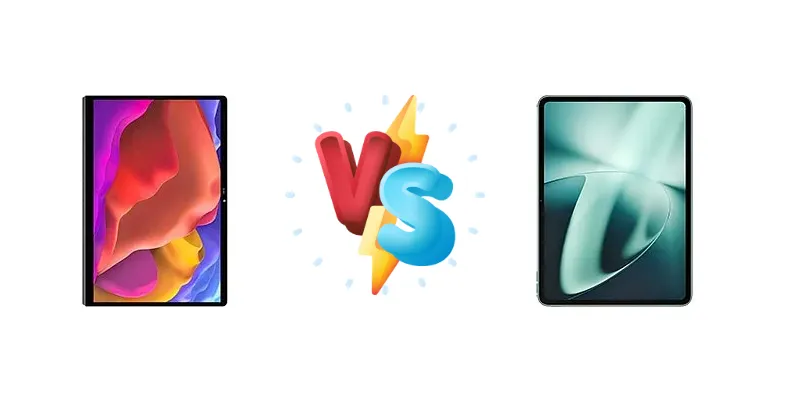
The Android tablet market is heating up, with the Lenovo Yoga Tab 13 and OnePlus Pad representing compelling options at different price points. The Yoga Tab 13, leveraging the Snapdragon 870, offers a proven performance profile, while the OnePlus Pad debuts with the newer MediaTek Dimensity 9000. This comparison dissects their key differences to determine which tablet best suits your needs.
🏆 Quick Verdict
For users prioritizing raw processing power and faster charging, the OnePlus Pad emerges as the winner. Its Dimensity 9000 chipset delivers a noticeable performance edge, and the 67W charging significantly reduces downtime. However, the Lenovo Yoga Tab 13 remains a strong contender, particularly for those seeking a well-rounded experience at a potentially lower cost.
| Network |
|---|
| 2G bands | N/A | N/A |
| 3G bands | N/A | N/A |
| 4G bands | N/A | N/A |
| EDGE | No | No |
| GPRS | No | No |
| Technology | No cellular connectivity | No cellular connectivity |
| Launch |
|---|
| Announced | 2021, May 24 | 2023, February 07 |
| Status | Available. Released 2021, May 31 | Available. Released 2023, April 28 |
| Body |
|---|
| Build | Glass front, aluminum frame, aluminum back | Glass front, aluminum back, aluminum frame |
| Dimensions | 293.4 mm x 204 mm x 6.2-24.9 mm | 258 x 189.4 x 6.5 mm (10.16 x 7.46 x 0.26 in) |
| SIM | No | No |
| Weight | 830 g (1.83 lb) | 552 g (1.22 lb) |
| | Built-in stainless steel kickstand
Stylus support | Stylus support |
| Display |
|---|
| Resolution | 1350 x 2160 pixels, 16:10 ratio (~196 ppi density) | 2000 x 2800 pixels (~296 ppi density) |
| Size | 13.0 inches, 490.0 cm2 (~56.7% screen-to-body ratio) | 11.61 inches, 411.3 cm2 (~84.2% screen-to-body ratio) |
| Type | IPS LCD, HDR10, Dolby Vision, 400 nits | IPS LCD, 1B colors, Dolby Vision, HDR10+, 144Hz, 500 nits (typ) |
| Platform |
|---|
| CPU | Octa-core (1x3.2 GHz Kryo 585 & 3x2.42 GHz Kryo 585 & 4x1.80 GHz Kryo 585) | Octa-core (1x3.05 GHz Cortex-X2 & 3x2.85 GHz Cortex-A710 & 4x1.80 GHz Cortex-A510) |
| Chipset | Qualcomm SM8250-AC Snapdragon 870 5G (7 nm) | Mediatek Dimensity 9000 (4 nm) |
| GPU | Adreno 650 | Mali-G710 MC10 |
| OS | Android 11, ZUI 12.5 | Android 13, upgradable to Android 15, OxygenOS 15 |
| Memory |
|---|
| Card slot | No | No |
| Internal | 256GB 8GB RAM | 128GB 8GB RAM, 256GB 12GB RAM |
| | UFS 3.0 | UFS 3.1 |
| Main Camera |
|---|
| No | - |
| Features | - | LED flash |
| Single | - | 13 MP, f/2.2, 23mm (wide) |
| Video | - | 4K@30fps, 1080p@30ps, gyro-EIS |
| Selfie camera |
|---|
| Single | 8 MP
TOF 3D, (biometrics sensor) | 8 MP, f/2.3, (wide), 1/4.0", 1.12µm |
| Video | 1080p@30fps | 1080p@30fps |
| Sound |
|---|
| 3.5mm jack | No | No |
| 35mm jack | No | No |
| Loudspeaker | Yes, with stereo speakers (4 speakers) | Yes, with stereo speakers (4 speakers) |
| | Tuned by JBL | - |
| Comms |
|---|
| Bluetooth | 5.2, A2DP, LE | 5.3, A2DP, LE, aptX HD |
| NFC | No | No |
| Positioning | Unspecified | GPS, GLONASS, GALILEO, BDS (B1+B1c) |
| Radio | No | No |
| USB | USB Type-C 3.1, micro HDMI | USB Type-C 2.0, OTG, accessory connector |
| WLAN | Wi-Fi 802.11 a/b/g/n/ac/6, dual-band, Wi-Fi Direct | Wi-Fi 802.11 a/b/g/n/ac/6, dual-band |
| Features |
|---|
| Sensors | Face recognition, accelerometer, gyro, proximity | Accelerometer, gyro, compass |
| Battery |
|---|
| Charging | - | 67W wired |
| Type | Li-Po 10200 mAh | Li-Po 9510 mAh |
| Misc |
|---|
| Colors | Gray | Halo Green |
| Models | ZA8E0018CN | - |
| Price | About 800 EUR | About 500 EUR |
| Tests |
|---|
| Display | - |
Contrast ratio: 1664:1 |
| Loudspeaker | - |
-22.5 LUFS (Excellent)
|
| Performance | - |
AnTuTu: 859019 (v9)
GeekBench: 3158 (v5.1)
GFXBench: 28fps (ES 3.1 onscreen) |
Lenovo Yoga Tab 13
- Proven Snapdragon 870 performance
- Potentially lower price point
- Versatile tablet experience
- Older 7nm process technology
- Likely slower charging speeds
- Display specifications not provided
OnePlus Pad
- Powerful MediaTek Dimensity 9000 chipset
- 4nm process for improved efficiency
- 67W fast charging
- Higher price point
- Potential for software optimization issues (early adopter)
- Display brightness may not be significantly higher
Display Comparison
The OnePlus Pad boasts a measured peak brightness of 442 nits and a 1195:1 contrast ratio, indicating a vibrant and readable display. While the Lenovo Yoga Tab 13’s display specifications are not provided, its market positioning suggests a comparable, though potentially less bright, panel. The OnePlus Pad’s 1664:1 contrast ratio suggests deeper blacks and a more immersive viewing experience. The absence of LTPO technology in either device means refresh rate is likely fixed, impacting battery life during dynamic content.
Camera Comparison
Neither tablet is positioned as a photography powerhouse, and detailed camera specifications are absent. Given the tablet form factor, camera quality is less critical. However, the absence of information regarding sensor size and aperture suggests both devices likely feature modest camera systems suitable for casual snapshots and video calls. We can assume both will rely heavily on software processing to enhance image quality.
Performance
The core difference lies in the chipsets. The OnePlus Pad’s MediaTek Dimensity 9000, fabricated on a 4nm process, offers a significant architectural advantage over the Lenovo Yoga Tab 13’s 7nm Qualcomm Snapdragon 870 5G. The Dimensity 9000’s Cortex-X2 prime core clocked at 3.05 GHz provides a substantial single-core performance boost, crucial for responsive UI and demanding applications. While the Snapdragon 870’s octa-core configuration is capable, the Dimensity 9000’s newer architecture and smaller node translate to improved power efficiency and sustained performance under load. The OnePlus Pad is likely to exhibit less thermal throttling during extended gaming sessions.
Battery Life
Battery capacity data is missing for both devices. However, the OnePlus Pad’s 67W wired charging is a significant advantage. This allows for a much faster 0-100% charge time compared to the charging speeds typically associated with tablets in this segment. While the Lenovo Yoga Tab 13’s battery life may be comparable, the OnePlus Pad’s rapid charging mitigates the inconvenience of longer usage periods, making it more convenient for on-the-go users.
Buying Guide
Buy the Lenovo Yoga Tab 13 if you need a versatile tablet for everyday tasks, media consumption, and light gaming, and value a proven chipset with good thermal management. Buy the OnePlus Pad if you prioritize demanding applications, faster charging speeds, and a more modern processor architecture, and are willing to invest slightly more for the performance boost.
Frequently Asked Questions
❓ Will the Dimensity 9000 in the OnePlus Pad experience thermal throttling during prolonged gaming sessions?
While the Dimensity 9000 is a powerful chipset, sustained performance depends on thermal management. The 4nm process should help mitigate throttling compared to the Snapdragon 870, but real-world performance will depend on the OnePlus Pad’s cooling solution. Initial reports suggest good thermal performance, but extended, demanding tasks may still result in some throttling.
❓ Is the Snapdragon 870 in the Lenovo Yoga Tab 13 still capable of handling demanding applications like video editing?
The Snapdragon 870 remains a capable processor for most tasks, including video editing. However, it will likely take longer to render complex projects compared to the Dimensity 9000. For casual video editing and everyday productivity, the Yoga Tab 13 should perform adequately.
❓ Does the OnePlus Pad support any stylus functionality or keyboard accessories?
Yes, the OnePlus Pad supports the OnePlus Stylo stylus and the OnePlus Folio Keyboard. These accessories are sold separately and enhance the tablet's productivity capabilities, transforming it into a more versatile device for note-taking and document editing.