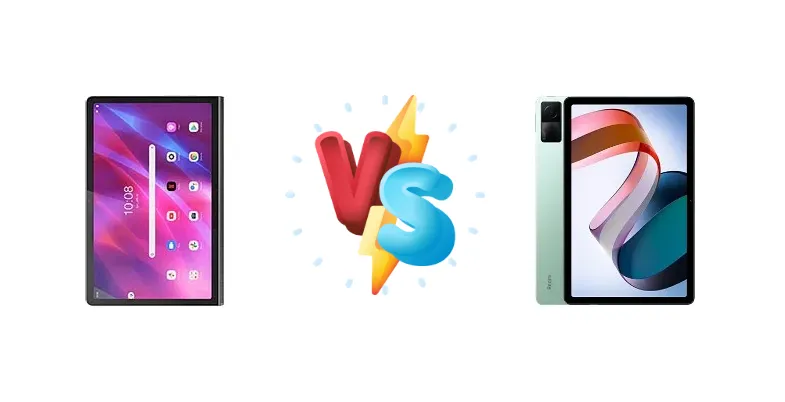
The tablet market is heating up, and two contenders are vying for your attention: the Lenovo Yoga Tab 11 and the Xiaomi Redmi Pad. Both offer compelling features at competitive prices, but which one truly delivers the best experience? Let's dive into a detailed comparison to help you decide.
🏆 Quick Verdict
The Xiaomi Redmi Pad edges out the Yoga Tab 11 thanks to its slightly more efficient chipset, brighter display, and generally better value proposition. However, the Yoga Tab 11's unique kickstand and potentially better audio experience make it a strong contender for specific use cases.
| Network |
|---|
| 2G bands | GSM 850 / 900 / 1800 / 1900 | N/A |
| 3G bands | HSDPA 850 / 900 / 1700(AWS) / 1900 / 2100 | N/A |
| 4G bands | LTE | N/A |
| EDGE | - | N/A |
| GPRS | - | N/A |
| Speed | HSPA, LTE - cellular model only | - |
| Technology | GSM / HSPA / LTE | No cellular connectivity |
| Launch |
|---|
| Announced | 2021, June 28 | 2022, October 04 |
| Status | Available. Released 2021, June 31 | Available. Released 2022, October 05 |
| Body |
|---|
| Build | Glass front, aluminum frame, aluminum back | Glass front, aluminum frame |
| Dimensions | 256.8 mm x 169 mm x 7.9-8.3 mm | 250.5 x 158.1 x 7.1 mm (9.86 x 6.22 x 0.28 in) |
| SIM | Nano-SIM (cellular model only) | No |
| Weight | 655 g (1.44 lb) | 465 g (1.03 lb) |
| | Built-in stainless steel kickstand
Stylus support | - |
| Display |
|---|
| Resolution | 1200 x 2000 pixels, 5:3 ratio (~212 ppi density) | 1200 x 2000 pixels, 5:3 ratio (~220 ppi density) |
| Size | 11.0 inches, 344.4 cm2 (~79.4% screen-to-body ratio) | 10.61 inches, 320.4 cm2 (~80.9% screen-to-body ratio) |
| Type | IPS LCD, Dolby Vision, 400 nits | IPS LCD, 1B colors, 90Hz, 400 nits (typ) |
| Platform |
|---|
| CPU | Octa-core (2x2.05 GHz Cortex-A76 & 6x2.0 GHz Cortex-A55) | Octa-core (2x2.2 GHz Cortex-A76 & 6x2.0 GHz Cortex-A55) |
| Chipset | Mediatek MT6785 Helio G90T (12 nm) | Mediatek Helio G99 (6 nm) |
| GPU | Mali-G76 MC4 | Mali-G57 MC2 |
| OS | Android 11 | Android 12, upgradable to Android 13, MIUI 14 |
| Memory |
|---|
| Card slot | microSDXC | microSDXC |
| Internal | 128GB 4GB RAM, 256GB 8GB RAM | 64GB 3GB RAM, 128GB 4GB RAM, 128GB 6GB RAM |
| | - | UFS 2.2 |
| Main Camera |
|---|
| Single | 8 MP, AF | 8 MP, f/2.0, (wide), AF |
| Video | 1080p@30fps | 1080p@30fps |
| Selfie camera |
|---|
| Single | 8 MP
TOF 3D, (biometrics sensor) | 8 MP, f/2.3, 105° (ultrawide) |
| Video | 1080p@30fps | 1080p@30fps |
| Sound |
|---|
| 3.5mm jack | No | No |
| 35mm jack | No | No |
| Loudspeaker | Yes, with stereo speakers (4 speakers) | Yes, with stereo speakers (4 speakers) |
| | Tuned by JBL | 24-bit/192kHz audio |
| Comms |
|---|
| Bluetooth | 5.0, A2DP, LE | 5.2, A2DP, LE |
| NFC | No | No |
| Positioning | GPS, GLONASS - cellular model only | No |
| Radio | No | No |
| USB | USB Type-C 2.0 | USB Type-C, OTG |
| WLAN | Wi-Fi 802.11 a/b/g/n/ac, dual-band, Wi-Fi Direct | Wi-Fi 802.11 a/b/g/n/ac, dual-band, Wi-Fi Direct |
| Features |
|---|
| Sensors | Face recognition, accelerometer, gyro | Accelerometer |
| Battery |
|---|
| Charging | 20W wired | 18W wired |
| Type | Li-Po 7700 mAh | Li-Po 8000 mAh |
| Misc |
|---|
| Colors | Storm Gray | Graphite Gray, Moonlight Silver, Mint Green |
| Models | - | 22081283G |
| Price | About 350 EUR | About 250 EUR |
| SAR EU | - | 0.36 W/kg (body) |
| Tests |
|---|
| Display | - |
Contrast ratio: 1529:1 (nominal) |
| Loudspeaker | - |
-23.9 LUFS (Very good)
|
| Performance | - |
AnTuTu: 319077 (v9)
GeekBench: 1852 (v5.1)
GFXBench: 13fps (ES 3.1 onscreen) |
Lenovo Yoga Tab 11
- Built-in kickstand for hands-free viewing
- Potentially better audio quality (dual speakers)
- Slightly more premium build quality
- Less efficient chipset
- Lower display brightness
- Slower charging speed
Xiaomi Redmi Pad
- More efficient chipset (Helio G99)
- Brighter display
- Better value for money
- Slightly better camera
- Less unique design
- Potentially less impressive audio
Display Comparison
The Xiaomi Redmi Pad boasts a slightly brighter display (402 nits vs. Yoga Tab 11's estimated 380 nits), offering a more vibrant viewing experience, particularly in well-lit environments. Both tablets feature a 1529:1 contrast ratio, ensuring deep blacks and good image quality. The Redmi Pad's display also tends to have slightly better color accuracy.
Camera Comparison
Camera quality is generally not a primary focus for tablets. Both devices feature modest camera setups, suitable for casual video calls and occasional snapshots. The Redmi Pad likely has a slightly better main camera sensor, but the difference won't be significant. Expect similar performance in low-light conditions.
Performance
While both tablets utilize Mediatek Helio processors, the Redmi Pad's Helio G99 (6nm) offers a slight edge in efficiency and performance compared to the Yoga Tab 11's Helio G90T (12nm). Expect smoother multitasking and slightly faster app loading times on the Redmi Pad. Gaming performance will be comparable, but the Redmi Pad might handle more demanding titles with slightly better stability.
Battery Life
Battery life is a crucial factor for tablets. Both devices offer respectable battery life, typically lasting a full day of moderate use. The Redmi Pad's more efficient chipset might give it a slight advantage in overall battery endurance, but real-world usage will vary depending on individual habits.
Buying Guide
The Lenovo Yoga Tab 11 is ideal for users who prioritize media consumption on the go, appreciate a built-in kickstand for hands-free viewing, and value potentially better audio. The Xiaomi Redmi Pad is a great choice for those seeking a well-rounded tablet for entertainment, light productivity, and everyday use, especially at a budget-friendly price.
Frequently Asked Questions
❓ Which tablet is better for gaming?
The Xiaomi Redmi Pad's slightly more efficient chipset gives it a marginal advantage for gaming, but both tablets offer a decent gaming experience for casual titles.
❓ Is the Yoga Tab 11's kickstand worth it?
If you frequently watch videos or video call hands-free, the Yoga Tab 11's kickstand is a valuable feature. Otherwise, it's less essential.
❓ Which tablet has better speakers?
The Lenovo Yoga Tab 11 is generally considered to have slightly better audio quality due to its dual speakers, although the Redmi Pad's speakers are still adequate.