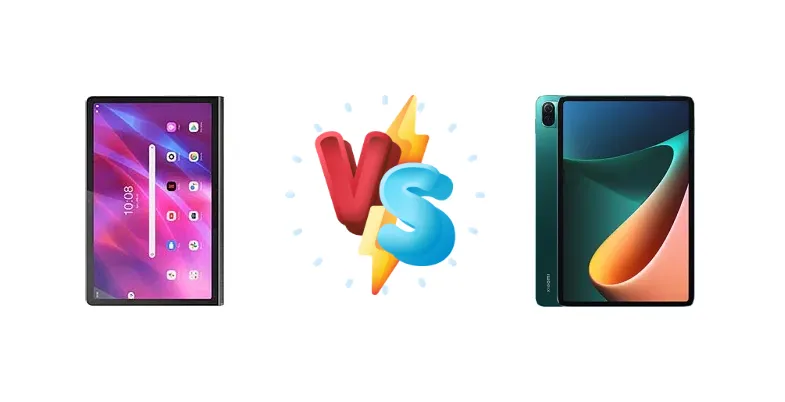
The Android tablet market is heating up, with compelling options emerging at various price points. The Lenovo Yoga Tab 11 and Xiaomi Pad 5 represent two strong contenders, each offering a unique blend of features and performance. This comparison dissects their key specifications to determine which tablet best suits your needs, from casual media consumption to more demanding productivity tasks.
🏆 Quick Verdict
For most users, the Xiaomi Pad 5 emerges as the superior choice. Its Qualcomm Snapdragon 860 chipset delivers significantly better performance than the Lenovo Yoga Tab 11’s MediaTek Helio G90T, making it more capable for gaming and multitasking. While the Yoga Tab 11 offers a unique form factor, the Pad 5’s overall refinement and power justify the price difference.
| Network |
|---|
| 2G bands | GSM 850 / 900 / 1800 / 1900 | N/A |
| 3G bands | HSDPA 850 / 900 / 1700(AWS) / 1900 / 2100 | N/A |
| 4G bands | LTE | - |
| EDGE | - | N/A |
| GPRS | - | N/A |
| Speed | HSPA, LTE - cellular model only | - |
| Technology | GSM / HSPA / LTE | No cellular connectivity |
| Launch |
|---|
| Announced | 2021, June 28 | 2021, August 10 |
| Status | Available. Released 2021, June 31 | Available. Released 2021, August 10 |
| Body |
|---|
| Build | Glass front, aluminum frame, aluminum back | Glass front, aluminum frame, plastic back |
| Dimensions | 256.8 mm x 169 mm x 7.9-8.3 mm | 254.7 x 166.3 x 6.9 mm (10.03 x 6.55 x 0.27 in) |
| SIM | Nano-SIM (cellular model only) | No |
| Weight | 655 g (1.44 lb) | 511 g (1.13 lb) |
| | Built-in stainless steel kickstand
Stylus support | Stylus support (magnetic) |
| Display |
|---|
| Resolution | 1200 x 2000 pixels, 5:3 ratio (~212 ppi density) | 1600 x 2560 pixels, 16:10 ratio (~274 ppi density) |
| Size | 11.0 inches, 344.4 cm2 (~79.4% screen-to-body ratio) | 11.0 inches, 350.9 cm2 (~82.8% screen-to-body ratio) |
| Type | IPS LCD, Dolby Vision, 400 nits | IPS LCD, 1B colors, 120Hz, HDR10, Dolby Vision |
| Platform |
|---|
| CPU | Octa-core (2x2.05 GHz Cortex-A76 & 6x2.0 GHz Cortex-A55) | Octa-core (1x2.96 GHz Kryo 485 Gold & 3x2.42 GHz Kryo 485 Gold & 4x1.78 GHz Kryo 485 Silver) |
| Chipset | Mediatek MT6785 Helio G90T (12 nm) | Qualcomm Snapdragon 860 (7 nm) |
| GPU | Mali-G76 MC4 | Adreno 640 |
| OS | Android 11 | Android 11, upgradable to Android 13, MIUI 14 |
| Memory |
|---|
| Card slot | microSDXC | No |
| Internal | 128GB 4GB RAM, 256GB 8GB RAM | 128GB 6GB RAM, 256GB 6GB RAM |
| | - | UFS 3.1 |
| Main Camera |
|---|
| Features | - | Dual-LED flash, HDR, panorama |
| Single | 8 MP, AF | 13 MP, f/2.0 |
| Video | 1080p@30fps | 4K@30fps, 1080p@30fps |
| Selfie camera |
|---|
| Single | 8 MP
TOF 3D, (biometrics sensor) | 8 MP, f/2.0 |
| Video | 1080p@30fps | 1080p@30fps |
| Sound |
|---|
| 3.5mm jack | No | No |
| 35mm jack | No | No |
| Loudspeaker | Yes, with stereo speakers (4 speakers) | Yes, with stereo speakers (4 speakers) |
| | Tuned by JBL | 24-bit/192kHz audio |
| Comms |
|---|
| Bluetooth | 5.0, A2DP, LE | 5.0, A2DP, LE |
| NFC | No | No |
| Positioning | GPS, GLONASS - cellular model only | No |
| Radio | No | No |
| USB | USB Type-C 2.0 | USB Type-C |
| WLAN | Wi-Fi 802.11 a/b/g/n/ac, dual-band, Wi-Fi Direct | Wi-Fi 802.11 a/b/g/n/ac, dual-band, Wi-Fi Direct |
| Features |
|---|
| Sensors | Face recognition, accelerometer, gyro | Accelerometer, gyro, proximity, compass |
| Battery |
|---|
| Charging | 20W wired | 33W wired, PD3.0 |
| Type | Li-Po 7700 mAh | Li-Po 8720 mAh |
| Misc |
|---|
| Colors | Storm Gray | Cosmic Gray, Pearl White, Green |
| Models | - | 21051182G, 21051182C |
| Price | About 350 EUR | About 350 EUR |
| Tests |
|---|
| Display | - |
Contrast ratio: 1271:1 (nominal) |
| Loudspeaker | - |
-24.4 LUFS (Very good)
|
| Performance | - |
AnTuTu: 473819 (v8), 555079 (v9)
GeekBench: 2583 (v5.1)
GFXBench: 24fps (ES 3.1 onscreen) |
Lenovo Yoga Tab 11
- Integrated kickstand for hands-free viewing.
- More affordable price point.
- Decent performance for everyday tasks.
- Inferior chipset compared to the Snapdragon 860.
- Slower charging speed (20W).
- Display lacks the brightness and vibrancy of the Pad 5.
Xiaomi Pad 5
- Powerful Snapdragon 860 chipset for smooth performance.
- Faster 33W charging with PD3.0.
- Brighter and more vibrant display.
- Higher price point.
- Lacks a built-in kickstand.
- Camera performance is not a standout feature.
Display Comparison
The Xiaomi Pad 5 boasts a brighter display, measured at 478 nits, compared to the Lenovo Yoga Tab 11’s unspecified brightness. Both share a contrast ratio of 1271:1 (nominal), suggesting similar color depth. However, the Pad 5’s higher brightness translates to better visibility in outdoor environments. The Yoga Tab 11’s display is adequate for indoor use, but lacks the vibrancy and clarity of the Pad 5. The lack of information regarding panel technology (IPS, AMOLED) for the Yoga Tab 11 makes a direct comparison difficult, but the Pad 5’s superior brightness is a clear advantage.
Camera Comparison
Neither tablet excels in the camera department, but the Xiaomi Pad 5 likely holds a slight edge due to Qualcomm’s image signal processing capabilities. Specific camera specs are unavailable for both devices, but Xiaomi generally prioritizes camera performance even in its tablet lineup. The Yoga Tab 11’s camera is likely geared towards basic video calls and occasional snapshots. Given the primary use case of tablets, camera quality is less critical, but the Pad 5’s superior chipset suggests better image processing.
Performance
The core difference lies in the chipsets. The Xiaomi Pad 5’s Qualcomm Snapdragon 860 (7nm) is a significant upgrade over the Lenovo Yoga Tab 11’s MediaTek Helio G90T (12nm). The Snapdragon 860’s Kryo 485 cores, with a prime core clocked at 2.96 GHz, offer substantially higher single-core and multi-core performance. The 7nm process node also contributes to better thermal efficiency, reducing the likelihood of performance throttling during extended gaming sessions. While the Yoga Tab 11’s octa-core CPU is competent for everyday tasks, it will struggle with graphically intensive games and demanding applications compared to the Pad 5.
Battery Life
Battery capacity is not specified for either device, making a direct comparison challenging. However, the Xiaomi Pad 5’s 33W wired charging with PD3.0 support is a significant advantage over the Lenovo Yoga Tab 11’s 20W charging. Faster charging translates to less downtime and quicker top-ups, especially important for users who rely on their tablets throughout the day. While a larger battery capacity on the Yoga Tab 11 could offset the slower charging, the Pad 5’s charging speed provides a more convenient user experience.
Buying Guide
Buy the Lenovo Yoga Tab 11 if you prioritize a built-in kickstand for hands-free viewing and a more affordable price point, making it ideal for casual users and families. Buy the Xiaomi Pad 5 if you demand smoother performance for gaming, video editing, or running demanding applications, and appreciate a brighter, more vibrant display, making it the better choice for power users and content creators.
Frequently Asked Questions
❓ Will the Helio G90T in the Yoga Tab 11 struggle with demanding games like Genshin Impact?
Yes, the MediaTek Helio G90T is likely to struggle with Genshin Impact and other graphically intensive games at higher settings. You’ll likely need to lower the graphics settings significantly to achieve playable frame rates, whereas the Snapdragon 860 in the Xiaomi Pad 5 can handle these games with more ease.
❓ Does the Xiaomi Pad 5 support stylus input and keyboard accessories?
Yes, the Xiaomi Pad 5 supports the Xiaomi Smart Pen (sold separately) and can be paired with a dedicated keyboard cover, transforming it into a more productivity-focused device. These accessories enhance its versatility beyond media consumption.
❓ How does the thermal management compare between the two tablets during prolonged gaming?
The Xiaomi Pad 5, with its Snapdragon 860 and 7nm process, generally exhibits better thermal management than the Lenovo Yoga Tab 11. The 12nm Helio G90T is more prone to throttling under sustained load, leading to performance drops during extended gaming sessions.
❓ Is the lack of a kickstand on the Xiaomi Pad 5 a significant drawback?
While the lack of a built-in kickstand is a valid concern, it can be easily addressed with a third-party tablet stand. The Pad 5’s superior performance and display quality often outweigh the convenience of a built-in kickstand for many users.