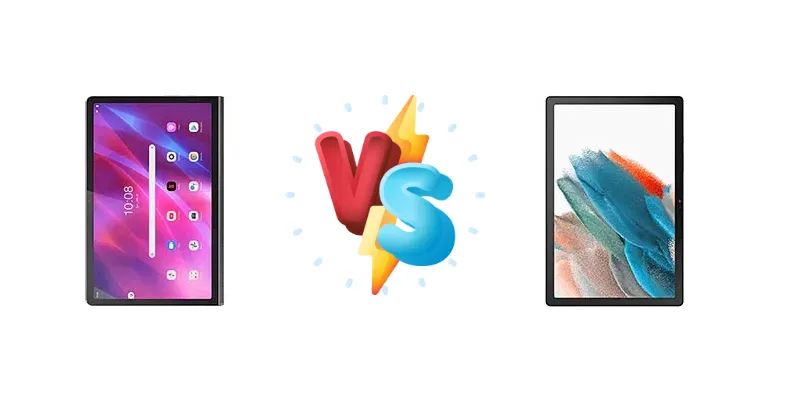
The Lenovo Yoga Tab 11 and Samsung Galaxy Tab A8 10.5 (2021) represent compelling options in the crowded budget-to-midrange Android tablet space. While both aim to deliver an accessible tablet experience, they diverge significantly in their core processing power and charging capabilities, impacting performance and usability for different types of users.
🏆 Quick Verdict
For users prioritizing performance and faster charging, the Lenovo Yoga Tab 11 emerges as the stronger choice. Its Mediatek Helio G90T chipset offers a noticeable advantage in CPU and GPU performance over the Samsung Galaxy Tab A8’s Unisoc Tiger T618, making it better suited for gaming and demanding applications. However, the Tab A8 remains a viable option for basic tasks and media consumption.
| Network |
|---|
| 2G bands | GSM 850 / 900 / 1800 / 1900 | GSM 850 / 900 / 1800 / 1900 |
| 3G bands | HSDPA 850 / 900 / 1700(AWS) / 1900 / 2100 | HSDPA 850 / 900 / 1700(AWS) / 1900 / 2100 |
| 4G bands | LTE | 1, 2, 3, 4, 5, 7, 8, 12, 17, 20, 28, 38, 40, 41, 66 |
| Speed | HSPA, LTE - cellular model only | HSPA, LTE - cellular model only |
| Technology | GSM / HSPA / LTE | GSM / HSPA / LTE |
| Launch |
|---|
| Announced | 2021, June 28 | 2021, December 15 |
| Status | Available. Released 2021, June 31 | Available. Released 2022, January 17 |
| Body |
|---|
| Build | Glass front, aluminum frame, aluminum back | - |
| Dimensions | 256.8 mm x 169 mm x 7.9-8.3 mm | 246.8 x 161.9 x 6.9 mm (9.72 x 6.37 x 0.27 in) |
| SIM | Nano-SIM (cellular model only) | Nano-SIM (cellular model only) |
| Weight | 655 g (1.44 lb) | 508 g (1.12 lb) |
| | Built-in stainless steel kickstand
Stylus support | - |
| Display |
|---|
| Resolution | 1200 x 2000 pixels, 5:3 ratio (~212 ppi density) | 1200 x 1920 pixels, 16:10 ratio (~216 ppi density) |
| Size | 11.0 inches, 344.4 cm2 (~79.4% screen-to-body ratio) | 10.5 inches, 319.7 cm2 (~80.0% screen-to-body ratio) |
| Type | IPS LCD, Dolby Vision, 400 nits | TFT LCD |
| Platform |
|---|
| CPU | Octa-core (2x2.05 GHz Cortex-A76 & 6x2.0 GHz Cortex-A55) | Octa-core (2x2.0 GHz Cortex-A75 & 6x2.0 GHz Cortex-A55) |
| Chipset | Mediatek MT6785 Helio G90T (12 nm) | Unisoc Tiger T618 (12 nm) |
| GPU | Mali-G76 MC4 | Mali G52 MP2 |
| OS | Android 11 | Android 11, upgradable to Android 14, One UI 6 |
| Memory |
|---|
| Card slot | microSDXC | microSDXC (dedicated slot) |
| Internal | 128GB 4GB RAM, 256GB 8GB RAM | 32GB 2GB RAM, 32GB 3GB RAM, 64GB 2GB RAM, 64GB 3GB RAM, 64GB 4GB RAM, 128GB 3GB RAM, 128GB 4GB RAM |
| Main Camera |
|---|
| Single | 8 MP, AF | 8 MP, AF |
| Video | 1080p@30fps | 1080p@30fps |
| Selfie camera |
|---|
| Single | 8 MP
TOF 3D, (biometrics sensor) | 5 MP |
| Video | 1080p@30fps | 1080p@30fps |
| Sound |
|---|
| 3.5mm jack | No | Yes |
| 35mm jack | No | Yes |
| Loudspeaker | Yes, with stereo speakers (4 speakers) | Yes, with stereo speakers (4 speakers) |
| | Tuned by JBL | - |
| Comms |
|---|
| Bluetooth | 5.0, A2DP, LE | 5.0, A2DP, LE |
| NFC | No | No |
| Positioning | GPS, GLONASS - cellular model only | GPS, GLONASS, BDS, GALILEO, QZSS - cellular model only |
| Radio | No | No |
| USB | USB Type-C 2.0 | USB Type-C 2.0 |
| WLAN | Wi-Fi 802.11 a/b/g/n/ac, dual-band, Wi-Fi Direct | Wi-Fi 802.11 a/b/g/n/ac, dual-band, Wi-Fi Direct |
| Features |
|---|
| Sensors | Face recognition, accelerometer, gyro | Accelerometer, gyro, proximity, compass |
| Battery |
|---|
| Charging | 20W wired | 15W wired |
| Type | Li-Po 7700 mAh | Li-Po 7040 mAh |
| Misc |
|---|
| Colors | Storm Gray | Gray, Silver, Pink Gold |
| Models | - | SM-X200, SM-X205 |
| Price | About 350 EUR | About 230 EUR |
| SAR EU | - | 0.92 W/kg (body) |
Lenovo Yoga Tab 11
- Faster processor (Helio G90T)
- Faster charging (20W)
- Better GPU performance for gaming
- Potential for slightly higher power consumption
- Software updates may be less frequent than Samsung
Samsung Galaxy Tab A8 10.5 (2021)
- Familiar Samsung One UI experience
- Potentially longer battery life (depending on capacity)
- Strong brand recognition and support
- Slower processor (Unisoc T618)
- Slower charging (15W)
- Less capable GPU for gaming
Display Comparison
Both tablets feature 10.5-inch displays with a 1920x1200 resolution, providing a similar visual experience in terms of sharpness. However, detailed display specs like brightness (nits), color gamut coverage, and panel type (IPS, TFT) are not provided. Given the price points, we can assume both utilize IPS panels. The absence of high refresh rate technology on either device suggests a focus on power efficiency rather than fluid motion. Bezels are likely comparable, typical of tablets in this segment.
Camera Comparison
Camera performance is unlikely to be a deciding factor for most buyers in this segment. Detailed camera specifications are unavailable, but it's safe to assume both tablets feature basic camera setups suitable for casual snapshots and video calls. Focusing on megapixel counts alone would be misleading without knowing sensor size and image processing capabilities. The absence of Optical Image Stabilization (OIS) on either device suggests image quality will be limited in low-light conditions.
Performance
The core difference lies in the chipsets. The Lenovo Yoga Tab 11’s Mediatek Helio G90T, built on a 12nm process, features an octa-core configuration with two Cortex-A76 cores clocked at 2.05 GHz and six Cortex-A55 cores at 2.0 GHz. This architecture prioritizes performance, particularly in single-core tasks and gaming. The Samsung Galaxy Tab A8 utilizes the Unisoc Tiger T618, also on a 12nm process, with two Cortex-A75 cores at 2.0 GHz and six Cortex-A55 cores at 2.0 GHz. While both are octa-core, the Cortex-A76 cores in the G90T offer a performance edge over the A75 cores in the T618. This translates to faster app loading times and smoother multitasking on the Lenovo. The G90T also boasts a more capable Mali-G76 MC4 GPU, further enhancing gaming performance.
Battery Life
Battery capacity is not specified for either device. However, the Lenovo Yoga Tab 11’s 20W wired charging is a significant advantage over the Samsung Galaxy Tab A8’s 15W charging. This faster charging speed will result in quicker top-ups, reducing downtime and improving overall usability. While a larger battery capacity on the Tab A8 could partially offset the slower charging, the G90T’s potentially higher power consumption might negate that advantage. Real-world usage will determine the actual battery life of each device.
Buying Guide
Buy the Lenovo Yoga Tab 11 if you need a tablet capable of handling moderate gaming, multitasking, and benefit from faster 20W charging. This is ideal for students, casual gamers, or anyone who frequently uses resource-intensive apps. Buy the Samsung Galaxy Tab A8 10.5 (2021) if you prioritize a familiar Samsung ecosystem, a slightly more streamlined software experience, and primarily intend to use the tablet for basic tasks like web browsing, video streaming, and light productivity – and are comfortable with slower charging speeds.
Frequently Asked Questions
❓ Will the Unisoc Tiger T618 in the Galaxy Tab A8 struggle with demanding games like Genshin Impact?
Yes, the Unisoc Tiger T618 is likely to struggle with graphically intensive games like Genshin Impact. While it can handle less demanding titles, you'll likely need to lower graphics settings significantly or experience noticeable frame rate drops. The Lenovo Yoga Tab 11’s Helio G90T offers a more capable GPU for gaming.
❓ How long will it take to fully charge the Lenovo Yoga Tab 11 from 0% with the 20W charger?
While a precise 0-100% charging time isn't available, the 20W charging on the Lenovo Yoga Tab 11 should significantly reduce charging times compared to the Tab A8. Expect a full charge in approximately 2-3 hours, depending on background app activity and battery health. This is considerably faster than the Tab A8’s 15W charging.
❓ Is the software experience on the Samsung Galaxy Tab A8 significantly better than on the Lenovo Yoga Tab 11?
Samsung’s One UI offers a polished and feature-rich software experience, known for its customization options and consistent updates. Lenovo’s software is generally more streamlined but may receive fewer long-term updates. Users invested in the Samsung ecosystem may prefer the Tab A8 for seamless integration with other Samsung devices.