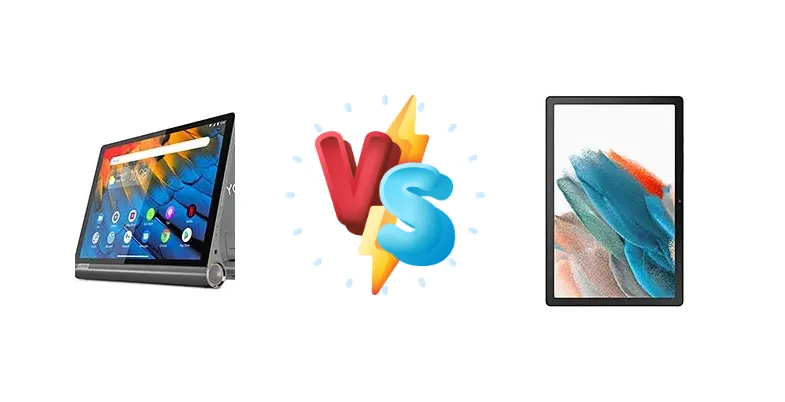
The sub-$200 tablet market is fiercely competitive, and the Lenovo Yoga Smart Tab and Samsung Galaxy Tab A8 10.5 (2021) are two of the leading contenders. While both aim to deliver an affordable Android experience, they take different approaches to performance and features. This comparison dives deep into the specifications to determine which tablet offers the best value for your money.
🏆 Quick Verdict
For most users, the Samsung Galaxy Tab A8 10.5 (2021) emerges as the better choice. Its Unisoc Tiger T618 chipset, featuring Cortex-A75 cores, provides a noticeable performance advantage over the Lenovo Yoga Smart Tab’s Snapdragon 439, making it more responsive for everyday tasks and light multitasking. While the Lenovo offers a unique smart assistant mode, the Samsung’s overall smoother experience justifies the slight price difference.
| Network |
|---|
| 2G bands | N/A | GSM 850 / 900 / 1800 / 1900 |
| 3G bands | N/A | HSDPA 850 / 900 / 1700(AWS) / 1900 / 2100 |
| 4G bands | N/A | 1, 2, 3, 4, 5, 7, 8, 12, 17, 20, 28, 38, 40, 41, 66 |
| EDGE | No | - |
| GPRS | No | - |
| Speed | - | HSPA, LTE - cellular model only |
| Technology | No cellular connectivity | GSM / HSPA / LTE |
| Launch |
|---|
| Announced | 2019, October. Released 2019, October | 2021, December 15 |
| Status | Discontinued | Available. Released 2022, January 17 |
| Body |
|---|
| Dimensions | 242mm x 166mm x 8.5-24mm | 246.8 x 161.9 x 6.9 mm (9.72 x 6.37 x 0.27 in) |
| SIM | No | Nano-SIM (cellular model only) |
| Weight | 580 g (1.28 lb) | 508 g (1.12 lb) |
| | Built-in 3-stage kickstand | - |
| Display |
|---|
| Resolution | 1200 x 1920 pixels, 16:10 ratio (~224 ppi density) | 1200 x 1920 pixels, 16:10 ratio (~216 ppi density) |
| Size | 10.1 inches, 295.8 cm2 (~73.6% screen-to-body ratio) | 10.5 inches, 319.7 cm2 (~80.0% screen-to-body ratio) |
| Type | IPS LCD | TFT LCD |
| Platform |
|---|
| CPU | Octa-core (4x1.95 GHz Cortex-A53 & 4x1.45 GHz Cortex A53) | Octa-core (2x2.0 GHz Cortex-A75 & 6x2.0 GHz Cortex-A55) |
| Chipset | Qualcomm SDM439 Snapdragon 439 (12 nm) | Unisoc Tiger T618 (12 nm) |
| GPU | Adreno 505 | Mali G52 MP2 |
| OS | Android 9.0 (Pie) | Android 11, upgradable to Android 14, One UI 6 |
| Memory |
|---|
| Card slot | microSDXC (dedicated slot) | microSDXC (dedicated slot) |
| Internal | 64GB 4GB RAM | 32GB 2GB RAM, 32GB 3GB RAM, 64GB 2GB RAM, 64GB 3GB RAM, 64GB 4GB RAM, 128GB 3GB RAM, 128GB 4GB RAM |
| | eMMC 5.1 | - |
| Main Camera |
|---|
| Single | 8 MP, AF | 8 MP, AF |
| Video | 1080p@30fps | 1080p@30fps |
| Selfie camera |
|---|
| Single | 5 MP | 5 MP |
| Video | 1080p@30fps | 1080p@30fps |
| Sound |
|---|
| 3.5mm jack | Yes | Yes |
| 35mm jack | Yes | Yes |
| Loudspeaker | Yes, with stereo speakers | Yes, with stereo speakers (4 speakers) |
| Comms |
|---|
| Bluetooth | 4.2, A2DP | 5.0, A2DP, LE |
| NFC | No | No |
| Positioning | No | GPS, GLONASS, BDS, GALILEO, QZSS - cellular model only |
| Radio | No | No |
| USB | USB Type-C 2.0 | USB Type-C 2.0 |
| WLAN | Wi-Fi 802.11 b/g/n/ac, Wi-Fi Direct | Wi-Fi 802.11 a/b/g/n/ac, dual-band, Wi-Fi Direct |
| Features |
|---|
| Sensors | Accelerometer | Accelerometer, gyro, proximity, compass |
| Battery |
|---|
| Charging | 10W wired | 15W wired |
| Type | Li-Po 7000 mAh, non-removable | Li-Po 7040 mAh |
| Misc |
|---|
| Colors | Iron Grey | Gray, Silver, Pink Gold |
| Models | YT-X705X | SM-X200, SM-X205 |
| Price | About 320 EUR | About 230 EUR |
| SAR EU | - | 0.92 W/kg (body) |
Lenovo Yoga Smart Tab
- Integrated stand for hands-free viewing.
- Built-in Google Assistant functionality.
- Potentially longer battery life due to efficient CPU cores (though unconfirmed).
- Slower processor (Snapdragon 439) leads to laggy performance.
- Slower 10W charging.
- Less responsive user experience.
Samsung Galaxy Tab A8 10.5 (2021)
- Faster and more responsive processor (Unisoc Tiger T618).
- Faster 15W charging.
- Smoother multitasking experience.
- More modern CPU architecture.
- Lacks the integrated stand of the Lenovo.
- No dedicated smart assistant features beyond standard Android.
- May have slightly shorter battery life under heavy load.
Display Comparison
Neither tablet boasts a particularly impressive display. Both are likely utilizing IPS LCD panels, common in this price bracket. However, detailed specs like peak brightness and color gamut coverage are unavailable. The focus here isn't on visual fidelity, but usability. Bezels are expected to be relatively thick on both devices, reflecting their budget positioning. The 10.5-inch size is standard for both, prioritizing portability and comfortable viewing over immersive experiences.
Camera Comparison
Camera performance is unlikely to be a deciding factor for either tablet. Both are equipped with basic camera setups geared towards video calls rather than photography. Detailed sensor information is unavailable, but it’s safe to assume both feature modest sensors. Focusing on megapixel counts would be misleading; image quality will be heavily reliant on software processing, and neither device is likely to excel in challenging lighting conditions. The absence of Optical Image Stabilization (OIS) on either device further limits their photographic capabilities.
Performance
The core difference lies in the chipsets. The Samsung Galaxy Tab A8’s Unisoc Tiger T618 utilizes a more modern CPU architecture. Its two Cortex-A75 cores clocked at 2.0 GHz offer significantly better single-core performance than the Snapdragon 439’s four Cortex-A53 cores at 1.95 GHz. While both are octa-core, the A75 cores provide a substantial boost in responsiveness for app launching and general navigation. The Snapdragon 439’s remaining four Cortex-A53 cores, clocked at 1.45 GHz, are geared towards efficiency, but struggle to keep pace with the Unisoc chip under load. This translates to a smoother experience on the Samsung, especially when multitasking. The Tab A8 also benefits from 6x Cortex-A55 cores, which are more efficient than the A53 cores found in the Lenovo.
Battery Life
Battery capacity is not specified for either device, but both are likely in the 6000-7000 mAh range, typical for 10-inch tablets. However, the Samsung Galaxy Tab A8 has a clear advantage in charging speed with its 15W wired charging support, compared to the Lenovo Yoga Smart Tab’s slower 10W charging. This means the Samsung will reach a full charge significantly faster, reducing downtime and increasing usability. While a larger battery capacity is desirable, faster charging can mitigate the impact of a slightly smaller battery.
Buying Guide
Buy the Lenovo Yoga Smart Tab if you prioritize a built-in stand and hands-free Google Assistant functionality for smart home control and media consumption. This makes it ideal for kitchen use or bedside entertainment. Buy the Samsung Galaxy Tab A8 10.5 (2021) if you value a more responsive user experience, smoother multitasking, and faster charging, making it better suited for students, casual gamers, and those who frequently browse the web.
Frequently Asked Questions
❓ Will the Unisoc Tiger T618 in the Galaxy Tab A8 struggle with demanding games?
While the Unisoc Tiger T618 isn't a gaming powerhouse, it's capable of handling most casual Android games at medium settings. Demanding titles like Genshin Impact will likely require significant graphical compromises to maintain playable frame rates. The Snapdragon 439 in the Lenovo Yoga Smart Tab will struggle even more with these games.
❓ How useful is the Lenovo Yoga Smart Tab's built-in stand in real-world scenarios?
The integrated stand is genuinely useful for hands-free video watching, video calls, and following recipes in the kitchen. It provides a stable viewing angle without requiring a separate case or prop. However, the stand's limited adjustability might not be ideal for all viewing positions.
❓ Is the performance difference between the two tablets noticeable for everyday tasks like browsing and email?
Yes, the performance difference is quite noticeable. The Samsung Galaxy Tab A8’s Unisoc Tiger T618 provides a smoother and more responsive experience when browsing the web, checking email, and switching between apps. The Lenovo Yoga Smart Tab’s Snapdragon 439 can feel sluggish, especially with multiple apps open.