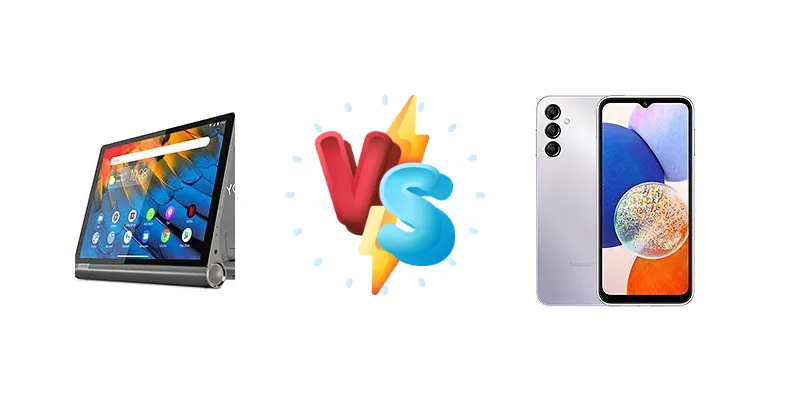
The Lenovo Yoga Smart Tab and Samsung Galaxy A14 5G represent distinct approaches to affordable mobile computing. The Yoga Smart Tab aims to be a versatile tablet with a built-in stand, while the Galaxy A14 5G prioritizes 5G connectivity and smartphone functionality at a low price point. This comparison dissects their key differences to help you determine which device best suits your needs.
🏆 Quick Verdict
For the average user, the Samsung Galaxy A14 5G emerges as the more compelling choice. Its significantly more powerful Exynos 1330 chipset (or Dimensity 700 variant) and 5G capabilities offer a broader range of functionality and future-proofing than the Lenovo Yoga Smart Tab's aging Snapdragon 439. However, the Yoga Tab remains a viable option for those primarily seeking a dedicated media consumption device.
| Network |
|---|
| 2G bands | N/A | GSM 850 / 900 / 1800 / 1900 |
| 3G bands | N/A | HSDPA 850 / 900 / 1700(AWS) / 1900 / 2100 |
| 4G bands | N/A | 1, 2, 3, 4, 5, 7, 8, 12, 17, 20, 26, 28, 38, 40, 41, 66 - International |
| 5G bands | - | 2, 5, 66, 77 Sub6/mmWave - USA |
| EDGE | No | - |
| GPRS | No | - |
| Speed | - | HSPA, LTE, 5G |
| Technology | No cellular connectivity | GSM / HSPA / LTE / 5G |
| | - | 1, 3, 5, 7, 8, 20, 28, 40, 41, 78 SA/NSA/Sub6 - India |
| Launch |
|---|
| Announced | 2019, October. Released 2019, October | 2023, January 04 |
| Status | Discontinued | Available. Released 2023, January 12 |
| Body |
|---|
| Build | - | Glass front, plastic back, plastic frame |
| Dimensions | 242mm x 166mm x 8.5-24mm | 167.7 x 78 x 9.1 mm (6.60 x 3.07 x 0.36 in) |
| SIM | No | · Nano-SIM· Nano-SIM + Nano-SIM |
| Weight | 580 g (1.28 lb) | 202 g (7.13 oz) |
| | Built-in 3-stage kickstand | - |
| Display |
|---|
| Resolution | 1200 x 1920 pixels, 16:10 ratio (~224 ppi density) | 1080 x 2408 pixels, 20:9 ratio (~400 ppi density) |
| Size | 10.1 inches, 295.8 cm2 (~73.6% screen-to-body ratio) | 6.6 inches, 104.9 cm2 (~80.2% screen-to-body ratio) |
| Type | IPS LCD | PLS LCD, 90Hz |
| Platform |
|---|
| CPU | Octa-core (4x1.95 GHz Cortex-A53 & 4x1.45 GHz Cortex A53) | Octa-core (2x2.4 GHz Cortex-A78 & 6x2.0 GHz Cortex-A55) - SM-A146BOcta-core (2x2.2 GHz Cortex-A76 & 6x2.0 GHz Cortex-A55) - SM-A146P |
| Chipset | Qualcomm SDM439 Snapdragon 439 (12 nm) | Exynos 1330 (5 nm) - SM-A146BMediatek Dimensity 700 (7 nm) - SM-A146P |
| GPU | Adreno 505 | Mali-G68 MP2 - SM-A146BMali-G57 MC2 - SM-A146P |
| OS | Android 9.0 (Pie) | Android 13, upgradable to Android 15, One UI Core 7 |
| Memory |
|---|
| Card slot | microSDXC (dedicated slot) | microSDXC (uses shared SIM slot) - USA onlymicroSDXC (dedicated slot) - International |
| Internal | 64GB 4GB RAM | 64GB 4GB RAM, 128GB 4GB RAM, 128GB 6GB RAM, 128GB 8GB RAM |
| | eMMC 5.1 | - |
| Main Camera |
|---|
| Features | - | LED flash, panorama, HDR |
| Single | 8 MP, AF | 13 MP, f/2.0, (wide) |
| Triple | - | 50 MP, f/1.8, 26mm (wide), 1/2.76", 0.64µm, PDAF
2 MP (macro)
Auxiliary lens |
| Video | 1080p@30fps | 1080p@30fps |
| Selfie camera |
|---|
| Single | 5 MP | 13 MP, f/2.0, 26mm (wide), 1.12µm |
| Video | 1080p@30fps | 1080p@30fps |
| Sound |
|---|
| 3.5mm jack | Yes | Yes |
| 35mm jack | Yes | Yes |
| Loudspeaker | Yes, with stereo speakers | Yes |
| Comms |
|---|
| Bluetooth | 4.2, A2DP | 5.2, A2DP, LE |
| NFC | No | Yes |
| Positioning | No | GPS, GLONASS, GALILEO |
| Radio | No | FM radio (Exynos 1330 chipset only), recording |
| USB | USB Type-C 2.0 | USB Type-C 2.0 |
| WLAN | Wi-Fi 802.11 b/g/n/ac, Wi-Fi Direct | Wi-Fi 802.11 a/b/g/n/ac, dual-band, Wi-Fi Direct |
| Features |
|---|
| Sensors | Accelerometer | Fingerprint (side-mounted), accelerometer, gyro, proximity, compass, barometer (USA only) |
| Battery |
|---|
| Charging | 10W wired | 15W wired |
| Type | Li-Po 7000 mAh, non-removable | Li-Po 5000 mAh |
| Misc |
|---|
| Colors | Iron Grey | Black, Light Green, Dark Red, Silver |
| Models | YT-X705X | SM-A146B, SM-A146B/DS, SM-A146P, SM-A146P/DS, SM-A146U, SM-A146U1, SM-A146U1/DS, SM-A146W, SM-A146P/N, SM-A146P/DSN, SM-S146VL, SM-A146M |
| Price | About 320 EUR | $ 77.63 / C$ 151.00 / £ 97.00 / € 159.79 / ₹ 14,990 |
| SAR | - | 1.00 W/kg (head) 1.00 W/kg (body) |
| SAR EU | - | 0.56 W/kg (head) 1.28 W/kg (body) |
| Tests |
|---|
| Battery life | - |
Endurance rating 130h
|
| Camera | - |
Photo / Video |
| Display | - |
Contrast ratio: 1334:1 (nominal) |
| Loudspeaker | - |
-26.8 LUFS (Good)
|
| Performance | - |
AnTuTu: 307886 (v9)
GeekBench: 1727 (v5.1)
GFXBench: 12fps (ES 3.1 onscreen) |
Lenovo Yoga Smart Tab
- Built-in stand for hands-free viewing
- Larger screen size ideal for media consumption
- Potentially lower price point
- Outdated Snapdragon 439 processor
- Limited performance for demanding tasks
- Slower 10W charging
Samsung Galaxy A14 5G
- Powerful Exynos 1330 or Dimensity 700 processor
- 5G connectivity for faster data speeds
- Faster 15W charging
- Smaller screen size compared to the Yoga Tab
- Smartphone form factor may not be ideal for all media consumption
- Potentially higher price point
Display Comparison
The Samsung Galaxy A14 5G boasts a brighter display, measured at 519 nits, compared to the Lenovo Yoga Smart Tab’s unspecified brightness. Both share a 1334:1 contrast ratio, suggesting similar color reproduction quality. However, the A14 5G’s larger screen size and smartphone form factor offer greater portability. The Yoga Smart Tab’s larger screen is beneficial for media, but its lack of mobility is a drawback. The A14 5G’s display is optimized for outdoor visibility due to its higher peak brightness.
Camera Comparison
Both devices feature photo and video capabilities, but details are limited. The Samsung Galaxy A14 5G likely benefits from Samsung’s image processing algorithms, offering potentially better image quality. The Yoga Smart Tab’s camera is likely a basic module intended for video calls rather than serious photography. Without specific sensor details, it’s difficult to make a definitive comparison, but the A14 5G’s smartphone form factor allows for a more sophisticated camera system.
Performance
The performance gap between these devices is substantial. The Samsung Galaxy A14 5G utilizes either the Exynos 1330 (5nm) or the MediaTek Dimensity 700 (7nm), both significantly more advanced than the Lenovo Yoga Smart Tab’s Qualcomm Snapdragon 439 (12nm). The Exynos 1330’s Cortex-A78 cores provide a noticeable performance boost over the Yoga Tab’s Cortex-A53 cores, resulting in smoother multitasking and faster app loading times. The 5nm/7nm process nodes also contribute to better thermal efficiency, reducing the likelihood of performance throttling under sustained load. The A14 5G is the clear winner for users who play mobile games or use demanding applications.
Battery Life
Both devices share an endurance rating of 130 hours, suggesting comparable battery life under similar usage scenarios. However, the Samsung Galaxy A14 5G supports 15W wired charging, while the Lenovo Yoga Smart Tab is limited to 10W. This means the A14 5G can recharge faster, minimizing downtime. While both offer similar endurance, the faster charging speed of the A14 5G provides a practical advantage.
Buying Guide
Buy the Lenovo Yoga Smart Tab if you need a portable media center with a built-in stand for hands-free viewing and don't require 5G connectivity or demanding app performance. Buy the Samsung Galaxy A14 5G if you prioritize a fully-featured smartphone experience with 5G, a more capable processor for everyday tasks and gaming, and a more versatile camera system.
Frequently Asked Questions
❓ Does the Exynos 1330 in the Galaxy A14 5G overheat during prolonged gaming sessions?
The Exynos 1330, built on a 5nm process, is relatively efficient. While it can get warm during extended gaming, it's unlikely to experience significant thermal throttling, offering a more consistent gaming experience than the Snapdragon 439 in the Yoga Smart Tab.
❓ Is the 2MP macro camera on the Galaxy A14 5G actually useful for taking detailed close-up photos?
Generally, 2MP macro cameras on budget phones offer limited detail and image quality. While it can capture close-up shots, don't expect professional-level results. It's more of a novelty feature than a truly useful camera component.
❓ Can the Samsung Galaxy A14 5G handle graphically demanding games like PUBG Mobile at high settings?
The Galaxy A14 5G, depending on the specific variant (Exynos or Dimensity), can run PUBG Mobile at medium to high settings with acceptable frame rates. However, achieving consistently smooth performance at the highest settings may require adjusting graphics options.
❓ Is the Lenovo Yoga Smart Tab's built-in stand durable enough for frequent use?
The durability of the Yoga Smart Tab's stand is a common concern. While generally functional, user reviews suggest it can be prone to wear and tear over time with frequent adjustments. It's important to handle it with care to avoid potential breakage.