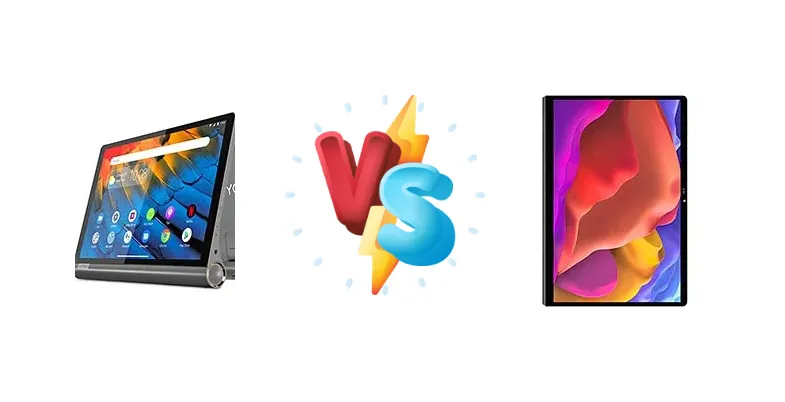
Lenovo's Yoga Tab line offers a unique blend of portability and functionality, but the Smart Tab and Tab 13 cater to vastly different needs. The Smart Tab prioritizes affordability and smart home integration, while the Tab 13 aims for a premium experience with significantly enhanced processing power. This comparison dissects the core differences to determine which tablet best suits your workflow and budget.
🏆 Quick Verdict
For the average user prioritizing everyday tasks like browsing, video streaming, and light productivity, the Lenovo Yoga Smart Tab offers excellent value. However, the Yoga Tab 13, powered by the Snapdragon 870, is the clear winner for demanding users who need robust performance for gaming, multitasking, and creative applications.
| Network |
|---|
| 2G bands | N/A | N/A |
| 3G bands | N/A | N/A |
| 4G bands | N/A | N/A |
| EDGE | No | No |
| GPRS | No | No |
| Technology | No cellular connectivity | No cellular connectivity |
| Launch |
|---|
| Announced | 2019, October. Released 2019, October | 2021, May 24 |
| Status | Discontinued | Available. Released 2021, May 31 |
| Body |
|---|
| Build | - | Glass front, aluminum frame, aluminum back |
| Dimensions | 242mm x 166mm x 8.5-24mm | 293.4 mm x 204 mm x 6.2-24.9 mm |
| SIM | No | No |
| Weight | 580 g (1.28 lb) | 830 g (1.83 lb) |
| | Built-in 3-stage kickstand | Built-in stainless steel kickstand
Stylus support |
| Display |
|---|
| Resolution | 1200 x 1920 pixels, 16:10 ratio (~224 ppi density) | 1350 x 2160 pixels, 16:10 ratio (~196 ppi density) |
| Size | 10.1 inches, 295.8 cm2 (~73.6% screen-to-body ratio) | 13.0 inches, 490.0 cm2 (~56.7% screen-to-body ratio) |
| Type | IPS LCD | IPS LCD, HDR10, Dolby Vision, 400 nits |
| Platform |
|---|
| CPU | Octa-core (4x1.95 GHz Cortex-A53 & 4x1.45 GHz Cortex A53) | Octa-core (1x3.2 GHz Kryo 585 & 3x2.42 GHz Kryo 585 & 4x1.80 GHz Kryo 585) |
| Chipset | Qualcomm SDM439 Snapdragon 439 (12 nm) | Qualcomm SM8250-AC Snapdragon 870 5G (7 nm) |
| GPU | Adreno 505 | Adreno 650 |
| OS | Android 9.0 (Pie) | Android 11, ZUI 12.5 |
| Memory |
|---|
| Card slot | microSDXC (dedicated slot) | No |
| Internal | 64GB 4GB RAM | 256GB 8GB RAM |
| | eMMC 5.1 | UFS 3.0 |
| Main Camera |
|---|
| - | No |
| Single | 8 MP, AF | - |
| Video | 1080p@30fps | - |
| Selfie camera |
|---|
| Single | 5 MP | 8 MP
TOF 3D, (biometrics sensor) |
| Video | 1080p@30fps | 1080p@30fps |
| Sound |
|---|
| 3.5mm jack | Yes | No |
| 35mm jack | Yes | No |
| Loudspeaker | Yes, with stereo speakers | Yes, with stereo speakers (4 speakers) |
| | - | Tuned by JBL |
| Comms |
|---|
| Bluetooth | 4.2, A2DP | 5.2, A2DP, LE |
| NFC | No | No |
| Positioning | No | Unspecified |
| Radio | No | No |
| USB | USB Type-C 2.0 | USB Type-C 3.1, micro HDMI |
| WLAN | Wi-Fi 802.11 b/g/n/ac, Wi-Fi Direct | Wi-Fi 802.11 a/b/g/n/ac/6, dual-band, Wi-Fi Direct |
| Features |
|---|
| Sensors | Accelerometer | Face recognition, accelerometer, gyro, proximity |
| Battery |
|---|
| Charging | 10W wired | - |
| Type | Li-Po 7000 mAh, non-removable | Li-Po 10200 mAh |
| Misc |
|---|
| Colors | Iron Grey | Gray |
| Models | YT-X705X | ZA8E0018CN |
| Price | About 320 EUR | About 800 EUR |
Lenovo Yoga Smart Tab
- Highly affordable price point
- Good battery life for basic tasks
- Integrated Google Assistant for smart home control
- Slow processor struggles with demanding apps
- Slow 10W charging
- Limited multitasking capabilities
Lenovo Yoga Tab 13
- Flagship-level Snapdragon 870 performance
- Smooth multitasking and gaming experience
- Potentially faster charging speeds
- Higher price tag
- Potentially shorter battery life under heavy load
- May require more frequent charging
Display Comparison
While both tablets likely feature IPS LCD panels (specifications not provided), the core difference lies in the processing power driving them. Display quality details like resolution and peak brightness are missing, but the Tab 13’s superior chipset will allow for smoother animations and faster response times, even if the panels themselves are similar. The Smart Tab’s display is adequate for its intended use, but the Tab 13 will provide a more visually fluid experience, especially when paired with high-resolution video content.
Camera Comparison
Camera specifications are not provided for either device. Given the target market, the Smart Tab likely features a basic camera setup suitable for video calls and occasional snapshots. The Tab 13, positioned as a more premium device, may offer a slightly improved camera system, but neither tablet is likely to excel in photography. Without specific sensor details, it’s difficult to make a definitive comparison, but the Tab 13’s more powerful ISP (Image Signal Processor) within the Snapdragon 870 could result in better image processing and low-light performance.
Performance
The performance disparity is stark. The Lenovo Yoga Smart Tab utilizes the Qualcomm Snapdragon 439 (12nm), an entry-level chipset designed for basic tasks. Its octa-core CPU, split between 1.95 GHz and 1.45 GHz Cortex-A53 cores, is sufficient for web browsing and video playback, but will struggle with demanding applications. Conversely, the Yoga Tab 13 boasts the Snapdragon 870 5G (7nm), a flagship-level processor. The 870’s Kryo 585 cores – a 1x3.2 GHz, 3x2.42 GHz, and 4x1.80 GHz configuration – deliver significantly faster processing speeds and improved multitasking capabilities. The 7nm process node also contributes to better thermal efficiency, reducing throttling during sustained workloads. This translates to a dramatically smoother experience for gaming, video editing, and running multiple apps simultaneously.
Battery Life
Battery capacity is not specified for either device. However, the Snapdragon 439 in the Smart Tab is significantly more power-efficient than the Snapdragon 870 in the Tab 13. The Smart Tab’s 10W wired charging is slow by modern standards, suggesting a focus on extending battery life rather than rapid replenishment. The Tab 13, while consuming more power, likely supports faster charging speeds (though not specified), allowing for quicker top-ups. Real-world battery life will depend heavily on usage patterns, but the Smart Tab will likely offer longer runtimes for basic tasks, while the Tab 13 will require more frequent charging with intensive use.
Buying Guide
Buy the Lenovo Yoga Smart Tab if you need a versatile, affordable tablet primarily for media consumption, casual gaming, and smart home control, leveraging its built-in Google Assistant features. Buy the Lenovo Yoga Tab 13 if you prefer a premium tablet experience with significantly faster performance for demanding tasks, extended multitasking, and a more responsive user interface, justifying the higher price point.
Frequently Asked Questions
❓ Will the Snapdragon 439 in the Yoga Smart Tab be sufficient for playing graphically intensive games like Genshin Impact?
No, the Snapdragon 439 is an entry-level chipset and will struggle to run Genshin Impact smoothly, even at the lowest settings. Expect significant frame rate drops and lag. The Yoga Tab 13’s Snapdragon 870 is far better suited for gaming.
❓ Does the Yoga Tab 13 support external displays or accessories for enhanced productivity?
While specific accessory compatibility isn't detailed, the Snapdragon 870 typically supports DisplayPort output via USB-C, allowing connection to external monitors. The Tab 13’s processing power also makes it a better candidate for using a Bluetooth keyboard and mouse for a laptop-like experience.
❓ How does the 10W charging on the Yoga Smart Tab compare to typical tablet charging speeds?
10W charging is relatively slow compared to modern tablets, many of which support 20W or higher. Expect a significantly longer time to fully charge the Yoga Smart Tab, potentially taking several hours from 0% to 100%. The Tab 13 likely supports faster charging, though the exact wattage is unspecified.