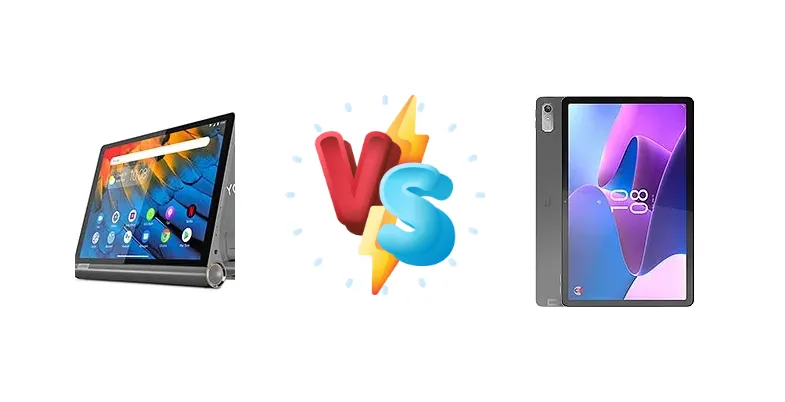
Lenovo offers a diverse tablet lineup, but the Yoga Smart Tab and Tab P11 Pro Gen 2 represent distinct approaches. The Yoga Smart Tab prioritizes affordability and portability, while the P11 Pro Gen 2 aims for a more premium experience with a focus on performance. This comparison dissects the key differences to determine which tablet best suits your needs.
🏆 Quick Verdict
For the average user prioritizing performance and future-proofing, the Lenovo Tab P11 Pro Gen 2 is the clear winner. Its Kompanio 1300T chipset offers a substantial performance leap over the Yoga Smart Tab’s Snapdragon 439, coupled with faster charging. However, the Yoga Smart Tab remains a viable option for basic tasks and budget-conscious buyers.
| Network |
|---|
| 2G bands | N/A | GSM 850 / 900 / 1800 / 1900 |
| 3G bands | N/A | HSDPA 850 / 900 / 1900 / 2100 |
| 4G bands | N/A | LTE |
| EDGE | No | - |
| GPRS | No | - |
| Speed | - | HSPA, LTE - cellular model only |
| Technology | No cellular connectivity | GSM / HSPA / LTE |
| Launch |
|---|
| Announced | 2019, October. Released 2019, October | 2022, September 01 |
| Status | Discontinued | Available. Released 2022, September 01 |
| Body |
|---|
| Build | - | Glass front, plastic back, plastic frame |
| Dimensions | 242mm x 166mm x 8.5-24mm | 263.7 x 166.7 x 6.8 mm (10.38 x 6.56 x 0.27 in) |
| SIM | No | Nano-SIM (cellular model only) |
| Weight | 580 g (1.28 lb) | 480 g (1.06 lb) |
| | Built-in 3-stage kickstand | Stylus support (magnetic) |
| Display |
|---|
| Resolution | 1200 x 1920 pixels, 16:10 ratio (~224 ppi density) | 1536 x 2560 pixels, 5:3 ratio (~267 ppi density) |
| Size | 10.1 inches, 295.8 cm2 (~73.6% screen-to-body ratio) | 11.2 inches, 357.0 cm2 (~81.2% screen-to-body ratio) |
| Type | IPS LCD | OLED, HDR10+, Dolby Vision, 120Hz, 420 nits (typ), 600 nits (peak) |
| Platform |
|---|
| CPU | Octa-core (4x1.95 GHz Cortex-A53 & 4x1.45 GHz Cortex A53) | Octa-core (4x2.6 GHz Cortex-A78 & 4x2.0 GHz Cortex-A55) |
| Chipset | Qualcomm SDM439 Snapdragon 439 (12 nm) | Mediatek MT8797 Kompanio 1300T (6 nm) |
| GPU | Adreno 505 | Mali-G77 MC9 |
| OS | Android 9.0 (Pie) | Android 12, upgradable to Android 13 |
| Memory |
|---|
| Card slot | microSDXC (dedicated slot) | microSDXC (dedicated slot) |
| Internal | 64GB 4GB RAM | 128GB 4GB RAM, 128GB 6GB RAM, 256GB 8GB RAM |
| | eMMC 5.1 | UFS 3.1 |
| Main Camera |
|---|
| Features | - | LED flash |
| Single | 8 MP, AF | 13 MP, f/2.4, (wide), AF |
| Video | 1080p@30fps | 1080p@30fps |
| Selfie camera |
|---|
| Single | 5 MP | 8 MP |
| Video | 1080p@30fps | 1080p@30fps |
| Sound |
|---|
| 3.5mm jack | Yes | No |
| 35mm jack | Yes | No |
| Loudspeaker | Yes, with stereo speakers | Yes, with stereo speakers (4 speakers) |
| | - | Tuned by JBL |
| Comms |
|---|
| Bluetooth | 4.2, A2DP | 5.1, A2DP, LE |
| NFC | No | No |
| Positioning | No | GPS, GLONASS - cellular model only |
| Radio | No | No |
| USB | USB Type-C 2.0 | USB Type-C 3.0, OTG, magnetic connector, video output |
| WLAN | Wi-Fi 802.11 b/g/n/ac, Wi-Fi Direct | Wi-Fi 802.11 a/b/g/n/ac/6, dual-band, Wi-Fi Direct |
| Features |
|---|
| Sensors | Accelerometer | Accelerometer, gyro, proximity, compass |
| Battery |
|---|
| Charging | 10W wired | 20W wired, QC3 |
| Type | Li-Po 7000 mAh, non-removable | Li-Po 8200 mAh |
| Misc |
|---|
| Colors | Iron Grey | Storm Grey, Oat |
| Models | YT-X705X | ZAB50194GB, ZAB50043SE |
| Price | About 320 EUR | About 500 EUR |
| Tests |
|---|
| Performance | - |
AnTuTu: 616573 (v9)
GeekBench: 2827 (v5.1) |
Lenovo Yoga Smart Tab
- Highly affordable price point
- Good portability due to likely smaller size
- Acceptable battery life for basic tasks
- Significantly slower processor
- Slow 10W charging
- Limited multitasking capabilities
Lenovo Tab P11 Pro Gen 2
- Powerful Kompanio 1300T processor
- Fast 20W charging with QC3
- Likely superior display quality
- Higher price compared to Yoga Smart Tab
- Potentially shorter battery life under heavy load
- Larger size may reduce portability
Display Comparison
While display specifications aren't provided, the P11 Pro Gen 2, given its 'Pro' designation and higher price point, likely features a higher resolution and potentially an OLED panel compared to the Yoga Smart Tab’s expected LCD. The Kompanio 1300T’s media capabilities suggest support for higher refresh rates, potentially offering smoother scrolling and animations. Bezels are likely slimmer on the P11 Pro Gen 2, contributing to a more immersive viewing experience. Color accuracy is also expected to be superior on the P11 Pro Gen 2, making it better suited for content consumption and creative tasks.
Camera Comparison
Camera details are limited, but the P11 Pro Gen 2 is expected to have a more capable camera system. While neither tablet is likely to compete with flagship smartphones, the P11 Pro Gen 2 likely benefits from the Kompanio 1300T’s image signal processor (ISP), offering better image quality and processing speeds. The Yoga Smart Tab’s Snapdragon 439 ISP is older and less sophisticated. We anticipate the P11 Pro Gen 2 will offer better low-light performance and more detailed images.
Performance
The performance gap between these tablets is significant. The Lenovo Tab P11 Pro Gen 2’s Mediatek Kompanio 1300T (6nm) utilizes Cortex-A78 cores clocked at 2.6 GHz, a substantial upgrade over the Yoga Smart Tab’s Snapdragon 439 (12nm) with its Cortex-A53 cores peaking at 1.95 GHz. The 6nm process node of the Kompanio 1300T translates to improved power efficiency and reduced thermal throttling during sustained workloads. This means the P11 Pro Gen 2 will handle demanding apps and multitasking with greater ease. The Yoga Smart Tab is adequate for basic tasks, but will struggle with resource-intensive applications.
Battery Life
Battery capacity isn't specified, but the P11 Pro Gen 2’s 20W wired charging with Quick Charge 3 (QC3) support is a major advantage. The Yoga Smart Tab is limited to 10W charging, resulting in significantly longer charge times. While the Yoga Smart Tab might offer comparable battery life due to its less powerful processor, the P11 Pro Gen 2’s faster charging allows for quicker top-ups and less downtime. The efficiency gains from the 6nm process also contribute to better real-world battery performance on the P11 Pro Gen 2.
Buying Guide
Buy the Lenovo Yoga Smart Tab if you need a highly portable, affordable tablet for light tasks like reading, web browsing, and video calls. It’s ideal for users who prioritize battery life over raw power. Buy the Lenovo Tab P11 Pro Gen 2 if you prefer a more responsive experience for multitasking, gaming, and content creation. Its faster processor and quicker charging make it a better investment for power users and those seeking a tablet that will remain relevant for longer.
Frequently Asked Questions
❓ Will the Snapdragon 439 in the Yoga Smart Tab struggle with demanding games like Genshin Impact?
Yes, the Snapdragon 439 is a low-end processor and will likely struggle to run graphically intensive games like Genshin Impact at playable frame rates. You'll likely need to lower graphics settings significantly, and even then, expect stuttering and lag. The P11 Pro Gen 2’s Kompanio 1300T is far better suited for gaming.
❓ Does the Lenovo Tab P11 Pro Gen 2 support stylus input, and is a stylus included?
While the Lenovo Tab P11 Pro Gen 2 is compatible with Lenovo Precision Pen 3 (sold separately), a stylus is not included in the box. This allows users to add a stylus for note-taking and creative tasks, but it's an additional purchase.
❓ How much faster is the charging on the P11 Pro Gen 2 compared to the Yoga Smart Tab in a real-world scenario?
The P11 Pro Gen 2’s 20W charging with QC3 can potentially charge the tablet from 0% to 50% in around 30-45 minutes, while the Yoga Smart Tab’s 10W charging could take over 2 hours to reach the same level. This difference is substantial and significantly reduces downtime.