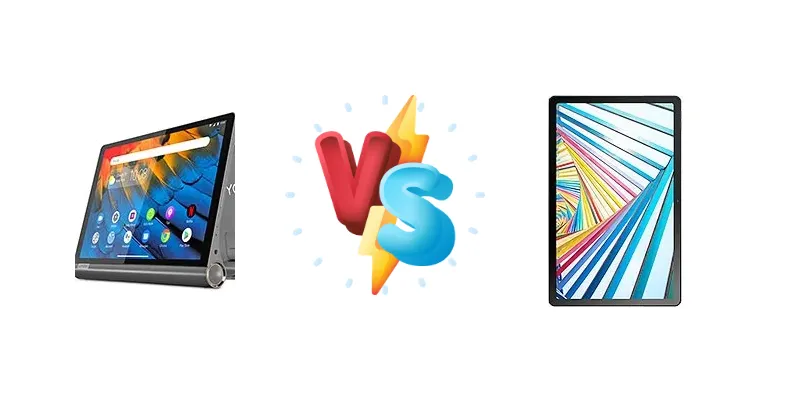
Lenovo offers a compelling range of affordable tablets, and the Yoga Smart Tab and Tab M10 Plus (3rd Gen) represent two popular choices. While both aim to deliver a solid tablet experience without breaking the bank, they diverge significantly in internal hardware, impacting performance and usability. This comparison dives deep into the specifications to determine which tablet offers the best value.
🏆 Quick Verdict
For most users, the Lenovo Tab M10 Plus (3rd Gen) is the superior choice. Its Snapdragon 680 (or Helio G80) chipset, built on a more efficient 6nm process, delivers substantially better performance than the Yoga Smart Tab’s Snapdragon 439. The faster 20W charging is also a significant advantage, offsetting the potentially smaller battery capacity.
| Network |
|---|
| 2G bands | N/A | GSM 850 / 900 / 1800 / 1900 |
| 3G bands | N/A | HSDPA 800 / 850 / 900 / 1900 / 2100 |
| 4G bands | N/A | 1, 2, 3, 4, 5, 7, 8, 19, 20, 26, 28, 28, 38, 40, 41 |
| EDGE | No | - |
| GPRS | No | - |
| Speed | - | HSPA 42.2/5.76 Mbps, LTE Cat13 390/75 Mbps - cellular model only |
| Technology | No cellular connectivity | GSM / HSPA / LTE |
| Launch |
|---|
| Announced | 2019, October. Released 2019, October | 2022, May |
| Status | Discontinued | Available. Released 2022, May |
| Body |
|---|
| Dimensions | 242mm x 166mm x 8.5-24mm | 251.2 x 158.8 x 7.5 mm (9.89 x 6.25 x 0.30 in) |
| SIM | No | Nano-SIM (cellular model only) |
| Weight | 580 g (1.28 lb) | 465 g (1.03 lb) |
| | Built-in 3-stage kickstand | Stylus support |
| Display |
|---|
| Resolution | 1200 x 1920 pixels, 16:10 ratio (~224 ppi density) | 1200 x 2000 pixels, 5:3 ratio (~220 ppi density) |
| Size | 10.1 inches, 295.8 cm2 (~73.6% screen-to-body ratio) | 10.61 inches, 320.4 cm2 (~80.3% screen-to-body ratio) |
| Type | IPS LCD | IPS LCD, 400 nits (typ) |
| Platform |
|---|
| CPU | Octa-core (4x1.95 GHz Cortex-A53 & 4x1.45 GHz Cortex A53) | Octa-core (4x2.4 GHz Kryo 265 Gold & 4x1.9 GHz Kryo 265 Silver) - LTE model Octa-core (2x2.0 GHz Cortex-A75 & 6x1.8 GHz Cortex-A55) - Wi-Fi only model |
| Chipset | Qualcomm SDM439 Snapdragon 439 (12 nm) | Qualcomm SM6225 Snapdragon 680 4G (6 nm) - LTE model Mediatek MT6769V/CU Helio G80 (12 nm) - Wi-Fi only model |
| GPU | Adreno 505 | Adreno 610 - LTE model Mali-G52 MC2 - Wi-Fi only model |
| OS | Android 9.0 (Pie) | Android 12 |
| Memory |
|---|
| Card slot | microSDXC (dedicated slot) | microSDXC (dedicated slot) |
| Internal | 64GB 4GB RAM | 32GB 3GB RAM, 64GB 4GB RAM, 128GB 4GB RAM, 128GB 6GB RAM |
| | eMMC 5.1 | eMCP/uMCP |
| Main Camera |
|---|
| Single | 8 MP, AF | 8 MP, AF |
| Video | 1080p@30fps | 1080p |
| Selfie camera |
|---|
| Single | 5 MP | 8 MP |
| Video | 1080p@30fps | - |
| Sound |
|---|
| 3.5mm jack | Yes | Yes |
| 35mm jack | Yes | Yes |
| Loudspeaker | Yes, with stereo speakers | Yes, with stereo speakers (4 speakers) |
| Comms |
|---|
| Bluetooth | 4.2, A2DP | 5.0, A2DP, LE |
| NFC | No | No |
| Positioning | No | GPS, GLONASS, BDS - cellular model only |
| Radio | No | FM Radio |
| USB | USB Type-C 2.0 | USB Type-C 2.0 |
| WLAN | Wi-Fi 802.11 b/g/n/ac, Wi-Fi Direct | Wi-Fi 802.11 a/b/g/n/ac, dual-band, Wi-Fi Direct |
| Features |
|---|
| Sensors | Accelerometer | Accelerometer, proximity, gyro |
| Battery |
|---|
| Charging | 10W wired | 20W wired |
| Type | Li-Po 7000 mAh, non-removable | Li-Po 7700 mAh |
| Misc |
|---|
| Colors | Iron Grey | Storm Grey, Frost Blue |
| Models | YT-X705X | - |
| Price | About 320 EUR | About 260 EUR |
Lenovo Yoga Smart Tab
- Integrated stand for hands-free viewing
- More affordable price point (likely)
- Lightweight and portable
- Significantly weaker processor
- Slow 10W charging
- Limited multitasking capabilities
Lenovo Tab M10 Plus (3rd Gen)
- Faster and more efficient processor (Snapdragon 680 or Helio G80)
- 20W fast charging
- Better multitasking and gaming performance
- May be slightly more expensive
- No integrated stand (requires separate purchase)
- LTE model adds to cost
Display Comparison
Both tablets likely feature IPS LCD panels, typical for this price range. However, detailed display specs like resolution and brightness are missing. The Yoga Smart Tab’s key feature is its integrated stand, impacting usability more than display quality. The M10 Plus benefits from a more modern chipset capable of driving higher resolution displays if Lenovo chose to implement one. Without specific nit ratings, it’s difficult to assess color accuracy or outdoor visibility, but the newer chipset in the M10 Plus suggests better image processing capabilities.
Camera Comparison
Camera performance is unlikely to be a deciding factor for either tablet. Both are likely equipped with basic camera setups. Given the context data, detailed analysis is limited. The M10 Plus, benefiting from a more powerful ISP within the Snapdragon 680 or Helio G80, may offer slightly better image processing and video recording capabilities, but expectations should remain low. We can assume both will struggle in low-light conditions.
Performance
The performance gap is the most significant differentiator. The Lenovo Tab M10 Plus (3rd Gen) offers two chipset options: the Snapdragon 680 (4G LTE model) built on a 6nm process, and the MediaTek Helio G80 (Wi-Fi only) on a 12nm process. Both are vastly superior to the Yoga Smart Tab’s Snapdragon 439 (12nm). The Snapdragon 680’s Kryo 265 Gold cores, clocked at 2.4 GHz, provide a substantial performance uplift over the Cortex-A53 cores in the SDM439. The 6nm process also translates to improved thermal efficiency, reducing throttling during sustained workloads. The Helio G80, while older, still outperforms the SD439. The M10 Plus will handle multitasking and more demanding apps with greater ease.
Battery Life
The Yoga Smart Tab’s 10W charging is a clear disadvantage compared to the M10 Plus’s 20W charging. While battery capacity isn’t specified, the faster charging speed of the M10 Plus allows for quicker top-ups, mitigating any potential capacity difference. The more efficient Snapdragon 680 (or Helio G80) in the M10 Plus will also contribute to longer battery life during typical usage, despite potentially having a similar or smaller battery capacity.
Buying Guide
Buy the Lenovo Yoga Smart Tab if your primary needs are basic media consumption, light web browsing, and a built-in stand for hands-free viewing. It’s a good option for those prioritizing portability and a simple, no-frills experience. Buy the Lenovo Tab M10 Plus (3rd Gen) if you want a tablet capable of handling more demanding tasks like multitasking, moderate gaming, and smoother video playback. The faster processor and charging make it a more future-proof investment.
Frequently Asked Questions
❓ Will the Snapdragon 680 in the M10 Plus handle demanding games like PUBG Mobile?
The Snapdragon 680 is capable of running PUBG Mobile, but likely at medium settings to maintain a stable frame rate. It’s not a gaming powerhouse, but it offers a significantly better gaming experience than the Snapdragon 439 in the Yoga Smart Tab.
❓ Is the lack of an integrated stand on the M10 Plus a major drawback?
While the Yoga Smart Tab’s integrated stand is convenient, aftermarket tablet stands are readily available and often offer more adjustability. This is a minor inconvenience that is easily remedied with a small additional purchase.
❓ Does the Wi-Fi only version of the M10 Plus offer the same performance as the LTE version?
The Wi-Fi only version uses the MediaTek Helio G80, which is still a capable processor, but slightly less powerful than the Snapdragon 680 found in the LTE model. However, for users who primarily connect to Wi-Fi, the performance difference will likely be minimal.
❓ How much faster is the 20W charging on the M10 Plus compared to the 10W charging on the Yoga Smart Tab?
The 20W charging on the M10 Plus will significantly reduce charging times. While exact 0-100% times are unavailable, you can expect the M10 Plus to charge roughly twice as fast as the Yoga Smart Tab, making it more convenient for users who need to quickly top up their battery.