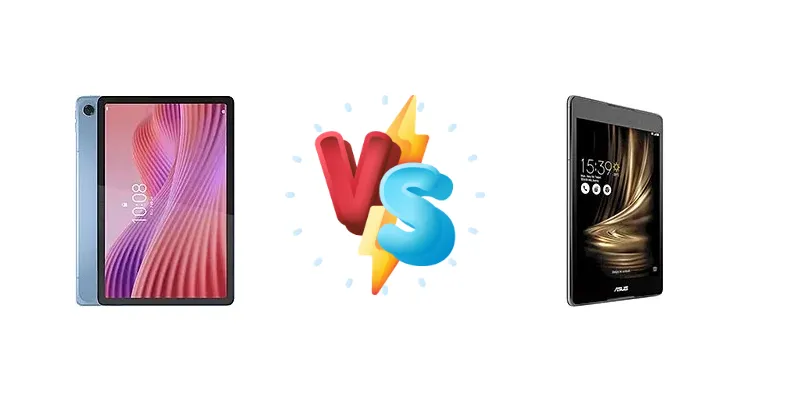
The tablet market offers a wide range of options, but finding the right balance between performance and price can be challenging. We're pitting the Lenovo Tab, powered by the Mediatek Helio G85, against the Asus Zenpad 3s 8.0 Z582KL, featuring the Qualcomm Snapdragon 652. This comparison focuses on how these chipsets translate into real-world usability for everyday tasks and light gaming.
🏆 Quick Verdict
For the average user prioritizing responsiveness and future-proofing, the Lenovo Tab emerges as the better choice. The Helio G85’s newer architecture and more efficient 12nm process provide a noticeable performance edge over the older, 28nm Snapdragon 652, despite the Zenpad’s Cortex-A72 cores.
| Network |
|---|
| 2G bands | GSM 850 / 900 / 1800 / 1900 - cellular model only | GSM 850 / 900 / 1800 / 1900 |
| 3G bands | HSDPA 850 / 900 / 2100 - cellular model only | HSDPA 850 / 900 / 2100 |
| 4G bands | LTE - cellular model only | LTE |
| Speed | HSPA, LTE - cellular model only | HSPA 42.2/5.76 Mbps, LTE (2CA) Cat6 300/50 Mbps |
| Technology | GSM / HSPA / LTE | GSM / HSPA / LTE |
| Launch |
|---|
| Announced | 2025, August 14 | 2017, May. Released 2017, November |
| Status | Available. Released 2025, August 18 | Discontinued |
| Body |
|---|
| Build | Glass front, plastic frame, plastic back | - |
| Dimensions | 235.7 x 154.5 x 7.5 mm (9.28 x 6.08 x 0.30 in) | 6.9 mm thickness |
| SIM | Nano-SIM (cellular model only) | Micro-SIM |
| Weight | 425 g (14.99 oz) | - |
| Display |
|---|
| Resolution | 1200 x 1920 pixels, 16:10 ratio (~224 ppi density) | 1536 x 2048 pixels, 4:3 ratio (~324 ppi density) |
| Size | 10.1 inches, 295.8 cm2 (~81.2% screen-to-body ratio) | 7.9 inches, 193.3 cm2 |
| Type | IPS LCD, 400 nits (typ) | IPS LCD |
| Platform |
|---|
| CPU | Octa-core (2x2.0 GHz Cortex-A75 & 6x1.8 GHz Cortex-A55) | Octa-core (4x1.8 GHz Cortex-A72 & 4x1.4 GHz Cortex-A53) |
| Chipset | Mediatek Helio G85 (12 nm) | Qualcomm MSM8976 Snapdragon 652 (28 nm) |
| GPU | Mali-G52 MC2 | Adreno 510 |
| OS | Android 14 | Android 7.1 (Nougat) |
| Memory |
|---|
| Card slot | microSDXC (dedicated slot) | microSDXC (dedicated slot) |
| Internal | 64GB 4GB RAM, 128GB 4GB RAM | 32GB 3GB RAM, 64GB 4GB RAM |
| | - | eMMC 5.1 |
| Main Camera |
|---|
| Single | 8 MP, AF | 13 MP, f/2.0, AF |
| Video | 1080p | 1080p@30fps |
| Selfie camera |
|---|
| Single | 5 MP | 5 MP |
| Video | 720p | - |
| Sound |
|---|
| 3.5mm jack | - | Yes |
| 35mm jack | Yes | Yes |
| Loudspeaker | Yes, with stereo speakers (with Dolby Atmos) | Yes, with stereo speakers |
| | - | 24-bit/192kHz audio |
| Comms |
|---|
| Bluetooth | 5.3, A2DP, LE | 4.1, A2DP, LE, aptX |
| NFC | No | No |
| Positioning | GPS, GLONASS, GALILEO, BDS - cellular model only | GPS, GLONASS |
| Radio | FM radio | No |
| USB | USB Type-C 2.0 | USB Type-C |
| WLAN | Wi-Fi 802.11 a/b/g/n/ac, dual-band, Wi-Fi Direct | Wi-Fi 802.11 a/b/g/n/ac, dual-band, Wi-Fi Direct |
| Features |
|---|
| Sensors | Accelerometer, proximity (accessories only) | Accelerometer, gyro, proximity, compass |
| Battery |
|---|
| Charging | 15W wired | - |
| Type | Li-Ion 5100 mAh | Li-Ion 4680 mAh, non-removable (18 Wh) |
| Misc |
|---|
| Colors | Polar Blue, Luna Grey | Black |
| Models | ZAEH0019IN, ZAEH0180IN, ZAEJ0054IN | - |
| Price | About 110 EUR | About 250 EUR |
Lenovo Tab
- More modern and efficient processor (Helio G85)
- Likely better battery life due to the 12nm process
- Potentially improved software support and updates
- Charging speed is limited to 15W
- Display specifications are unknown
Asus Zenpad 3s 8.0 Z582KL
- Potentially lower price point
- Compact 8-inch form factor
- Established brand reputation (Asus)
- Older and less efficient processor (Snapdragon 652)
- Likely shorter battery life
- Outdated software and potentially limited updates
Display Comparison
Neither device's display specifications are provided, so a direct comparison is limited. However, given the Zenpad 3s 8.0's age, it likely utilizes an IPS LCD panel with a standard 60Hz refresh rate. The Lenovo Tab, being a more recent release, *may* benefit from improved color accuracy and potentially a higher peak brightness, though this is speculative. Bezels are likely to be more substantial on the Zenpad due to its older design.
Camera Comparison
Without specific camera specs, a detailed comparison is impossible. However, given the age and market segment of the Zenpad 3s 8.0, its camera system is likely to be less sophisticated than what's found in modern tablets. The Lenovo Tab, while not a camera-focused device, likely benefits from newer image processing algorithms and potentially larger sensor sizes, resulting in better image quality in various lighting conditions. We can assume both devices will have a primary camera and a front-facing camera for video calls.
Performance
The core difference lies in the chipsets. The Lenovo Tab’s Mediatek Helio G85 (12nm) utilizes an octa-core configuration with 2x2.0 GHz Cortex-A75 and 6x1.8 GHz Cortex-A55 cores. This architecture is significantly newer than the Asus Zenpad 3s 8.0’s Qualcomm Snapdragon 652 (28nm), which features 4x1.8 GHz Cortex-A72 and 4x1.4 GHz Cortex-A53 cores. The 12nm process of the Helio G85 offers superior power efficiency, leading to less thermal throttling during sustained workloads. While the Zenpad’s Cortex-A72 cores are individually faster than the G85’s A75 cores, the G85’s overall architecture and core count provide a more balanced and responsive experience. The older 28nm process of the Snapdragon 652 will result in higher power consumption and potentially noticeable heat buildup.
Battery Life
The Lenovo Tab features 15W wired charging. The Asus Zenpad 3s 8.0’s charging speed is unknown, but likely falls in the same range. The Helio G85’s power efficiency gives the Lenovo Tab an advantage in battery life, meaning it can potentially operate for longer on a single charge despite potentially having a similar battery capacity to the Zenpad. The Snapdragon 652’s 28nm process will consume more power, leading to shorter battery life and potentially longer charging times.
Buying Guide
Buy the Lenovo Tab if you need a tablet that feels snappy for everyday tasks like browsing, video streaming, and social media, and you anticipate using it for a few years. Buy the Asus Zenpad 3s 8.0 Z582KL if you prioritize a potentially lower price point and are primarily focused on very basic tablet functions, understanding that performance will feel dated compared to newer devices.
Frequently Asked Questions
❓ Will the Snapdragon 652 in the Asus Zenpad 3s 8.0 struggle with multitasking?
Yes, the Snapdragon 652, while capable for basic tasks, will likely exhibit noticeable slowdowns when multitasking with several apps open simultaneously. The older architecture and limited RAM (spec not provided, but likely lower than modern tablets) will hinder its ability to efficiently manage multiple processes.
❓ Is the Mediatek Helio G85 in the Lenovo Tab powerful enough for casual gaming?
The Helio G85 is well-suited for casual gaming and can handle many popular mobile titles at medium settings. While it won't deliver flagship-level performance, it provides a smooth and enjoyable gaming experience for less demanding games.
❓ How will the older manufacturing process of the Snapdragon 652 affect long-term performance?
The 28nm process of the Snapdragon 652 generates more heat than the 12nm process of the Helio G85. Over time, this can lead to thermal throttling, where the processor reduces its clock speed to prevent overheating, resulting in sustained performance degradation.