
Lenovo Tab vs. Apple iPad Pro 13 (2025): A Deep Dive into Tablet Performance and Value
| Phones Images | |||||
|---|---|---|---|---|---|
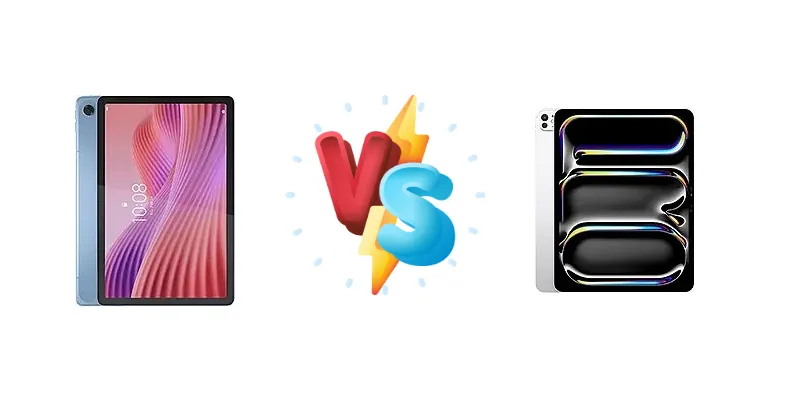
|
🏆 Quick Verdict
For the average user prioritizing affordability and casual tasks, the Lenovo Tab offers a functional experience. However, the iPad Pro 13 (2025) is the clear winner for power users, creative professionals, and anyone valuing long-term performance and battery longevity thanks to the Apple M5 chip and exceptional 76-hour endurance.
| PHONES | ||
|---|---|---|
| Phone Names | Lenovo Tab | Apple iPad Pro 13 (2025) |
| Network | ||
|---|---|---|
| 2G bands | GSM 850 / 900 / 1800 / 1900 - cellular model only | GSM 850 / 900 / 1800 / 1900 - cellular model only |
| 3G bands | HSDPA 850 / 900 / 2100 - cellular model only | HSDPA 850 / 900 / 1700(AWS) / 1900 / 2100 - cellular model only |
| 4G bands | LTE - cellular model only | 1, 2, 3, 4, 5, 7, 8, 11, 12, 13, 14, 17, 18, 19, 20, 21, 25, 26, 28, 29, 30, 32, 34, 38, 39, 40, 41, 42, 48, 66, 71 - A3361 - cellular model only |
| 5G bands | - | 1, 2, 3, 5, 7, 8, 12, 14, 20, 25, 26, 28, 29, 30, 38, 40, 41, 48, 66, 70, 71, 75, 77, 78, 79 SA/NSA/Sub6 - A3361, A3362 - cellular model only |
| Speed | HSPA, LTE - cellular model only | HSPA, LTE, 5G - cellular model only |
| Technology | GSM / HSPA / LTE | GSM / HSPA / LTE / 5G |
| Launch | ||
|---|---|---|
| Announced | 2025, August 14 | 2025, October 16 |
| Status | Available. Released 2025, August 18 | Available. Released 2025, October 22 |
| Body | ||
|---|---|---|
| Build | Glass front, plastic frame, plastic back | Glass front, aluminum back, aluminum frame |
| Dimensions | 235.7 x 154.5 x 7.5 mm (9.28 x 6.08 x 0.30 in) | 281.6 x 215.5 x 5.1 mm (11.09 x 8.48 x 0.20 in) |
| SIM | Nano-SIM (cellular model only) | eSIM - cellular model only |
| Weight | 425 g (14.99 oz) | 579 g (Wi-Fi), 582 g (5G) (1.28 lb) |
| Display | ||
|---|---|---|
| Protection | - | Scratch-resistant glass, oleophobic coating, Mohs level 4 |
| Resolution | 1200 x 1920 pixels, 16:10 ratio (~224 ppi density) | 2064 x 2752 pixels, 4:3 ratio (~265 ppi density) |
| Size | 10.1 inches, 295.8 cm2 (~81.2% screen-to-body ratio) | 13.0 inches, 523.4 cm2 (~86.2% screen-to-body ratio) |
| Type | IPS LCD, 400 nits (typ) | Ultra Retina Tandem OLED, 120Hz, HDR10, Dolby Vision, 1000 nits (HBM), 1600 nits (peak) |
| Platform | ||
|---|---|---|
| CPU | Octa-core (2x2.0 GHz Cortex-A75 & 6x1.8 GHz Cortex-A55) | 9-core (3 performance cores, 6 efficiency cores) - 256/512GB models10-core (4 performance cores, 6 efficiency cores) - 1/2TB models |
| Chipset | Mediatek Helio G85 (12 nm) | Apple M5 |
| GPU | Mali-G52 MC2 | Apple GPU (10-core graphics) |
| OS | Android 14 | iPadOS 26, upgradable to iPadOS 26.1 |
| Memory | ||
|---|---|---|
| Card slot | microSDXC (dedicated slot) | No |
| Internal | 64GB 4GB RAM, 128GB 4GB RAM | 256GB 12GB RAM, 512GB 12GB RAM, 1TB 16GB RAM, 2TB 16GB RAM |
| Main Camera | ||
|---|---|---|
| Features | - | Quad-LED dual-tone flash, HDR |
| Single | 8 MP, AF | 12 MP, f/1.8, (wide), dual pixel PDAF TOF 3D LiDAR scanner (depth) |
| Video | 1080p | 4K@24/25/30/60fps, 1080p@25/30/60/120/240fps; gyro-EIS, ProRes (4K, 1080p) |
| Selfie camera | ||
|---|---|---|
| Features | - | Face detection, HDR, panorama |
| Single | 5 MP | 12 MP, f/2.0, 122˚ (ultrawide) |
| Video | 720p | 1080p@25/30/60fps, gyro-EIS, HDR |
| Sound | ||
|---|---|---|
| 35mm jack | Yes | No |
| Loudspeaker | Yes, with stereo speakers (with Dolby Atmos) | Yes, with stereo speakers (4 speakers) |
| Comms | ||
|---|---|---|
| Bluetooth | 5.3, A2DP, LE | 6.0, A2DP, LE, EDR |
| NFC | No | No |
| Positioning | GPS, GLONASS, GALILEO, BDS - cellular model only | GPS, GLONASS, GALILEO, QZSS (Wi‑Fi + Cellular model only) |
| Radio | FM radio | No |
| USB | USB Type-C 2.0 | USB Type-C 4 (Thunderbolt 3), DisplayPort, magnetic connector |
| WLAN | Wi-Fi 802.11 a/b/g/n/ac, dual-band, Wi-Fi Direct | Wi-Fi 802.11 a/b/g/n/ac/6e/7, dual-band, hotspot |
| Features | ||
|---|---|---|
| Sensors | Accelerometer, proximity (accessories only) | Face ID, accelerometer, gyro, compass, barometer |
| Battery | ||
|---|---|---|
| Charging | 15W wired | 50% in 30 min |
| Type | Li-Ion 5100 mAh | Li-Po 10290 mAh |
| Misc | ||
|---|---|---|
| Colors | Polar Blue, Luna Grey | Silver, Space Black |
| Models | ZAEH0019IN, ZAEH0180IN, ZAEJ0054IN | A3360, A3361, A3362 |
| Price | About 110 EUR | About 1450 EUR |
| EU LABEL | ||
|---|---|---|
| Battery | - | 76:00h endurance, 1000 cycles |
| Energy | - | Class G |
| Free fall | - | Class E (40 falls) |
| Repairability | - | Class C |
Lenovo Tab
- Significantly more affordable
- Portable and lightweight
- Suitable for basic tasks
- Limited performance
- Slow charging
- Likely lower quality display
Apple iPad Pro 13 (2025)
- Exceptional performance with Apple M5
- Long battery life and 1000 charge cycles
- Fast charging (50% in 30 min)
- Significantly higher price
- May be overkill for basic users
- Premium price point
Display Comparison
Display specifications are absent for the Lenovo Tab, but given its market positioning, we can expect a standard LCD panel. The iPad Pro 13 (2025) likely features a Mini-LED display with ProMotion (adaptive refresh rate) technology, offering superior brightness, contrast, and color accuracy. The absence of LTPO information for the iPad Pro suggests a potential refinement of existing ProMotion technology, focusing on efficiency. Bezels on the Lenovo Tab will likely be more pronounced, impacting immersion compared to the iPad Pro’s slimmer design.
Camera Comparison
Camera details for the Lenovo Tab are unavailable, suggesting a focus on functionality rather than photographic excellence. The iPad Pro 13 (2025) is expected to feature a significantly more advanced camera system, potentially including a larger sensor and improved image processing capabilities. While tablets aren’t typically primary cameras, the iPad Pro’s superior hardware will result in better image quality in various lighting conditions. The absence of details on the Lenovo Tab suggests it will likely feature basic sensors suitable for video calls and casual snapshots.
Performance
The Lenovo Tab’s Mediatek Helio G85 (12 nm) chipset, while capable for everyday tasks, is significantly outmatched by the Apple M5 in the iPad Pro 13 (2025). The M5’s 9-core (or 10-core in higher storage models) CPU architecture, built on a more advanced process node (likely 3nm or 4nm), delivers substantially higher single-core and multi-core performance. This translates to faster app loading times, smoother multitasking, and the ability to handle demanding applications without slowdown. The iPad Pro’s LPDDR5X RAM further enhances performance, while the Lenovo Tab’s RAM specification is unknown, likely being lower capacity and slower. The M5’s integrated GPU will also provide a far superior graphics experience.
Battery Life
The Lenovo Tab’s 15W wired charging is slow compared to the iPad Pro 13 (2025)’s ability to reach 50% charge in just 30 minutes. More importantly, the iPad Pro boasts a remarkable 76-hour endurance and a 1000-cycle battery lifespan, indicating exceptional longevity and reduced battery degradation over time. While the Lenovo Tab’s battery capacity is unknown, its slower charging speed and lack of cycle count information suggest a less robust battery solution. The M5’s power efficiency further contributes to the iPad Pro’s extended battery life.
Buying Guide
Buy the Lenovo Tab if you need a portable tablet for basic media consumption, light web browsing, and occasional productivity tasks, and are constrained by a tight budget. Buy the Apple iPad Pro 13 (2025) if you prioritize professional-grade performance for demanding applications like video editing, graphic design, or 3D rendering, and value a premium user experience with exceptional battery life and fast charging.