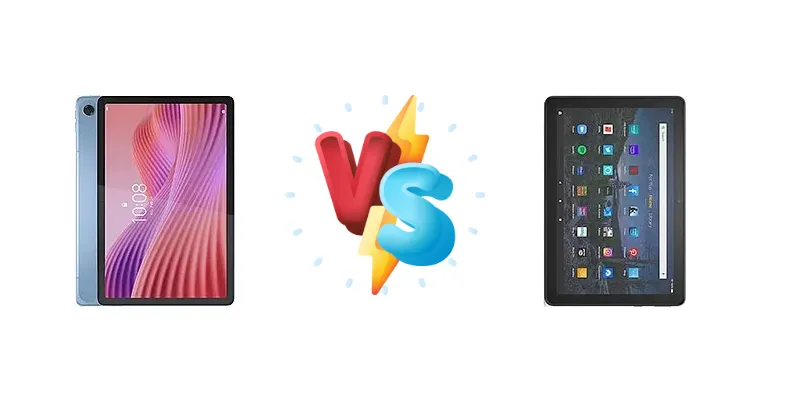
The budget tablet market is fiercely competitive, and the Lenovo Tab and Amazon Fire HD 10 Plus (2021) represent two compelling options. While both aim to deliver affordable entertainment and productivity, they take distinctly different approaches. The Lenovo Tab offers a more standard Android experience with a focus on performance, while the Fire HD 10 Plus prioritizes Amazon’s ecosystem and convenience features. This comparison dives deep into the hardware and software differences to determine which tablet best suits your needs.
🏆 Quick Verdict
For users prioritizing raw performance and a flexible Android experience, the Lenovo Tab emerges as the better choice. Its Mediatek Helio G85 chipset, featuring Cortex-A75 cores, provides a noticeable edge in responsiveness and gaming. However, the Fire HD 10 Plus’s wireless charging and deep Amazon integration make it ideal for existing Amazon Prime subscribers.
| Network |
|---|
| 2G bands | GSM 850 / 900 / 1800 / 1900 - cellular model only | N/A |
| 3G bands | HSDPA 850 / 900 / 2100 - cellular model only | - |
| 4G bands | LTE - cellular model only | - |
| EDGE | - | No |
| GPRS | - | No |
| Speed | HSPA, LTE - cellular model only | - |
| Technology | GSM / HSPA / LTE | No cellular connectivity |
| Launch |
|---|
| Announced | 2025, August 14 | 2021, April 27. Released 2021, May 26 |
| Status | Available. Released 2025, August 18 | Discontinued |
| Body |
|---|
| Build | Glass front, plastic frame, plastic back | - |
| Dimensions | 235.7 x 154.5 x 7.5 mm (9.28 x 6.08 x 0.30 in) | 247 x 166 x 9.2 mm (9.72 x 6.54 x 0.36 in) |
| SIM | Nano-SIM (cellular model only) | No |
| Weight | 425 g (14.99 oz) | 468 g (1.03 lb) |
| Display |
|---|
| Protection | - | Aluminosilicate glass |
| Resolution | 1200 x 1920 pixels, 16:10 ratio (~224 ppi density) | 1920 x 1200 pixels, 16:10 ratio (~224 ppi density) |
| Size | 10.1 inches, 295.8 cm2 (~81.2% screen-to-body ratio) | 10.1 inches, 295.8 cm2 (~72.1% screen-to-body ratio) |
| Type | IPS LCD, 400 nits (typ) | IPS LCD |
| Platform |
|---|
| CPU | Octa-core (2x2.0 GHz Cortex-A75 & 6x1.8 GHz Cortex-A55) | Octa-core (4x2.0 GHz Cortex-A73 & 4x2.0 GHz Cortex-A53) |
| Chipset | Mediatek Helio G85 (12 nm) | Mediatek MT8183 Helio P60T (12 nm) |
| GPU | Mali-G52 MC2 | Mali-G72 MP3 |
| OS | Android 14 | Android 9.0 (Pie), Fire OS 7 |
| Memory |
|---|
| Card slot | microSDXC (dedicated slot) | microSDXC (dedicated slot) |
| Internal | 64GB 4GB RAM, 128GB 4GB RAM | 32GB 4GB RAM, 64GB 4GB RAM |
| | - | eMMC 5.1 |
| Main Camera |
|---|
| Single | 8 MP, AF | 5 MP |
| Video | 1080p | 720p |
| Selfie camera |
|---|
| Single | 5 MP | 2 MP |
| Video | 720p | 720p |
| Sound |
|---|
| 3.5mm jack | - | Yes |
| 35mm jack | Yes | Yes |
| Loudspeaker | Yes, with stereo speakers (with Dolby Atmos) | Yes, with stereo speakers |
| Comms |
|---|
| Bluetooth | 5.3, A2DP, LE | 5.0, A2DP, LE |
| NFC | No | No |
| Positioning | GPS, GLONASS, GALILEO, BDS - cellular model only | No |
| Radio | FM radio | No |
| USB | USB Type-C 2.0 | USB Type-C 2.0, OTG |
| WLAN | Wi-Fi 802.11 a/b/g/n/ac, dual-band, Wi-Fi Direct | Wi-Fi 802.11 a/b/g/n/ac, dual-band |
| Features |
|---|
| Sensors | Accelerometer, proximity (accessories only) | Accelerometer |
| | - | Text-to-Speech English-language content reader |
| Battery |
|---|
| Charging | 15W wired | Wireless |
| Type | Li-Ion 5100 mAh | Li-Ion |
| Misc |
|---|
| Colors | Polar Blue, Luna Grey | Slate |
| Models | ZAEH0019IN, ZAEH0180IN, ZAEJ0054IN | T76N2P |
| Price | About 110 EUR | About 150 EUR |
Lenovo Tab
- More powerful processor (Helio G85)
- Standard Android experience with Google Play Store access
- Greater customization options
- No wireless charging
- Potentially less optimized for Amazon content
Amazon Fire HD 10 Plus (2021)
- Wireless charging for added convenience
- Deep integration with Amazon’s ecosystem (Prime Video, Kindle)
- Hands-free Alexa access
- Less powerful processor (Helio P60T)
- Amazon’s Fire OS is a heavily customized Android experience
Display Comparison
Both tablets utilize 12nm chipsets, suggesting similar power efficiency constraints impacting display capabilities. While specific display specs (resolution, brightness) are missing, the core difference lies in the user experience. The Fire HD 10 Plus’s software leans heavily into Amazon’s content, potentially optimizing display settings for video. The Lenovo Tab, running a more standard Android build, allows for greater user control over color calibration and brightness. Bezels are likely comparable given the price points, and neither device is expected to feature high-end panel technology like LTPO.
Camera Comparison
Given the budget nature of both devices, camera performance isn’t a primary focus. Detailed camera specs are unavailable, but it’s safe to assume both tablets feature modest camera setups suitable for basic video calls and casual snapshots. The absence of information suggests neither device will excel in low-light conditions or offer advanced photography features. Focusing on camera quality for either tablet would be a misallocation of expectations.
Performance
The Lenovo Tab’s Mediatek Helio G85 chipset is the key performance differentiator. Its octa-core configuration, featuring two 2.0 GHz Cortex-A75 cores and six 1.8 GHz Cortex-A55 cores, provides a more powerful CPU cluster than the Amazon Fire HD 10 Plus’s Mediatek MT8183 Helio P60T. The P60T utilizes four 2.0 GHz Cortex-A73 cores and four 2.0 GHz Cortex-A53 cores. The A75 cores in the G85 offer a significant architectural improvement over the A73, resulting in faster single-core and multi-core performance. This translates to snappier app launches, smoother multitasking, and a better gaming experience on the Lenovo Tab. While both use 12nm fabrication, the core architecture gives Lenovo the edge.
Battery Life
Battery capacity details are missing for both devices. However, the Amazon Fire HD 10 Plus gains a significant advantage with its support for wireless charging. This adds convenience for users who prefer to top up their device without cables. The Lenovo Tab relies solely on 15W wired charging. While 15W isn’t slow, the lack of wireless charging is a notable omission. Real-world battery life will depend heavily on usage patterns, but the Fire HD 10 Plus’s wireless charging capability provides a flexibility the Lenovo Tab lacks.
Buying Guide
Buy the Lenovo Tab if you need a versatile tablet for everyday tasks, light gaming, and accessing a wide range of Android apps without ecosystem lock-in. It’s a solid choice for students or anyone who wants a more open and customizable experience. Buy the Amazon Fire HD 10 Plus (2021) if you are heavily invested in the Amazon ecosystem – Prime Video, Kindle, Audible – and value the convenience of wireless charging and hands-free Alexa integration. It’s best suited for media consumption and casual browsing.
Frequently Asked Questions
❓ Will the Lenovo Tab run demanding games like Genshin Impact smoothly?
While the Helio G85 is capable, Genshin Impact will likely require reduced graphics settings for a playable experience. The G85 is better suited for less demanding titles or older games. Expect some frame drops during intense scenes.
❓ Can I easily sideload apps onto the Amazon Fire HD 10 Plus?
Sideloading apps onto the Fire HD 10 Plus is possible, but it requires enabling developer mode and using third-party app stores like APKPure. It's not as straightforward as installing apps from the Google Play Store on the Lenovo Tab and carries some security risks.
❓ How much storage is expandable on each device?
While specific storage expansion limits aren't provided, both tablets typically support microSD card expansion. The Lenovo Tab is more likely to support larger capacity cards due to its more open Android build. The Fire HD 10 Plus may have limitations imposed by Amazon’s software.
❓ Is the Amazon Fire HD 10 Plus heavily filled with bloatware?
Yes, the Fire HD 10 Plus comes pre-loaded with a significant amount of Amazon apps and services. While some users may find these useful, others may consider them bloatware. Uninstalling these apps is limited, and they often reappear after updates.