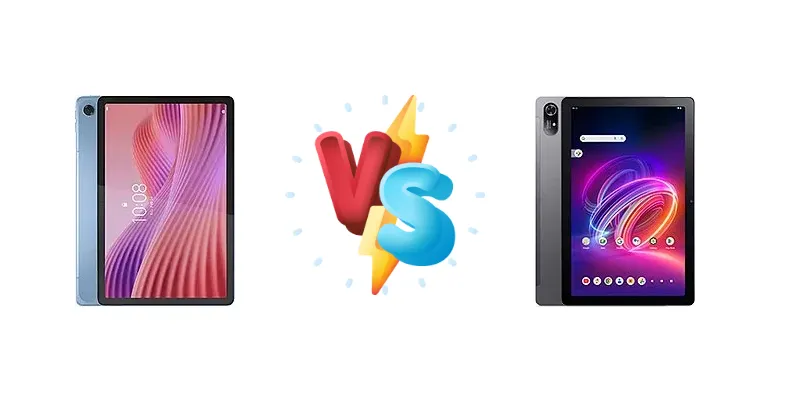
The Android tablet market continues to evolve, offering options for every user. We pit the Acer Iconia Tab P11 (2025), a newer contender, against the established Lenovo Tab to determine which provides the best balance of performance, features, and value. This comparison focuses on the core hardware differences and their impact on real-world usage.
🏆 Quick Verdict
For users prioritizing performance and future-proofing, the Acer Iconia Tab P11 (2025) is the clear winner thanks to its more efficient Helio G99 chipset. However, the Lenovo Tab remains a compelling choice for basic media consumption and light tasks, especially if budget is a primary concern.
| Network |
|---|
| 2G bands | GSM 850 / 900 / 1800 / 1900 - cellular model only | N/A |
| 3G bands | HSDPA 850 / 900 / 2100 - cellular model only | N/A |
| 4G bands | LTE - cellular model only | N/A |
| EDGE | - | No |
| GPRS | - | No |
| Speed | HSPA, LTE - cellular model only | - |
| Technology | GSM / HSPA / LTE | No cellular connectivity |
| Launch |
|---|
| Announced | 2025, August 14 | 2025, Q4 |
| Status | Available. Released 2025, August 18 | Available. Released 2025, Q4 |
| Body |
|---|
| Build | Glass front, plastic frame, plastic back | Glass front, aluminum alloy frame |
| Dimensions | 235.7 x 154.5 x 7.5 mm (9.28 x 6.08 x 0.30 in) | 265.2 x 169.9 x 8.1 mm (10.44 x 6.69 x 0.32 in) |
| SIM | Nano-SIM (cellular model only) | No |
| Weight | 425 g (14.99 oz) | 550 g (1.21 lb) |
| Display |
|---|
| Resolution | 1200 x 1920 pixels, 16:10 ratio (~224 ppi density) | 1200 x 2000 pixels, 5:3 ratio (~212 ppi density) |
| Size | 10.1 inches, 295.8 cm2 (~81.2% screen-to-body ratio) | 11.0 inches, 344.4 cm2 (~76.4% screen-to-body ratio) |
| Type | IPS LCD, 400 nits (typ) | IPS LCD, 90Hz |
| Platform |
|---|
| CPU | Octa-core (2x2.0 GHz Cortex-A75 & 6x1.8 GHz Cortex-A55) | Octa-core (2x2.2 GHz Cortex-A76 & 6x2.0 GHz Cortex-A55) |
| Chipset | Mediatek Helio G85 (12 nm) | Mediatek Helio G99 (6 nm) |
| GPU | Mali-G52 MC2 | Mali-G57 MC2 |
| OS | Android 14 | Android 14 |
| Memory |
|---|
| Card slot | microSDXC (dedicated slot) | microSDXC (dedicated slot) |
| Internal | 64GB 4GB RAM, 128GB 4GB RAM | 256GB 6GB RAM, 256GB 8GB RAM |
| Main Camera |
|---|
| Features | - | LED flash |
| Single | 8 MP, AF | 13 MP, AF |
| Video | 1080p | 1080p@30fps |
| Selfie camera |
|---|
| Single | 5 MP | 5 MP |
| Video | 720p | Yes |
| Sound |
|---|
| 35mm jack | Yes | Yes |
| Loudspeaker | Yes, with stereo speakers (with Dolby Atmos) | Yes, with stereo speakers (4 speakers) |
| Comms |
|---|
| Bluetooth | 5.3, A2DP, LE | Yes |
| NFC | No | No |
| Positioning | GPS, GLONASS, GALILEO, BDS - cellular model only | Unspecified |
| Radio | FM radio | No |
| USB | USB Type-C 2.0 | USB Type-C 2.0 |
| WLAN | Wi-Fi 802.11 a/b/g/n/ac, dual-band, Wi-Fi Direct | Wi-Fi 802.11 a/b/g/n/ac, dual-band |
| Features |
|---|
| Sensors | Accelerometer, proximity (accessories only) | Unspecified |
| Battery |
|---|
| Charging | 15W wired | 20W wired |
| Type | Li-Ion 5100 mAh | 8000 mAh |
| Misc |
|---|
| Colors | Polar Blue, Luna Grey | Iron Gray |
| Models | ZAEH0019IN, ZAEH0180IN, ZAEJ0054IN | P11-11-8113 |
| Price | About 110 EUR | About 260 EUR |
Lenovo Tab
- More affordable price point.
- Sufficient for basic tasks like browsing and streaming.
- Established brand reputation.
- Older, less efficient chipset.
- Slower charging speed.
- Potentially lower performance in demanding applications.
Acer Iconia Tab P11 (2025)
- More powerful and efficient Helio G99 chipset.
- Faster 20W wired charging.
- Improved multitasking and gaming performance.
- Likely a higher price tag.
- May not offer a significant visual upgrade without display specs.
- Potential for software bloat (Acer's history).
Display Comparison
Both tablets’ display specifications are not provided, so a direct comparison is limited. However, given the Acer Iconia Tab P11 (2025) is a newer model, it’s reasonable to expect improvements in display quality, potentially including higher brightness and color accuracy. The absence of details like panel type (IPS, AMOLED) or resolution makes a definitive statement impossible, but Acer’s recent tablet offerings suggest a focus on vibrant displays.
Camera Comparison
Without specific camera sensor details, a detailed comparison is challenging. However, it’s likely both tablets feature modest camera setups geared towards video calls and casual snapshots. The absence of information regarding sensor size, aperture, or optical image stabilization (OIS) suggests neither tablet will excel in photography. Focusing on the chipset’s image signal processor (ISP) capabilities, the Helio G99 in the Acer Iconia Tab P11 (2025) likely offers slightly better image processing and noise reduction compared to the Helio G85.
Performance
The core difference lies in the chipsets: the Lenovo Tab utilizes the Mediatek Helio G85 (12nm), while the Acer Iconia Tab P11 (2025) boasts the Helio G99 (6nm). This 6nm process node is a significant advantage for the Acer tablet, offering improved power efficiency and thermal performance. The Helio G99’s CPU, with 2x2.2 GHz Cortex-A76 cores, also represents a step up from the Lenovo Tab’s 2x2.0 GHz Cortex-A75 cores, translating to faster application loading and smoother multitasking. While both are octa-core designs, the architectural improvements in the G99 will be noticeable in demanding applications.
Battery Life
Battery capacity isn’t specified for either device, making a direct mAh comparison impossible. However, the Acer Iconia Tab P11 (2025) benefits from 20W wired charging, a step up from the Lenovo Tab’s 15W charging. This faster charging speed will reduce the time required to replenish the battery, offering a more convenient user experience. The Helio G99’s 6nm process also contributes to better power efficiency, potentially offsetting any difference in battery capacity.
Buying Guide
Buy the Lenovo Tab if you need a simple, affordable tablet for casual browsing, video streaming, and basic productivity tasks. It’s ideal for users who prioritize cost-effectiveness over raw power. Buy the Acer Iconia Tab P11 (2025) if you prefer a smoother, more responsive experience, particularly when multitasking or playing mobile games. Its newer chipset offers improved performance and efficiency, making it a better long-term investment.
Frequently Asked Questions
❓ Will the Acer Iconia Tab P11 (2025) handle demanding games like Genshin Impact?
While the Helio G99 is a capable chipset, Genshin Impact is a particularly demanding title. Expect to play at lower graphics settings to maintain a stable frame rate. The Lenovo Tab’s Helio G85 would likely struggle significantly with this game.
❓ How much faster is the charging on the Acer Iconia Tab P11 (2025) compared to the Lenovo Tab?
The 20W charging on the Acer Iconia Tab P11 (2025) will noticeably reduce charging times compared to the Lenovo Tab’s 15W charging. While exact 0-100% times are unavailable, expect a 25-30% reduction in charging duration with the Acer tablet.
❓ Is the difference between the Cortex-A75 and Cortex-A76 cores significant for everyday use?
For basic tasks like browsing and email, the difference is minimal. However, the Cortex-A76 cores in the Acer Iconia Tab P11 (2025) offer a performance boost in more demanding applications, resulting in snappier multitasking and faster app loading times.
❓ Does the 6nm process node of the Helio G99 translate to a noticeable improvement in battery life?
Yes, the 6nm process node is more power-efficient than the 12nm node used in the Helio G85. This means the Acer Iconia Tab P11 (2025) will consume less power for the same tasks, potentially leading to longer battery life, especially during sustained usage.