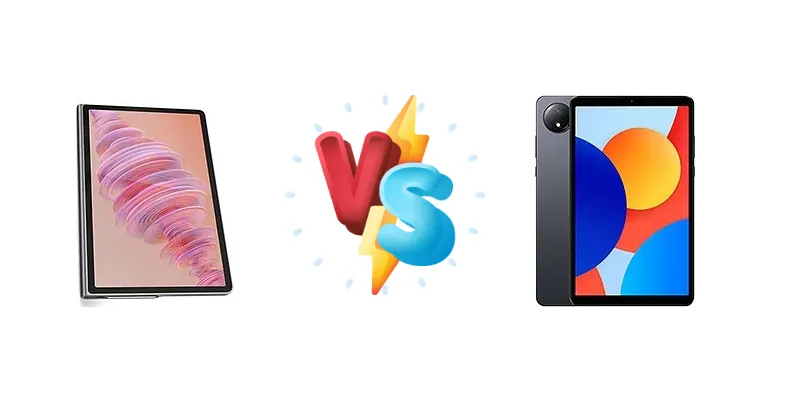
The sub-$200 tablet market is heating up, with the Lenovo Tab Plus and Xiaomi Redmi Pad SE 8.7 vying for dominance. Both offer compelling features for media consumption and light productivity, but significant differences in their core hardware – specifically the chipset and charging capabilities – dictate which tablet is best suited for different users. This comparison dissects those differences to provide a definitive recommendation.
🏆 Quick Verdict
For most users, the Lenovo Tab Plus emerges as the superior choice. Its Mediatek Helio G99 chipset, built on a more efficient 6nm process, delivers noticeably better performance and longevity. The 45W charging is a significant advantage, offsetting the lack of detailed battery capacity information, promising faster top-ups than the Redmi Pad SE 8.7.
| Network |
|---|
| 2G bands | N/A | GSM 850 / 900 / 1800 / 1900 |
| 3G bands | N/A | HSDPA 800 / 850 / 900 / 1700(AWS) / 1900 / 2100 |
| 4G bands | N/A | 1, 2, 3, 4, 5, 7, 8, 13, 18, 19, 20, 26, 28, 38, 40, 41, 66 |
| EDGE | No | - |
| GPRS | No | - |
| Speed | - | HSPA, LTE - cellular model only |
| Technology | No cellular connectivity | GSM / HSPA / LTE |
| Launch |
|---|
| Announced | 2024, June 20 | 2024, July 29 |
| Status | Available. Released 2024, June | Available. Released 2024, August 08 |
| Body |
|---|
| Build | - | Glass front (Gorilla Glass 3) |
| Dimensions | 268.3 x 174.3 x 7.7 - 13.6 mm | 211.6 x 125.5 x 8.8 mm (8.33 x 4.94 x 0.35 in) |
| SIM | No | Nano-SIM + Nano-SIM (cellular model only) |
| Weight | 650 g (1.43 lb) | 370 / 373 / 375 g (13.05 oz) |
| Display |
|---|
| Protection | Mohs level 6 | Corning Gorilla Glass 3 |
| Resolution | 1200 x 2000 pixels, 5:3 ratio (~203 ppi density) | 800 x 1340 pixels, 5:3 ratio (~179 ppi density) |
| Size | 11.5 inches, 376.4 cm2 (~80.5% screen-to-body ratio) | 8.7 inches, 214.9 cm2 (~80.9% screen-to-body ratio) |
| Type | IPS LCD, 90Hz, 400 nits (typ) | IPS LCD, 1B colors, 90Hz, 600 nits (HBM) |
| Platform |
|---|
| CPU | Octa-core (2x2.2 GHz Cortex-A76 & 6x2.0 GHz Cortex-A55) | Octa-core (2x2.0 GHz Cortex-A75 & 6x1.8 GHz Cortex-A55) |
| Chipset | Mediatek Helio G99 (6 nm) | Mediatek Helio G85 (12 nm) |
| GPU | Mali-G57 MC2 | Mali-G52 MC2 |
| OS | Android 14 | Android 14, HyperOS |
| Memory |
|---|
| Card slot | microSDXC (dedicated slot) | microSDXC (dedicated slot) |
| Internal | 128GB 8GB RAM, 256GB 8GB RAM | 64GB 4GB RAM, 128GB 4GB RAM, 128GB 6GB RAM |
| Main Camera |
|---|
| Features | - | LED flash |
| Single | 8 MP, AF | 8 MP, f/2.0, (wide), 1/4.0", 1.12µm |
| Video | 1080p@30fps | 1080p@30fps |
| Selfie camera |
|---|
| Single | 8 MP | 5 MP, f/2.2, (wide), 1/5.0", 1.12µm |
| Video | 1080p@30fps | 1080p@30fps |
| Sound |
|---|
| 35mm jack | Yes | Yes |
| Loudspeaker | Yes, with stereo speakers (8 JBL Hi-Fi speakers) | Yes, with stereo speakers |
| Comms |
|---|
| Bluetooth | 5.2, A2DP, LE | 5.3, A2DP, LE |
| Infrared port | - | Yes |
| NFC | No | No |
| Positioning | GPS, GALILEO, GLONASS | GPS, GALILEO, GLONASS, BDS - cellular model only |
| Radio | No | FM radio |
| USB | USB Type-C 2.0 | USB Type-C 2.0 |
| WLAN | Wi-Fi 802.11 a/b/g/n/ac, dual-band, Wi-Fi Direct | Wi-Fi 802.11 a/b/g/n/ac, dual-band |
| Features |
|---|
| Sensors | Accelerometer, gyro | Accelerometer, proximity (accessories only), compass |
| Battery |
|---|
| Charging | 45W wired | 18W wired (Int'l)
10W wired (India) |
| Type | Li-Po 8600 mAh | 6650 mAh |
| Misc |
|---|
| Colors | Luna grey | Aurora Green (Forest Green), Sky Blue (Ocean Blue), Graphite Gray (Urban Grey) |
| Models | TB351FU | 220233L2G |
| Price | About 280 EUR | About 120 EUR |
| SAR | - | 0.90 W/kg (head) 0.65 W/kg (body) |
| SAR EU | - | 0.40 W/kg (head) 0.99 W/kg (body) |
| EU LABEL |
|---|
| Battery | 134:05h endurance, 1000 cycles | - |
| Energy | Class D | - |
| Free fall | Class D (72 falls) | - |
| Repairability | Class A | - |
Lenovo Tab Plus
- Superior chipset performance with the Mediatek Helio G99
- Faster 45W charging for quicker top-ups
- Excellent battery endurance (134:05h)
- Battery capacity (mAh) is unknown
- Price may be slightly higher than the Redmi Pad SE 8.7
Xiaomi Redmi Pad SE 8.7
- More affordable price point
- Compact 8.7-inch display for portability
- Adequate performance for basic tasks
- Slower 18W/10W charging
- Less powerful Mediatek Helio G85 chipset
- Lower overall performance and efficiency
Display Comparison
Display specifications are not provided in the context data, but considering the price points, both tablets likely utilize IPS LCD panels. The Redmi Pad SE 8.7’s 8.7-inch size suggests a focus on portability, while the Lenovo Tab Plus’s size is unspecified, but likely similar. Without knowing peak brightness, color gamut coverage, or refresh rates, it’s difficult to definitively declare a winner. However, the smaller screen size of the Redmi Pad SE 8.7 *could* translate to a slightly higher pixel density.
Camera Comparison
Neither device is positioned as a photography powerhouse, and the provided data doesn’t offer specifics on camera sensors. It’s safe to assume both tablets feature basic camera setups suitable for video calls and casual snapshots. Without sensor size, aperture, or image processing details, a meaningful comparison is impossible. Focusing on the core strengths of these tablets – performance and battery – is more relevant than scrutinizing potentially low-quality camera modules.
Performance
The Lenovo Tab Plus’s Mediatek Helio G99 chipset, fabricated on a 6nm process, represents a clear advantage over the Xiaomi Redmi Pad SE 8.7’s Helio G85 (12nm). The 6nm node allows for greater transistor density and improved power efficiency, meaning the G99 can deliver more performance with less heat. The Tab Plus’s CPU configuration – 2x2.2 GHz Cortex-A76 & 6x2.0 GHz Cortex-A55 – also edges out the Redmi Pad SE’s 2x2.0 GHz Cortex-A75 & 6x1.8 GHz Cortex-A55, offering a boost in both single-core and multi-core performance. This translates to snappier app launches, smoother multitasking, and a more enjoyable gaming experience on the Lenovo Tab Plus.
Battery Life
The Lenovo Tab Plus boasts an impressive 134:05h endurance rating and a claimed 1000 charge cycles, suggesting excellent longevity. While the actual battery capacity (mAh) is unknown, the endurance figure indicates efficient power management. The 45W wired charging is a significant advantage, allowing for much faster top-ups compared to the Redmi Pad SE 8.7’s 18W (International) or 10W (India) charging. The Redmi Pad SE 8.7’s slower charging speeds will require significantly more time to reach a full charge, potentially impacting usability for users who need a quick power boost.
Buying Guide
Buy the Lenovo Tab Plus if you prioritize sustained performance for gaming or multitasking, and value faster charging speeds. This tablet is ideal for users who frequently use demanding apps or want a device that can keep up with a busy lifestyle. Buy the Xiaomi Redmi Pad SE 8.7 if your primary use case is casual media consumption and you're on a very tight budget. The G85 is adequate for basic tasks, but it will struggle with more intensive workloads.
Frequently Asked Questions
❓ Does the Mediatek Helio G99 in the Lenovo Tab Plus generate excessive heat during prolonged gaming sessions?
The Helio G99’s 6nm process is designed for improved thermal efficiency compared to the Redmi Pad SE 8.7’s 12nm Helio G85. While some heat generation is inevitable during gaming, the G99 is less prone to throttling and should maintain higher sustained performance for longer periods.
❓ What is the real-world impact of the 45W charging on the Lenovo Tab Plus compared to the Redmi Pad SE 8.7’s 18W/10W charging?
The 45W charging on the Lenovo Tab Plus will significantly reduce charging times. Expect a much faster 0-100% charge compared to the Redmi Pad SE 8.7, potentially cutting charging time in half or more. This is particularly beneficial for users who need to quickly top up their tablet before heading out.
❓ Is the difference in CPU architecture (Cortex-A76 vs Cortex-A75) noticeable in everyday tasks?
Yes, the Cortex-A76 cores in the Lenovo Tab Plus offer a performance improvement over the Cortex-A75 cores in the Redmi Pad SE 8.7. While the difference may not be dramatic in simple tasks like web browsing, it will be noticeable in more demanding applications, multitasking, and gaming.
❓ How does the 1000 charge cycle claim for the Lenovo Tab Plus affect the long-term usability of the device?
The 1000 charge cycle claim suggests the Lenovo Tab Plus’s battery is designed to retain a significant portion of its original capacity even after numerous charge-discharge cycles. This indicates a longer lifespan and reduced battery degradation compared to tablets with lower-rated battery cycles.