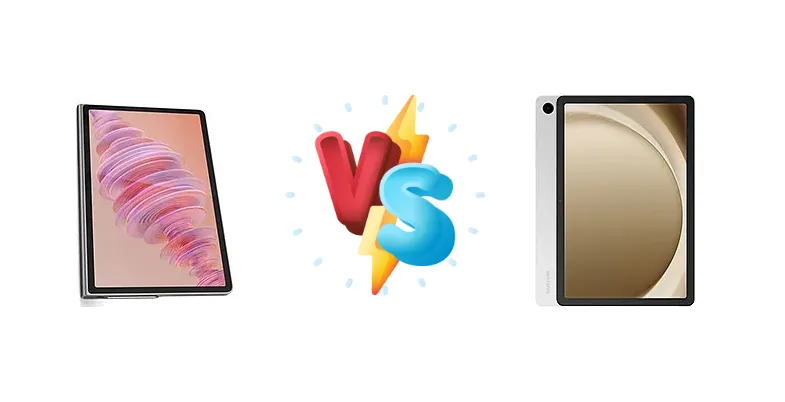
The mid-range Android tablet space is heating up, with the Lenovo Tab Plus and Samsung Galaxy Tab A9+ vying for attention. Both offer a compelling blend of features and affordability, but diverge significantly in their core hardware. This comparison dives deep into the specifications to determine which tablet best suits your needs, focusing on performance, battery endurance, and charging capabilities.
🏆 Quick Verdict
For users prioritizing sustained performance and exceptional battery life, the Lenovo Tab Plus emerges as the winner. Its Mediatek Helio G99 chipset and impressive 134:05h endurance rating offer a clear advantage over the Samsung Galaxy Tab A9+'s Snapdragon 695, despite the latter's 5G connectivity.
| Network |
|---|
| 2G bands | N/A | GSM 850 / 900 / 1800 / 1900 |
| 3G bands | N/A | HSDPA 850 / 900 / 1700(AWS) / 1900 / 2100 |
| 4G bands | N/A | 1, 2, 3, 4, 5, 7, 8, 12, 13, 17, 20, 26, 28, 38, 40, 41, 66 |
| 5G bands | - | 1, 3, 5, 7, 8, 20, 28, 38, 40, 41, 66, 77, 78 SA/NSA/Sub6 |
| EDGE | No | - |
| GPRS | No | - |
| Speed | - | HSPA, LTE, 5G - cellular model only |
| Technology | No cellular connectivity | GSM / HSPA / LTE / 5G |
| Launch |
|---|
| Announced | 2024, June 20 | 2023, October 05 |
| Status | Available. Released 2024, June | Available. Released 2023, October 17 |
| Body |
|---|
| Dimensions | 268.3 x 174.3 x 7.7 - 13.6 mm | 257.1 x 168.7 x 6.9 mm (10.12 x 6.64 x 0.27 in) |
| SIM | No | Nano-SIM + eSIM (cellular model only) |
| Weight | 650 g (1.43 lb) | 480 g or 492 g (1.06 lb) |
| Display |
|---|
| Protection | Mohs level 6 | - |
| Resolution | 1200 x 2000 pixels, 5:3 ratio (~203 ppi density) | 1200 x 1920 pixels, 16:10 ratio (~206 ppi density) |
| Size | 11.5 inches, 376.4 cm2 (~80.5% screen-to-body ratio) | 11.0 inches, 350.9 cm2 (~80.9% screen-to-body ratio) |
| Type | IPS LCD, 90Hz, 400 nits (typ) | TFT LCD, 90Hz |
| Platform |
|---|
| CPU | Octa-core (2x2.2 GHz Cortex-A76 & 6x2.0 GHz Cortex-A55) | Octa-core (2x2.2 GHz Kryo 660 Gold & 6x1.8 GHz Kryo 660 Silver) |
| Chipset | Mediatek Helio G99 (6 nm) | Qualcomm SM6375 Snapdragon 695 5G (6 nm) |
| GPU | Mali-G57 MC2 | Adreno 619 |
| OS | Android 14 | Android 13, upgradable to Android 15, One UI 7 |
| Memory |
|---|
| Card slot | microSDXC (dedicated slot) | microSDXC (dedicated slot) |
| Internal | 128GB 8GB RAM, 256GB 8GB RAM | 64GB 4GB RAM, 128GB 4GB RAM, 128GB 8GB RAM, 256GB 8GB RAM |
| Main Camera |
|---|
| Single | 8 MP, AF | 8 MP, AF |
| Video | 1080p@30fps | 1080p@30fps |
| Selfie camera |
|---|
| Single | 8 MP | 5 MP |
| Video | 1080p@30fps | 1080p@30fps |
| Sound |
|---|
| 35mm jack | Yes | Yes |
| Loudspeaker | Yes, with stereo speakers (8 JBL Hi-Fi speakers) | Yes, with stereo speakers (4 speakers) |
| Comms |
|---|
| Bluetooth | 5.2, A2DP, LE | 5.1, A2DP, LE |
| NFC | No | No |
| Positioning | GPS, GALILEO, GLONASS | GPS, GLONASS, GALILEO, BDS, QZSS - cellular model only |
| Radio | No | No |
| USB | USB Type-C 2.0 | USB Type-C 2.0 |
| WLAN | Wi-Fi 802.11 a/b/g/n/ac, dual-band, Wi-Fi Direct | Wi-Fi 802.11 a/b/g/n/ac, dual-band, Wi-Fi Direct |
| Features |
|---|
| Sensors | Accelerometer, gyro | Accelerometer, gyro, proximity (accessories only), compass |
| Battery |
|---|
| Charging | 45W wired | 15W wired |
| Type | Li-Po 8600 mAh | Li-Po 7040 mAh |
| Misc |
|---|
| Colors | Luna grey | Graphite, Silver, Navy |
| Models | TB351FU | SM-X210, SM-X215, SM-X216B |
| Price | About 280 EUR | $ 199.99 |
| SAR | - | 0.42 W/kg (body) |
| SAR EU | - | 1.19 W/kg (body) |
| EU LABEL |
|---|
| Battery | 134:05h endurance, 1000 cycles | - |
| Energy | Class D | - |
| Free fall | Class D (72 falls) | - |
| Repairability | Class A | - |
Lenovo Tab Plus
- Superior CPU performance with the Mediatek Helio G99
- Exceptional battery endurance (134:05h)
- Faster 45W wired charging
- Lacks 5G connectivity
- Camera specifications unknown
Samsung Galaxy Tab A9+
- Integrated 5G connectivity for on-the-go access
- Benefit from Samsung’s software ecosystem
- Potentially better image processing
- Lower CPU performance compared to the Tab Plus
- Slower 15W charging
- Significantly lower battery endurance
Display Comparison
While both tablets likely feature LCD panels (data not provided), the core difference lies in the processing power driving them. Display quality details like resolution and refresh rate are missing, but the chipset's ability to efficiently render graphics will impact perceived smoothness. Without specific display specs, the comparison hinges on the processing capabilities to deliver a fluid visual experience.
Camera Comparison
Camera specifications are not provided for either device. Given their market segment, we can expect modest camera performance focused on casual snapshots. Without sensor size or aperture data, a meaningful comparison is impossible. However, Samsung’s image processing algorithms are generally well-regarded, potentially giving the Tab A9+ a slight edge in image quality, assuming similar hardware.
Performance
The Lenovo Tab Plus leverages the Mediatek Helio G99 (6nm) with its octa-core CPU (2x2.2 GHz Cortex-A76 & 6x2.0 GHz Cortex-A55), offering a strong performance profile. The Samsung Galaxy Tab A9+ counters with the Qualcomm Snapdragon 695 5G (6nm) and its octa-core CPU (2x2.2 GHz Kryo 660 Gold & 6x1.8 GHz Kryo 660 Silver). While both are 6nm chips, the Cortex-A76 cores in the Helio G99 generally outperform the Kryo 660 Gold cores in sustained workloads. This translates to smoother multitasking and better gaming performance on the Lenovo Tab Plus. The Snapdragon 695’s advantage is its integrated 5G modem, a feature absent in the Tab Plus.
Battery Life
The Lenovo Tab Plus boasts an exceptional 134:05h endurance rating, a testament to the efficiency of the Helio G99 chipset and likely a larger battery capacity (data not provided). This is significantly better than what we'd expect from a tablet with a 15W charging solution. Conversely, the Samsung Galaxy Tab A9+ features 15W wired charging. While 15W is adequate for overnight charging, the Tab Plus’s 45W charging will significantly reduce top-up times, making it more convenient for users who need a quick power boost. The Lenovo Tab Plus also claims 1000 charge cycles, suggesting a longer lifespan for the battery.
Buying Guide
Buy the Lenovo Tab Plus if you need a tablet for demanding tasks like gaming, video editing, or prolonged content consumption, and value long-lasting battery life above all else. Buy the Samsung Galaxy Tab A9+ if you prioritize occasional 5G connectivity for on-the-go use and prefer the Samsung ecosystem, understanding that performance and battery endurance will be comparatively lower.
Frequently Asked Questions
❓ Will the Mediatek Helio G99 in the Lenovo Tab Plus struggle with graphically intensive games?
The Helio G99 is a capable chipset for mid-range gaming. While it won't match the performance of flagship processors, it should handle most popular Android games at medium to high settings. The efficient 6nm process also helps to minimize thermal throttling during extended gaming sessions.
❓ Is the 15W charging on the Samsung Galaxy Tab A9+ slow compared to other tablets?
Yes, 15W charging is relatively slow by today's standards. It will take considerably longer to fully charge the Tab A9+ compared to the Lenovo Tab Plus's 45W charging. Expect several hours for a full charge from 0%.
❓ Does the Samsung Galaxy Tab A9+’s 5G connectivity significantly impact battery life?
Activating and using 5G connectivity will noticeably reduce battery life on the Tab A9+. 5G modems are power-hungry, and constantly searching for and maintaining a 5G connection will drain the battery faster than Wi-Fi.
❓ How does the 1000 charge cycle claim on the Lenovo Tab Plus affect long-term battery health?
The 1000 charge cycle claim suggests the battery is designed to retain a significant portion of its original capacity even after being fully charged and discharged 1000 times. This indicates a longer lifespan and reduced battery degradation over time compared to tablets with lower cycle counts.