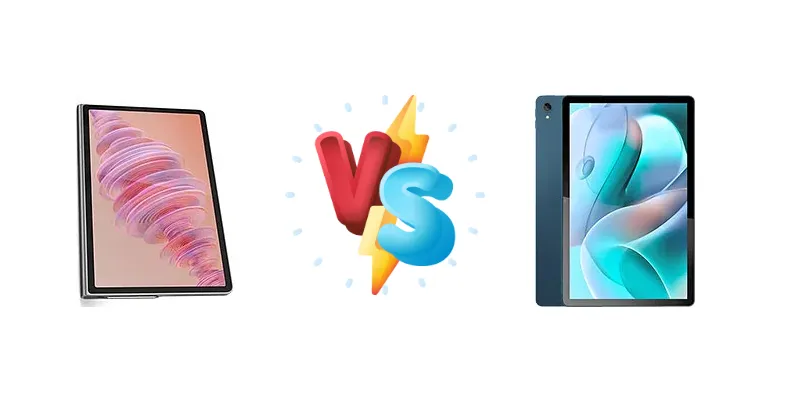
The Lenovo Tab Plus and Motorola Moto Tab G70 both aim to deliver an affordable Android tablet experience, but they take different approaches. The Tab Plus leverages the newer, more efficient Mediatek Helio G99, while the Moto Tab G70 relies on the older Helio G90T. This comparison will dissect the implications of these chipset choices, alongside battery endurance and charging capabilities, to determine which tablet best suits your needs.
🏆 Quick Verdict
For most users, the Lenovo Tab Plus emerges as the superior choice. Its Mediatek Helio G99 chipset, built on a 6nm process, offers a performance edge and significantly improved battery endurance (134:05h) compared to the Moto Tab G70. While the G70 is still capable, the Tab Plus provides a more future-proof and efficient experience.
| Network |
|---|
| 2G bands | N/A | GSM 850 / 900 / 1800 / 1900 |
| 3G bands | N/A | HSDPA 850 / 900 / 1900 / 2100 |
| 4G bands | N/A | 1, 2, 4, 7, 8, 20, 28, 38, 40, 41 |
| EDGE | No | - |
| GPRS | No | - |
| Speed | - | HSPA 42.2/5.76 Mbps, LTE Cat4 150/50 Mbps - cellular model only |
| Technology | No cellular connectivity | GSM / HSPA / LTE |
| Launch |
|---|
| Announced | 2024, June 20 | 2022, January 12 |
| Status | Available. Released 2024, June | Available. Released 2022, January 13 |
| Body |
|---|
| Build | - | Glass front, aluminum back, aluminum frame |
| Dimensions | 268.3 x 174.3 x 7.7 - 13.6 mm | 258.4 x 163 x 7.5 mm (10.17 x 6.42 x 0.30 in) |
| SIM | No | Nano-SIM (cellular model only) |
| Weight | 650 g (1.43 lb) | 500 g (1.10 lb) |
| | - | Water repellent design |
| Display |
|---|
| Protection | Mohs level 6 | - |
| Resolution | 1200 x 2000 pixels, 5:3 ratio (~203 ppi density) | 1200 x 2000 pixels, 5:3 ratio (~212 ppi density) |
| Size | 11.5 inches, 376.4 cm2 (~80.5% screen-to-body ratio) | 11.0 inches, 344.4 cm2 (~81.8% screen-to-body ratio) |
| Type | IPS LCD, 90Hz, 400 nits (typ) | IPS LCD, 400 nits (typ) |
| Platform |
|---|
| CPU | Octa-core (2x2.2 GHz Cortex-A76 & 6x2.0 GHz Cortex-A55) | Octa-core (2x2.05 GHz Cortex-A76 & 6x2.0 GHz Cortex-A55) |
| Chipset | Mediatek Helio G99 (6 nm) | Mediatek MT6785 Helio G90T (12 nm) |
| GPU | Mali-G57 MC2 | Mali-G76 MC4 |
| OS | Android 14 | Android 11 |
| Memory |
|---|
| Card slot | microSDXC (dedicated slot) | microSDXC (dedicated slot) |
| Internal | 128GB 8GB RAM, 256GB 8GB RAM | 64GB 4GB RAM, 128GB 6GB RAM |
| | - | eMMC 5.1 |
| Main Camera |
|---|
| Features | - | LED flash |
| Single | 8 MP, AF | 13 MP, f/2.2, 26mm (wide), AF |
| Video | 1080p@30fps | 1080p@30fps |
| Selfie camera |
|---|
| Single | 8 MP | 8 MP, f/2.0, 26mm (wide) |
| Video | 1080p@30fps | 1080p@30fps |
| Sound |
|---|
| 3.5mm jack | - | Yes |
| 35mm jack | Yes | Yes |
| Loudspeaker | Yes, with stereo speakers (8 JBL Hi-Fi speakers) | Yes, with stereo speakers (4 speakers) |
| Comms |
|---|
| Bluetooth | 5.2, A2DP, LE | 5.2, A2DP, LE |
| NFC | No | No |
| Positioning | GPS, GALILEO, GLONASS | GPS, GLONASS - cellular model only |
| Radio | No | No |
| USB | USB Type-C 2.0 | USB Type-C 2.0, OTG |
| WLAN | Wi-Fi 802.11 a/b/g/n/ac, dual-band, Wi-Fi Direct | Wi-Fi 802.11 a/b/g/n/ac, dual-band, Wi-Fi Direct |
| Features |
|---|
| Sensors | Accelerometer, gyro | Accelerometer, gyro, proximity |
| Battery |
|---|
| Charging | 45W wired | 20W wired |
| Type | Li-Po 8600 mAh | Li-Po 7700 mAh |
| Misc |
|---|
| Colors | Luna grey | Modernist Teal, Blue |
| Models | TB351FU | - |
| Price | About 280 EUR | About 380 EUR |
| EU LABEL |
|---|
| Battery | 134:05h endurance, 1000 cycles | - |
| Energy | Class D | - |
| Free fall | Class D (72 falls) | - |
| Repairability | Class A | - |
Lenovo Tab Plus
- Superior chipset efficiency (Helio G99, 6nm)
- Significantly longer battery life (134:05h endurance)
- Faster 45W wired charging
- Potentially higher price point
- Display specs unknown, potential for similar quality to G70
Motorola Moto Tab G70
- Likely more affordable price
- Acceptable performance for basic tasks
- Functional for casual media consumption
- Less efficient chipset (Helio G90T, 12nm)
- Shorter battery life
- Slower 20W wired charging
Display Comparison
Display specifications are not provided, so a direct comparison is impossible. However, given the market positioning, it's reasonable to assume both tablets utilize IPS LCD panels. The Tab Plus's more modern chipset *could* allow for more sophisticated display processing, potentially resulting in slightly better color accuracy. Bezels are likely comparable, focusing on cost reduction in both models.
Camera Comparison
Camera details are absent, making a detailed comparison impossible. Given the price bracket, both tablets likely feature modest camera setups focused on video calls and casual snapshots. Expect primary sensors in the 8-13MP range. Image processing will likely be basic, prioritizing speed over advanced features. Without specific sensor information, it's difficult to assess image quality differences.
Performance
The core difference lies in the chipsets. The Lenovo Tab Plus’s Mediatek Helio G99 (6nm) boasts a clear advantage over the Motorola Moto Tab G70’s Helio G90T (12nm). The 6nm process node is significantly more efficient, leading to lower power consumption and reduced thermal throttling during sustained workloads. While both CPUs feature the same core configuration (2x2.2 GHz Cortex-A76 & 6x2.0 GHz Cortex-A55), the G99’s architecture benefits from process improvements, resulting in a noticeable performance uplift. This translates to smoother multitasking, faster app loading times, and a more responsive user experience on the Tab Plus.
Battery Life
The Lenovo Tab Plus shines in battery endurance, boasting an impressive 134:05 hours of usage. This is a direct result of the more efficient Mediatek Helio G99 chipset. The Moto Tab G70, while likely having a comparable battery capacity (spec not provided), will suffer from shorter runtimes due to the less efficient Helio G90T. Furthermore, the Tab Plus supports 45W wired charging, significantly faster than the G70’s 20W charging. This means the Tab Plus will reach a full charge much quicker, minimizing downtime.
Buying Guide
Buy the Lenovo Tab Plus if you prioritize long battery life for extended streaming, gaming, or productivity on the go. Its more efficient chipset translates to less frequent charging. Buy the Motorola Moto Tab G70 if you are on a tighter budget and primarily need a tablet for basic tasks like web browsing and video consumption, and aren't concerned about maximizing battery life or future performance.
Frequently Asked Questions
❓ Will the Mediatek Helio G99 in the Lenovo Tab Plus handle demanding games like Genshin Impact?
While the Helio G99 is a capable chipset, Genshin Impact is a particularly demanding title. Expect to play at medium settings with moderate frame rates. The 6nm process will help mitigate thermal throttling, but sustained high performance may still result in some frame drops.
❓ How long will it take to fully charge the Lenovo Tab Plus with the 45W charger?
While a precise 0-100% charge time isn't available, the 45W charging should significantly reduce charging times compared to the Moto Tab G70's 20W charger. Expect a full charge in approximately 1.5 to 2 hours, depending on usage during charging.
❓ Is the difference in chipset efficiency between the Helio G99 and Helio G90T noticeable in everyday use?
Yes, the difference is noticeable. The Helio G99's 6nm process consumes less power for the same tasks, resulting in longer battery life and less heat generation. This translates to a smoother, more responsive experience, especially during prolonged use.