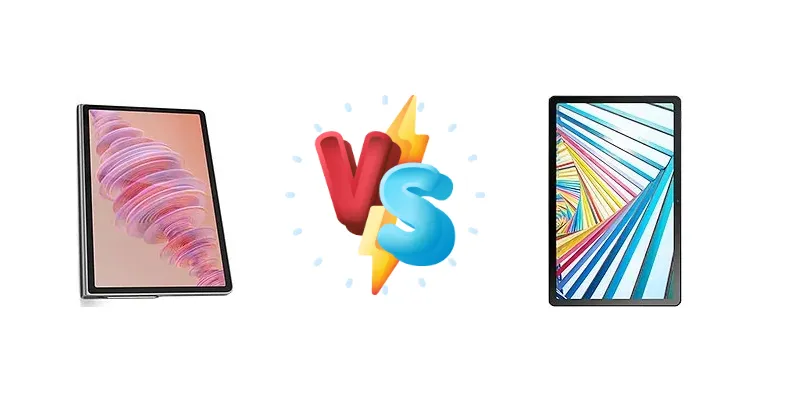
Lenovo's Tab Plus and M10 Plus (3rd Gen) represent compelling options in the crowded Android tablet space, but cater to slightly different priorities. The Tab Plus aims for a performance edge with its newer chipset, while the M10 Plus offers a more established, and potentially more affordable, experience. This comparison dives deep into the specifications to determine which tablet best suits your needs.
🏆 Quick Verdict
For most users, the Lenovo Tab Plus emerges as the superior choice. Its Mediatek Helio G99 chipset, built on a 6nm process, delivers noticeably better performance than the Snapdragon 680 or Helio G80 found in the M10 Plus, and its 45W charging significantly reduces downtime. While the M10 Plus remains a viable option, the Tab Plus offers a more future-proof experience.
| Network |
|---|
| 2G bands | N/A | GSM 850 / 900 / 1800 / 1900 |
| 3G bands | N/A | HSDPA 800 / 850 / 900 / 1900 / 2100 |
| 4G bands | N/A | 1, 2, 3, 4, 5, 7, 8, 19, 20, 26, 28, 28, 38, 40, 41 |
| EDGE | No | - |
| GPRS | No | - |
| Speed | - | HSPA 42.2/5.76 Mbps, LTE Cat13 390/75 Mbps - cellular model only |
| Technology | No cellular connectivity | GSM / HSPA / LTE |
| Launch |
|---|
| Announced | 2024, June 20 | 2022, May |
| Status | Available. Released 2024, June | Available. Released 2022, May |
| Body |
|---|
| Dimensions | 268.3 x 174.3 x 7.7 - 13.6 mm | 251.2 x 158.8 x 7.5 mm (9.89 x 6.25 x 0.30 in) |
| SIM | No | Nano-SIM (cellular model only) |
| Weight | 650 g (1.43 lb) | 465 g (1.03 lb) |
| | - | Stylus support |
| Display |
|---|
| Protection | Mohs level 6 | - |
| Resolution | 1200 x 2000 pixels, 5:3 ratio (~203 ppi density) | 1200 x 2000 pixels, 5:3 ratio (~220 ppi density) |
| Size | 11.5 inches, 376.4 cm2 (~80.5% screen-to-body ratio) | 10.61 inches, 320.4 cm2 (~80.3% screen-to-body ratio) |
| Type | IPS LCD, 90Hz, 400 nits (typ) | IPS LCD, 400 nits (typ) |
| Platform |
|---|
| CPU | Octa-core (2x2.2 GHz Cortex-A76 & 6x2.0 GHz Cortex-A55) | Octa-core (4x2.4 GHz Kryo 265 Gold & 4x1.9 GHz Kryo 265 Silver) - LTE model Octa-core (2x2.0 GHz Cortex-A75 & 6x1.8 GHz Cortex-A55) - Wi-Fi only model |
| Chipset | Mediatek Helio G99 (6 nm) | Qualcomm SM6225 Snapdragon 680 4G (6 nm) - LTE model Mediatek MT6769V/CU Helio G80 (12 nm) - Wi-Fi only model |
| GPU | Mali-G57 MC2 | Adreno 610 - LTE model Mali-G52 MC2 - Wi-Fi only model |
| OS | Android 14 | Android 12 |
| Memory |
|---|
| Card slot | microSDXC (dedicated slot) | microSDXC (dedicated slot) |
| Internal | 128GB 8GB RAM, 256GB 8GB RAM | 32GB 3GB RAM, 64GB 4GB RAM, 128GB 4GB RAM, 128GB 6GB RAM |
| | - | eMCP/uMCP |
| Main Camera |
|---|
| Single | 8 MP, AF | 8 MP, AF |
| Video | 1080p@30fps | 1080p |
| Selfie camera |
|---|
| Single | 8 MP | 8 MP |
| Video | 1080p@30fps | - |
| Sound |
|---|
| 3.5mm jack | - | Yes |
| 35mm jack | Yes | Yes |
| Loudspeaker | Yes, with stereo speakers (8 JBL Hi-Fi speakers) | Yes, with stereo speakers (4 speakers) |
| Comms |
|---|
| Bluetooth | 5.2, A2DP, LE | 5.0, A2DP, LE |
| NFC | No | No |
| Positioning | GPS, GALILEO, GLONASS | GPS, GLONASS, BDS - cellular model only |
| Radio | No | FM Radio |
| USB | USB Type-C 2.0 | USB Type-C 2.0 |
| WLAN | Wi-Fi 802.11 a/b/g/n/ac, dual-band, Wi-Fi Direct | Wi-Fi 802.11 a/b/g/n/ac, dual-band, Wi-Fi Direct |
| Features |
|---|
| Sensors | Accelerometer, gyro | Accelerometer, proximity, gyro |
| Battery |
|---|
| Charging | 45W wired | 20W wired |
| Type | Li-Po 8600 mAh | Li-Po 7700 mAh |
| Misc |
|---|
| Colors | Luna grey | Storm Grey, Frost Blue |
| Models | TB351FU | - |
| Price | About 280 EUR | About 260 EUR |
| EU LABEL |
|---|
| Battery | 134:05h endurance, 1000 cycles | - |
| Energy | Class D | - |
| Free fall | Class D (72 falls) | - |
| Repairability | Class A | - |
Lenovo Tab Plus
- Superior performance with the Mediatek Helio G99 chipset.
- Faster 45W charging for reduced downtime.
- Longer battery endurance (134:05h).
- Potentially higher price point.
- Display specifications are unknown.
Lenovo Tab M10 Plus (3rd Gen)
- More affordable price (likely).
- LTE connectivity available on some models.
- Established platform with known reliability.
- Slower performance, especially with the Helio G80 variant.
- Slower 20W charging.
- Lower battery endurance compared to the Tab Plus.
Display Comparison
Display specifications are not provided, so a direct comparison is limited. However, considering the Tab Plus's positioning, it likely features a higher-quality panel with potentially better color accuracy and brightness. The M10 Plus (3rd Gen) likely offers a standard LCD experience. Bezels are a key consideration; newer models generally minimize these for a more immersive viewing experience, and the Tab Plus likely benefits from this trend. The absence of refresh rate data suggests both tablets operate at a standard 60Hz.
Camera Comparison
Camera details are absent, making a meaningful comparison impossible. Given the tablet segment, neither device is likely to excel in photography. Expect basic image quality suitable for casual snapshots and video calls. The presence or absence of Optical Image Stabilization (OIS) would be a key differentiator, but this information is unavailable. Focusing on the chipset's ISP capabilities, the Helio G99 likely offers slightly better image processing than the older Helio G80, but the Snapdragon 680 is comparable.
Performance
The core difference lies in the chipsets. The Lenovo Tab Plus’s Mediatek Helio G99 (6nm) boasts a more modern architecture – Cortex-A76 cores alongside A55s – compared to the Qualcomm Snapdragon 680 (6nm) in the LTE M10 Plus. The Wi-Fi only M10 Plus uses the older 12nm Helio G80, representing a significant performance step down. The G99’s 6nm fabrication process also translates to improved thermal efficiency, reducing the likelihood of performance throttling during sustained workloads. The Tab Plus’s CPU configuration (2x2.2 GHz Cortex-A76 & 6x2.0 GHz Cortex-A55) is optimized for both single-core and multi-core tasks, giving it an edge over the M10 Plus’s CPU options. The Snapdragon 680’s Kryo cores (4x2.4 GHz Kryo 265 Gold & 4x1.9 GHz Kryo 265 Silver) are competent, but less efficient than the G99’s setup.
Battery Life
The Lenovo Tab Plus boasts an impressive 134:05h endurance rating, suggesting excellent battery life. While the exact battery capacity isn't specified, the efficient Helio G99 chipset and 6nm process contribute significantly to this longevity. Crucially, the Tab Plus supports 45W wired charging, enabling significantly faster recharge times compared to the M10 Plus’s 20W charging. This difference is substantial; 45W charging will dramatically reduce downtime, especially for users who frequently use their tablet throughout the day. The Tab Plus also claims 1000 charge cycles, indicating a longer lifespan before significant battery degradation.
Buying Guide
Buy the Lenovo Tab Plus if you prioritize performance for gaming, multitasking, or demanding applications, and value faster charging speeds. This tablet is ideal for users who want a responsive and capable device for both work and entertainment. Buy the Lenovo Tab M10 Plus (3rd Gen) if you're on a tighter budget and primarily need a tablet for basic tasks like web browsing, video streaming, and light productivity. The M10 Plus is a solid choice for casual users who don't require cutting-edge performance.
Frequently Asked Questions
❓ Does the Mediatek Helio G99 in the Tab Plus get hot during extended gaming sessions?
The Helio G99's 6nm process and efficient architecture are designed to minimize thermal throttling. While some heat generation is inevitable during demanding tasks, the Tab Plus should maintain stable performance for longer periods compared to tablets with less efficient chipsets like the Helio G80.
❓ Is the difference in charging speed between 20W and 45W charging really that noticeable on the Tab Plus?
Yes, the difference is substantial. 45W charging can significantly reduce recharge times, potentially cutting the 0-100% charge time in half compared to the M10 Plus's 20W charging. This is particularly beneficial for users who rely on their tablet throughout the day and need to quickly top up the battery.
❓ Which tablet is better for multitasking – running multiple apps simultaneously?
The Lenovo Tab Plus is better suited for multitasking. Its Mediatek Helio G99 chipset, with its more powerful CPU cores and efficient architecture, can handle multiple applications running concurrently with greater ease than the Snapdragon 680 or Helio G80 found in the M10 Plus.
❓ Does the Lenovo Tab M10 Plus (3rd Gen) support expandable storage via microSD card?
While not explicitly stated in the provided data, Lenovo tablets in this segment typically include a microSD card slot for expandable storage. However, it's crucial to verify this specification with the retailer or Lenovo's official product page before purchasing.