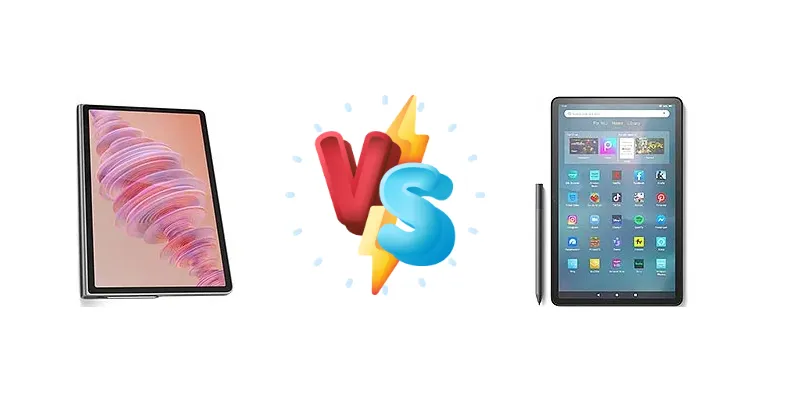
The tablet market offers a diverse range of options, but narrowing down the choices can be challenging. We're pitting the Lenovo Tab Plus against the Amazon Fire Max 11, two tablets targeting the mid-range segment. While both aim to provide a versatile experience, they diverge significantly in their core hardware, particularly in chipset and charging capabilities, impacting performance and longevity.
🏆 Quick Verdict
For users prioritizing sustained performance and longer battery life, the Lenovo Tab Plus emerges as the stronger contender. Its Mediatek Helio G99 chipset, built on a 6nm process, offers a performance edge and superior endurance compared to the Amazon Fire Max 11's MT8188J. However, the Fire Max 11 remains a viable option for casual users within the Amazon ecosystem.
| Network |
|---|
| 2G bands | N/A | N/A |
| 3G bands | N/A | - |
| 4G bands | N/A | - |
| EDGE | No | No |
| GPRS | No | No |
| Technology | No cellular connectivity | No cellular connectivity |
| Launch |
|---|
| Announced | 2024, June 20 | 2023, May 23 |
| Status | Available. Released 2024, June | Available. Released 2023, May 23 |
| Body |
|---|
| Dimensions | 268.3 x 174.3 x 7.7 - 13.6 mm | 259.1 x 163.7 x 7.5 mm (10.20 x 6.44 x 0.30 in) |
| SIM | No | No |
| Weight | 650 g (1.43 lb) | 490 g (1.08 lb) |
| Display |
|---|
| Protection | Mohs level 6 | - |
| Resolution | 1200 x 2000 pixels, 5:3 ratio (~203 ppi density) | 2000 x 1200 pixels, 5:3 ratio (~212 ppi density) |
| Size | 11.5 inches, 376.4 cm2 (~80.5% screen-to-body ratio) | 11.0 inches, 344.4 cm2 (~81.2% screen-to-body ratio) |
| Type | IPS LCD, 90Hz, 400 nits (typ) | IPS LCD |
| Platform |
|---|
| CPU | Octa-core (2x2.2 GHz Cortex-A76 & 6x2.0 GHz Cortex-A55) | Octa-core (2x2.2 GHz Cortex-A78 & 6x2.0 GHz Cortex-A55) |
| Chipset | Mediatek Helio G99 (6 nm) | Mediatek MT8188J |
| GPU | Mali-G57 MC2 | Mali-G57 MC2 |
| OS | Android 14 | Android 11, Fire OS 8 |
| Memory |
|---|
| Card slot | microSDXC (dedicated slot) | microSDXC (dedicated slot) |
| Internal | 128GB 8GB RAM, 256GB 8GB RAM | 64GB 4GB RAM, 128GB 4GB RAM |
| Main Camera |
|---|
| Single | 8 MP, AF | 8 MP, AF |
| Video | 1080p@30fps | 1080p |
| Selfie camera |
|---|
| Single | 8 MP | 8 MP |
| Video | 1080p@30fps | 1080p |
| Sound |
|---|
| 35mm jack | Yes | No |
| Loudspeaker | Yes, with stereo speakers (8 JBL Hi-Fi speakers) | Yes, with stereo speakers |
| Comms |
|---|
| Bluetooth | 5.2, A2DP, LE | 5.3, A2DP, LE |
| NFC | No | No |
| Positioning | GPS, GALILEO, GLONASS | No |
| Radio | No | No |
| USB | USB Type-C 2.0 | USB Type-C 2.0, OTG, magnetic accessory connector |
| WLAN | Wi-Fi 802.11 a/b/g/n/ac, dual-band, Wi-Fi Direct | Wi-Fi 802.11 a/b/g/n/ac/6, dual-band |
| Features |
|---|
| Sensors | Accelerometer, gyro | Fingerprint (side-mounted), accelerometer, proximity (accessories only) |
| Battery |
|---|
| Charging | 45W wired | 15W wired |
| Type | Li-Po 8600 mAh | Li-Ion |
| Misc |
|---|
| Colors | Luna grey | Gray |
| Models | TB351FU | KFSNWI |
| Price | About 280 EUR | About 270 EUR |
| EU LABEL |
|---|
| Battery | 134:05h endurance, 1000 cycles | - |
| Energy | Class D | - |
| Free fall | Class D (72 falls) | - |
| Repairability | Class A | - |
Lenovo Tab Plus
- Superior chipset efficiency (6nm Helio G99)
- Faster 45W charging
- Longer battery endurance (134:05h)
- Potentially higher price point
- Software experience may not be as tightly integrated with a specific ecosystem
Amazon Fire Max 11
- Strong integration with Amazon services
- Potentially lower price point
- Newer Cortex-A78 cores (though offset by process node)
- Slower 15W charging
- Less efficient chipset (MT8188J)
- Likely shorter battery life
Display Comparison
Display specifications are not provided, so a direct comparison is limited. However, given the price points, both tablets likely utilize IPS LCD panels. The Lenovo Tab Plus’s potential for a higher refresh rate (not specified) would be a significant advantage for smoother scrolling and gaming. Bezels are likely comparable, and color accuracy will depend on calibration, a detail typically absent in this segment. Without specific data, it's reasonable to assume both offer adequate, but not exceptional, visual experiences.
Camera Comparison
Camera specifications are not provided. Given the target market, both tablets likely feature modest camera setups focused on video calls and casual snapshots. Image quality will likely be similar, with performance heavily reliant on software processing. Without detailed sensor information, it’s difficult to assess a clear advantage.
Performance
The core difference lies in the chipsets. The Lenovo Tab Plus boasts the Mediatek Helio G99 (6nm), featuring an octa-core configuration with 2x2.2 GHz Cortex-A76 and 6x2.0 GHz Cortex-A55 cores. This is contrasted by the Amazon Fire Max 11’s Mediatek MT8188J, also an octa-core processor with 2x2.2 GHz Cortex-A78 and 6x2.0 GHz Cortex-A55 cores. While both utilize the same Cortex-A55 efficiency cores, the Cortex-A78 in the Fire Max 11 is a newer architecture than the A76 in the Lenovo Tab Plus. However, the 6nm fabrication process of the Helio G99 provides a significant advantage in thermal efficiency, allowing for sustained performance without throttling. The G99’s architecture is optimized for gaming, suggesting a smoother experience in graphically intensive applications. The Fire Max 11’s MT8188J, while capable, will likely exhibit more performance degradation under prolonged load.
Battery Life
The Lenovo Tab Plus claims an impressive 134:05h endurance, suggesting a substantial battery capacity (though the exact mAh is unspecified). This, combined with the 6nm Helio G99’s efficiency, translates to significantly longer usage times. The Amazon Fire Max 11 lacks published endurance data, but its 15W charging is considerably slower than the Lenovo Tab Plus’s 45W wired charging. This means the Lenovo Tab Plus will recharge much faster, minimizing downtime. The 1000 charge cycle rating for the Lenovo Tab Plus also indicates a longer lifespan for the battery itself.
Buying Guide
Buy the Lenovo Tab Plus if you need a tablet capable of handling demanding tasks like gaming or multitasking, and value extended battery life for on-the-go use. Its faster charging also minimizes downtime. Buy the Amazon Fire Max 11 if you are deeply integrated into the Amazon ecosystem, primarily consume media, and prioritize affordability over raw performance. The Fire Max 11’s software experience is tailored for Amazon services.
Frequently Asked Questions
❓ Will the Mediatek Helio G99 in the Lenovo Tab Plus handle demanding games like Genshin Impact?
The Helio G99 is specifically designed for gaming, and while it won't deliver flagship-level performance, it should be capable of running Genshin Impact at medium settings with reasonable frame rates. The 6nm process and optimized architecture will help mitigate throttling during extended gaming sessions, providing a more consistent experience than the Fire Max 11.
❓ How much faster is the 45W charging on the Lenovo Tab Plus compared to the 15W charging on the Fire Max 11?
The 45W charging on the Lenovo Tab Plus will significantly reduce charging times. While exact 0-100% times are unavailable, it's reasonable to expect the Lenovo Tab Plus to fully charge in approximately 1.5-2 hours, compared to potentially 4-5 hours for the Amazon Fire Max 11. This difference is crucial for users who need to quickly top up their tablet's battery.
❓ Is the Amazon Fire Max 11 a good choice if I already use a lot of Amazon services?
Absolutely. The Amazon Fire Max 11 is deeply integrated with Amazon's ecosystem, offering seamless access to Prime Video, Kindle, Audible, and other Amazon services. The Fire OS interface is tailored for these services, providing a convenient experience for existing Amazon users.