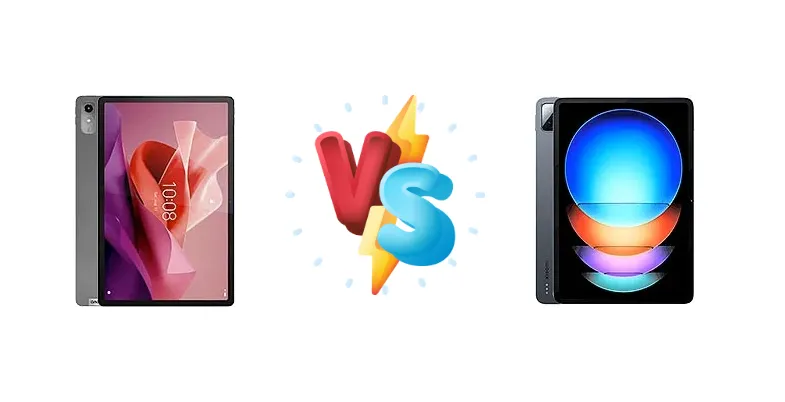
The Android tablet market is heating up, with Lenovo and Xiaomi offering compelling options at various price points. The Lenovo Tab P12 aims for a balance of features and affordability, while the Xiaomi Pad 6S Pro 12.4 aggressively targets the high-end with a flagship Snapdragon processor and blazing-fast charging. This comparison dissects the key differences to determine which tablet best suits your needs.
🏆 Quick Verdict
For most users, the Xiaomi Pad 6S Pro 12.4 is the superior choice. Its Snapdragon 8 Gen 2 chipset delivers significantly faster performance than the Lenovo Tab P12’s Dimensity 7050, and the 120W charging is a game-changer. While the Tab P12 offers a more conservative approach, the Pro’s power justifies the potential price premium.
| Network |
|---|
| 2G bands | N/A | N/A |
| 3G bands | N/A | N/A |
| 4G bands | N/A | - |
| EDGE | No | N/A |
| GPRS | No | N/A |
| Technology | No cellular connectivity | No cellular connectivity |
| Launch |
|---|
| Announced | 2023, July 28 | 2024, February 22 |
| Status | Available. Released 2023, July 28 | Available. Released 2024, February 22 |
| Body |
|---|
| Build | - | Glass front (Gorilla Glass 5), aluminum frame, aluminum back |
| Dimensions | 293.3 x 190.7 x 6.9 mm (11.55 x 7.51 x 0.27 in) | 278.7 x 191.6 x 6.3 mm (10.97 x 7.54 x 0.25 in) |
| SIM | No | No |
| Weight | 615 g (1.36 lb) | 590 g (1.30 lb) |
| Display |
|---|
| Protection | - | Corning Gorilla Glass 5 |
| Resolution | 1840 x 2944 pixels, 16:10 ratio (~273 ppi density) | 2032 x 3048 pixels, 3:2 ratio (~295 ppi density) |
| Size | 12.7 inches, 467.7 cm2 (~83.6% screen-to-body ratio) | 12.4 inches, 457.8 cm2 (~85.7% screen-to-body ratio) |
| Type | IPS LCD | IPS LCD, 68B colors, 144Hz, HDR10, Dolby Vision, 900 nits (peak) |
| Platform |
|---|
| CPU | Octa-core (2x2.6 GHz Cortex-A78 & 6x2.0 GHz Cortex-A55) | Octa-core (1x3.2 GHz Cortex-X3 & 2x2.8 GHz Cortex-A715 & 2x2.8 GHz Cortex-A710 & 3x2.0 GHz Cortex-A510) |
| Chipset | Mediatek Dimensity 7050 (6 nm) | Qualcomm SM8550-AB Snapdragon 8 Gen 2 (4 nm) |
| GPU | Mali-G68 MC4 | Adreno 740 |
| OS | Android 13 | Android 14, up to 3 major Android upgrades, HyperOS |
| Memory |
|---|
| Card slot | microSDXC (dedicated slot) | No |
| Internal | 128GB 4GB RAM, 128GB 8GB RAM, 256GB 8GB RAM | 256GB 8GB RAM, 256GB 12GB RAM, 512GB 12GB RAM, 1TB 16GB RAM |
| Main Camera |
|---|
| Dual | - | 50 MP, f/1.8, (wide), 1/2.76", 0.64µm, PDAF
Auxiliary lens |
| Features | LED flash | LED flash, HDR, panorama |
| Single | 8 MP, (wide), AF | - |
| Video | 4K@30fps, 1080p@30fps | 4K@30/60fps, 1080p@30/60fps |
| Selfie camera |
|---|
| Single | 13 MP, (ultrawide) | 32 MP, f/2.2, (wide), 1/3.6", 0.61µm |
| Video | 1080p@30fps | 1080p@30fps |
| Sound |
|---|
| 35mm jack | No | No |
| Loudspeaker | Yes, with stereo speakers (4 speakers) | Yes, with stereo speakers (6 speakers) |
| Comms |
|---|
| Bluetooth | 5.1, A2DP, LE | 5.3, A2DP, LE, LHDC |
| NFC | No | Yes (file transfer only) |
| Positioning | No | No |
| Radio | No | No |
| USB | USB Type-C 2.0 | USB Type-C 3.2, accessory connector |
| WLAN | Wi-Fi 802.11 a/b/g/n/ac/6, dual-band, Wi-Fi Direct | Wi-Fi 802.11 a/b/g/n/a/6/7, dual-band, Wi-Fi Direct |
| Features |
|---|
| Sensors | Fingerprint (side-mounted), accelerometer, gyro, compass | Fingerprint (side-mounted), accelerometer, gyro, proximity (accessories only), compass |
| Battery |
|---|
| Charging | 30W wired, QC4 | 120W wired, PD3.0, QC4, 45% in 10 min, 100% in 35 min |
| Type | Li-Po 10200 mAh | 10000 mAh |
| Misc |
|---|
| Colors | Storm Grey, Oat | Black, Blue, Green |
| Models | ZACH0165US | 24018RPACG |
| Price | About 400 EUR | About 700 EUR |
| SAR EU | - | 0.99 W/kg (body) |
Lenovo Tab P12
- More affordable price point
- Balanced feature set for everyday use
- QC4 charging compatibility
- Significantly less powerful processor
- Slower charging speed
- Display likely lacks the brightness and contrast of the Xiaomi
Xiaomi Pad 6S Pro 12.4
- Flagship Snapdragon 8 Gen 2 performance
- Ultra-fast 120W charging
- Brighter and higher contrast display
- Higher price tag
- Potentially more expensive repairs
- May require a more powerful charger (sold separately)
Display Comparison
The Xiaomi Pad 6S Pro 12.4 boasts a brighter display, achieving a measured peak brightness of 848 nits, compared to an unspecified brightness for the Lenovo Tab P12. The 1378:1 contrast ratio on the Xiaomi further enhances visual fidelity. While both likely utilize IPS LCD technology (given the lack of OLED specification), the Xiaomi’s superior brightness makes it more usable outdoors. Bezels are assumed to be comparable, given the similar screen sizes, but the Xiaomi’s higher resolution likely contributes to a slightly sharper image.
Camera Comparison
Neither tablet is positioned as a photography powerhouse, but the Xiaomi Pad 6S Pro 12.4 likely holds an edge due to its processor’s superior image signal processing capabilities. Without specific camera specs for the Lenovo Tab P12, it’s difficult to make a direct comparison. However, the Snapdragon 8 Gen 2’s ISP will deliver better dynamic range and noise reduction. The inclusion of OIS (Optical Image Stabilization) on the Xiaomi, if present, would further improve image quality in low-light conditions.
Performance
The performance gap is substantial. The Xiaomi Pad 6S Pro 12.4’s Qualcomm Snapdragon 8 Gen 2 (4nm) is a significant leap over the Lenovo Tab P12’s MediaTek Dimensity 7050 (6nm). The Snapdragon 8 Gen 2 features a prime Cortex-X3 core clocked at 3.2 GHz, alongside high-performance Cortex-A715 and A710 cores, offering a considerable advantage in both single-core and multi-core tasks. The Dimensity 7050, while capable, relies on older Cortex-A78 and A55 cores. The 4nm process node of the Snapdragon also translates to better thermal efficiency, minimizing throttling during sustained workloads. The Xiaomi will excel in demanding games and professional applications.
Battery Life
The Xiaomi Pad 6S Pro 12.4’s 120W wired charging is a standout feature, capable of charging to 45% in just 10 minutes and reaching 100% in 35 minutes. The Lenovo Tab P12’s 30W charging is considerably slower. While the Xiaomi Pad 6S Pro 12.4 has an active use score of 11:14h, the faster charging mitigates any concerns about battery life, allowing for quick top-ups. The Lenovo Tab P12’s battery capacity is unspecified, but the slower charging speed suggests a potentially smaller battery.
Buying Guide
Buy the Lenovo Tab P12 if you prioritize a more budget-friendly option for everyday tasks like media consumption, light productivity, and casual gaming. Buy the Xiaomi Pad 6S Pro 12.4 if you demand top-tier performance for demanding applications, gaming, and appreciate the convenience of incredibly fast charging. The Pro is geared towards power users and those who want a tablet that won't slow down for years.
Frequently Asked Questions
❓ Will the Snapdragon 8 Gen 2 in the Xiaomi Pad 6S Pro 12.4 handle demanding games like Genshin Impact at max settings?
Yes, the Snapdragon 8 Gen 2 is more than capable of running Genshin Impact and other graphically intensive games at maximum settings with consistently high frame rates. Its advanced cooling system should also prevent significant thermal throttling during extended gaming sessions.
❓ Does the 120W charging of the Xiaomi Pad 6S Pro 12.4 degrade the battery health over time?
While fast charging can theoretically contribute to battery degradation over the long term, Xiaomi employs intelligent charging algorithms to minimize this effect. The system dynamically adjusts the charging speed based on usage patterns and battery health, ensuring optimal longevity.
❓ Is the Lenovo Tab P12 a good choice for taking handwritten notes with a stylus?
The Lenovo Tab P12 supports stylus input, but its performance will be limited by the Dimensity 7050 chipset. Latency may be noticeable compared to tablets with more powerful processors and optimized stylus support. It's suitable for basic note-taking, but not ideal for artists or those requiring precise input.
❓ What type of display technology does the Xiaomi Pad 6S Pro 12.4 use, and does it support HDR content?
While not explicitly stated, the Xiaomi Pad 6S Pro 12.4 likely utilizes an IPS LCD panel. It supports HDR10+ content, delivering a wider dynamic range and more vibrant colors when viewing compatible videos and movies. The high peak brightness further enhances the HDR experience.