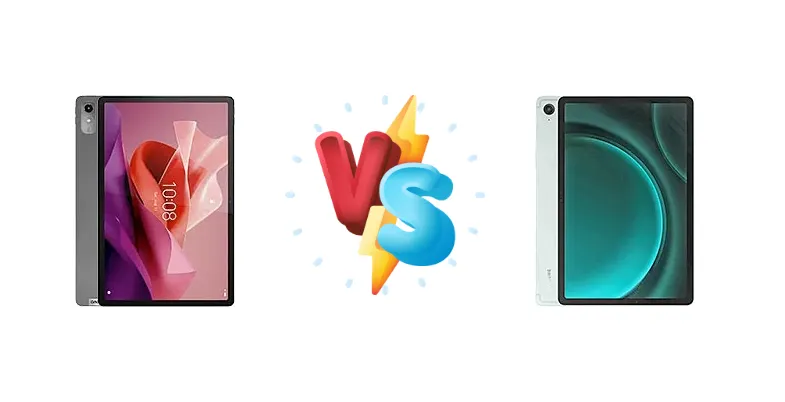
The mid-range Android tablet space is heating up, with the Lenovo Tab P12 and Samsung Galaxy Tab S9 FE offering compelling features at attractive price points. While both aim to deliver a versatile tablet experience, they diverge in their core approaches to performance and charging, making the choice less straightforward than it appears. This comparison dives deep into the specifications and implications of each device to determine which one best suits your needs.
🏆 Quick Verdict
For the average user prioritizing fast charging and a slightly more refined software experience, the Samsung Galaxy Tab S9 FE is the better choice. Its 45W charging significantly reduces downtime, and the Exynos 1380 provides comparable performance to the Dimensity 7050, despite being built on a more efficient 5nm process.
| Network |
|---|
| 2G bands | N/A | GSM 850 / 900 / 1800 / 1900 |
| 3G bands | N/A | HSDPA 850 / 900 / 1700(AWS) / 1900 / 2100 |
| 4G bands | N/A | 1, 2, 3, 4, 5, 7, 8, 12, 13, 17, 20, 26, 28, 32, 38, 40, 41, 66 |
| 5G bands | - | 1, 3, 5, 7, 8, 20, 28, 38, 40, 41, 66, 77, 78 SA/NSA/Sub6 |
| EDGE | No | - |
| GPRS | No | - |
| Speed | - | HSPA, LTE, 5G - cellular model only |
| Technology | No cellular connectivity | GSM / HSPA / LTE / 5G |
| Launch |
|---|
| Announced | 2023, July 28 | 2023, October 04 |
| Status | Available. Released 2023, July 28 | Available. Released 2023, October 16 |
| Body |
|---|
| Build | - | Glass front, aluminum back, aluminum frame |
| Dimensions | 293.3 x 190.7 x 6.9 mm (11.55 x 7.51 x 0.27 in) | 254.3 x 165.8 x 6.5 mm (10.01 x 6.53 x 0.26 in) |
| SIM | No | Nano-SIM + eSIM (cellular model only) |
| Weight | 615 g (1.36 lb) | 523 g or 524 g (1.15 lb) |
| Display |
|---|
| Resolution | 1840 x 2944 pixels, 16:10 ratio (~273 ppi density) | 1440 x 2304 pixels, 16:10 ratio (~249 ppi density) |
| Size | 12.7 inches, 467.7 cm2 (~83.6% screen-to-body ratio) | 10.9 inches, 344.5 cm2 (~81.7% screen-to-body ratio) |
| Type | IPS LCD | IPS LCD, 90Hz |
| Platform |
|---|
| CPU | Octa-core (2x2.6 GHz Cortex-A78 & 6x2.0 GHz Cortex-A55) | Octa-core (4x2.4 GHz Cortex-A78 & 4x2.0 GHz Cortex-A55) |
| Chipset | Mediatek Dimensity 7050 (6 nm) | Exynos 1380 (5 nm) |
| GPU | Mali-G68 MC4 | Mali-G68 MP5 |
| OS | Android 13 | Android 13, up to 4 major Android upgrades, One UI 6 |
| Memory |
|---|
| Card slot | microSDXC (dedicated slot) | microSDXC (dedicated slot) |
| Internal | 128GB 4GB RAM, 128GB 8GB RAM, 256GB 8GB RAM | 128GB 6GB RAM, 128GB 8GB RAM, 256GB 8GB RAM |
| Main Camera |
|---|
| Features | LED flash | - |
| Single | 8 MP, (wide), AF | 8 MP, (wide) |
| Video | 4K@30fps, 1080p@30fps | 4K@30fps, 1080p@30fps |
| Selfie camera |
|---|
| Single | 13 MP, (ultrawide) | 12 MP, (ultrawide) |
| Video | 1080p@30fps | Yes |
| Sound |
|---|
| 35mm jack | No | No |
| Loudspeaker | Yes, with stereo speakers (4 speakers) | Yes, with stereo speakers |
| Comms |
|---|
| Bluetooth | 5.1, A2DP, LE | 5.3, A2DP, LE |
| NFC | No | No |
| Positioning | No | GPS, GALILEO, GLONASS, BDS, QZSS - cellular model only |
| Radio | No | No |
| USB | USB Type-C 2.0 | USB Type-C 2.0, magnetic connector |
| WLAN | Wi-Fi 802.11 a/b/g/n/ac/6, dual-band, Wi-Fi Direct | Wi-Fi 802.11 a/b/g/n/ac/6, dual-band, Wi-Fi Direct |
| Features |
|---|
| Sensors | Fingerprint (side-mounted), accelerometer, gyro, compass | Fingerprint (side-mounted), accelerometer, gyro, compass, proximity (accessories only) |
| Battery |
|---|
| Charging | 30W wired, QC4 | 45W wired, QC2.0 |
| Type | Li-Po 10200 mAh | Li-Po 8000 mAh |
| Misc |
|---|
| Colors | Storm Grey, Oat | Mint, Silver, Gray, Lavender |
| Models | ZACH0165US | SM-X510, SM-X516B |
| Price | About 400 EUR | About 300 EUR |
| SAR | - | 1.55 W/kg (body) |
| SAR EU | - | 0.59 W/kg (body) |
Lenovo Tab P12
- Potentially lower price point
- Strong CPU clock speeds for burst performance
- Reliable Mediatek chipset
- Slower 30W charging
- Less efficient 6nm Dimensity 7050
- Potentially shorter software support lifecycle
Samsung Galaxy Tab S9 FE
- Faster 45W charging with QC2.0
- More efficient 5nm Exynos 1380
- Samsung's One UI software experience
- Potentially higher price
- Slightly lower CPU clock speeds on prime cores
- Samsung bloatware (subjective)
Display Comparison
Neither Lenovo nor Samsung provided display specs beyond the basic device information. However, given the market positioning, we can infer both likely utilize IPS LCD panels. The key difference lies in the chipset's impact on display rendering. The Exynos 1380's slightly more efficient architecture *could* translate to marginally better sustained brightness levels, but this is speculative. Bezels are likely comparable, typical of this price bracket. Color accuracy will depend on software calibration, a Samsung strength.
Camera Comparison
Camera performance is unlikely to be a deciding factor for most tablet buyers. Both devices likely feature modest camera setups. Without specific sensor details, it's difficult to make a definitive statement. However, Samsung generally excels in image processing, potentially delivering more pleasing results even with similar hardware. The inclusion of a 2MP macro camera on either device is largely a marketing gimmick and offers minimal practical benefit.
Performance
The core of the difference lies in the chipsets. The Samsung Galaxy Tab S9 FE’s Exynos 1380 (5nm) boasts a slight edge in CPU core configuration with 4x2.4 GHz Cortex-A78 cores versus the Lenovo Tab P12’s Dimensity 7050’s 2x2.6 GHz Cortex-A78 cores. While the P12 has a higher clock speed on its prime cores, the Exynos’s 5nm fabrication process offers superior power efficiency. This means the S9 FE is less likely to throttle under sustained load, benefiting users engaged in prolonged gaming or video editing. Both utilize 4x2.0 GHz Cortex-A55 efficiency cores, so background tasks will perform similarly. The S9 FE likely benefits from LPDDR5x RAM, further enhancing performance.
Battery Life
While battery capacity isn't specified, the charging capabilities are a clear differentiator. The Samsung Galaxy Tab S9 FE supports 45W wired charging with QC2.0, significantly faster than the Lenovo Tab P12’s 30W charging with QC4. This translates to substantially reduced charging times, a critical advantage for on-the-go users. The 5nm Exynos 1380’s efficiency also contributes to potentially longer battery life during typical usage, offsetting any potential capacity difference.
Buying Guide
Buy the Lenovo Tab P12 if you prioritize a balance of performance and affordability, and aren't heavily reliant on ultra-fast charging. It's a solid option for media consumption and light productivity tasks. Buy the Samsung Galaxy Tab S9 FE if you value quicker charging times, a more streamlined software experience with Samsung's One UI, and potentially longer-term software support. It's ideal for users who frequently use their tablet on the go and need to minimize downtime.
Frequently Asked Questions
❓ Does the Exynos 1380 in the S9 FE tend to overheat during extended gaming sessions?
The Exynos 1380's 5nm process is designed for improved thermal efficiency. While some heat generation is inevitable during demanding tasks like gaming, it's less prone to significant throttling compared to the 6nm Dimensity 7050 in the Tab P12, allowing for more sustained performance.
❓ Is the 30W charging on the Lenovo Tab P12 slow enough to be a major inconvenience?
30W charging is adequate for overnight charging, but it will take considerably longer to reach a full charge compared to the S9 FE's 45W charging. Users who frequently need to quickly top up their tablet's battery will find the S9 FE's charging speed a significant advantage.
❓ How does Samsung's One UI affect the user experience on the S9 FE compared to the Lenovo Tab P12's software?
Samsung's One UI offers a more polished and feature-rich software experience, with added functionalities like DeX mode for desktop-like productivity. However, it also includes pre-installed Samsung apps (bloatware) that some users may find undesirable. Lenovo's software is generally cleaner and closer to stock Android.
❓ Will either tablet struggle with multitasking, such as running multiple apps simultaneously?
Both tablets should handle moderate multitasking without issue. The S9 FE's likely use of LPDDR5x RAM provides a slight edge in memory bandwidth, potentially resulting in smoother performance when juggling numerous applications. However, both devices are equipped with sufficient RAM for typical tablet usage.