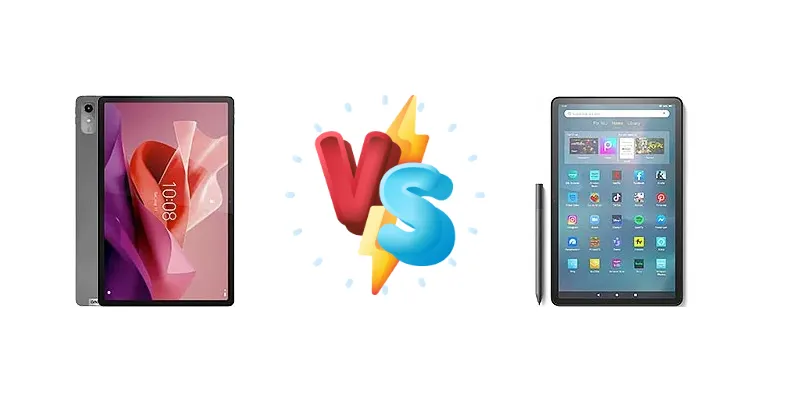
The Lenovo Tab P12 and Amazon Fire Max 11 both aim to deliver a premium tablet experience without the flagship price tag. However, they take distinctly different approaches. The Tab P12 focuses on raw performance with a modern chipset, while the Fire Max 11 prioritizes Amazon’s ecosystem integration and affordability. This comparison dissects their key differences to determine which tablet best suits your needs.
🏆 Quick Verdict
For users prioritizing performance and faster charging, the Lenovo Tab P12 is the clear winner. Its Mediatek Dimensity 7050 chipset offers a noticeable performance advantage over the Fire Max 11’s MT8188J, and the 30W charging significantly reduces downtime. However, the Fire Max 11 remains a compelling option for those deeply invested in the Amazon ecosystem.
| Network |
|---|
| 2G bands | N/A | N/A |
| 3G bands | N/A | - |
| 4G bands | N/A | - |
| EDGE | No | No |
| GPRS | No | No |
| Technology | No cellular connectivity | No cellular connectivity |
| Launch |
|---|
| Announced | 2023, July 28 | 2023, May 23 |
| Status | Available. Released 2023, July 28 | Available. Released 2023, May 23 |
| Body |
|---|
| Dimensions | 293.3 x 190.7 x 6.9 mm (11.55 x 7.51 x 0.27 in) | 259.1 x 163.7 x 7.5 mm (10.20 x 6.44 x 0.30 in) |
| SIM | No | No |
| Weight | 615 g (1.36 lb) | 490 g (1.08 lb) |
| Display |
|---|
| Resolution | 1840 x 2944 pixels, 16:10 ratio (~273 ppi density) | 2000 x 1200 pixels, 5:3 ratio (~212 ppi density) |
| Size | 12.7 inches, 467.7 cm2 (~83.6% screen-to-body ratio) | 11.0 inches, 344.4 cm2 (~81.2% screen-to-body ratio) |
| Type | IPS LCD | IPS LCD |
| Platform |
|---|
| CPU | Octa-core (2x2.6 GHz Cortex-A78 & 6x2.0 GHz Cortex-A55) | Octa-core (2x2.2 GHz Cortex-A78 & 6x2.0 GHz Cortex-A55) |
| Chipset | Mediatek Dimensity 7050 (6 nm) | Mediatek MT8188J |
| GPU | Mali-G68 MC4 | Mali-G57 MC2 |
| OS | Android 13 | Android 11, Fire OS 8 |
| Memory |
|---|
| Card slot | microSDXC (dedicated slot) | microSDXC (dedicated slot) |
| Internal | 128GB 4GB RAM, 128GB 8GB RAM, 256GB 8GB RAM | 64GB 4GB RAM, 128GB 4GB RAM |
| Main Camera |
|---|
| Features | LED flash | - |
| Single | 8 MP, (wide), AF | 8 MP, AF |
| Video | 4K@30fps, 1080p@30fps | 1080p |
| Selfie camera |
|---|
| Single | 13 MP, (ultrawide) | 8 MP |
| Video | 1080p@30fps | 1080p |
| Sound |
|---|
| 35mm jack | No | No |
| Loudspeaker | Yes, with stereo speakers (4 speakers) | Yes, with stereo speakers |
| Comms |
|---|
| Bluetooth | 5.1, A2DP, LE | 5.3, A2DP, LE |
| NFC | No | No |
| Positioning | No | No |
| Radio | No | No |
| USB | USB Type-C 2.0 | USB Type-C 2.0, OTG, magnetic accessory connector |
| WLAN | Wi-Fi 802.11 a/b/g/n/ac/6, dual-band, Wi-Fi Direct | Wi-Fi 802.11 a/b/g/n/ac/6, dual-band |
| Features |
|---|
| Sensors | Fingerprint (side-mounted), accelerometer, gyro, compass | Fingerprint (side-mounted), accelerometer, proximity (accessories only) |
| Battery |
|---|
| Charging | 30W wired, QC4 | 15W wired |
| Type | Li-Po 10200 mAh | Li-Ion |
| Misc |
|---|
| Colors | Storm Grey, Oat | Gray |
| Models | ZACH0165US | KFSNWI |
| Price | About 400 EUR | About 270 EUR |
Lenovo Tab P12
- Faster processor with Mediatek Dimensity 7050
- Significantly faster 30W charging with QC4
- More versatile Android experience
- Likely higher price point
- May lack deep Amazon ecosystem integration
Amazon Fire Max 11
- Lower price point
- Seamless Amazon ecosystem integration (Prime Video, Kindle)
- Alexa voice control
- Slower processor with Mediatek MT8188J
- Slower 15W charging
- Fire OS may be restrictive for some users
Display Comparison
While both tablets likely feature LCD panels (data not provided), the core performance difference lies elsewhere. Display quality details like resolution and refresh rate are missing, but the chipset impacts the smoothness of UI navigation and video playback. The absence of LTPO technology in either device suggests neither will dynamically adjust refresh rates for power saving.
Camera Comparison
Camera specifications are not provided for either device, making a direct comparison difficult. However, given the market positioning of the Fire Max 11, it’s likely to feature a more basic camera setup focused on video calls rather than photography. The Tab P12, aiming for a more premium experience, may offer a slightly more capable camera system, but neither is expected to compete with flagship smartphone cameras.
Performance
The Lenovo Tab P12’s Mediatek Dimensity 7050, fabricated on a 6nm process, represents a significant step up from the Amazon Fire Max 11’s Mediatek MT8188J. Both chipsets utilize an octa-core configuration with 2x Cortex-A78 cores and 6x Cortex-A55 cores, but the Dimensity 7050’s higher clock speeds (2.6 GHz vs 2.2 GHz) translate to faster processing. The 6nm node also contributes to improved thermal efficiency, potentially reducing throttling during sustained workloads. This means the Tab P12 will handle demanding apps and multitasking more effectively.
Battery Life
Battery capacity is not specified for either device. However, the charging capabilities are a clear differentiator. The Lenovo Tab P12 supports 30W wired charging with Quick Charge 4 (QC4) compatibility, enabling significantly faster charging times compared to the Fire Max 11’s 15W charging. This faster charging is a substantial benefit for users who rely on their tablets throughout the day and need to quickly top up the battery.
Buying Guide
Buy the Lenovo Tab P12 if you need a versatile tablet for productivity, media consumption, and light gaming, and value faster performance and charging speeds. It’s ideal for users who want a more standard Android experience. Buy the Amazon Fire Max 11 if you primarily consume Amazon content (Prime Video, Kindle books), rely heavily on Alexa, and prioritize affordability over raw processing power. It’s a strong choice for families and casual users.
Frequently Asked Questions
❓ Will the Mediatek Dimensity 7050 in the Tab P12 handle demanding games like Genshin Impact?
The Dimensity 7050 is a capable mid-range chipset. While it won't deliver flagship-level gaming performance, it should be able to run Genshin Impact at medium settings with reasonable frame rates. The 6nm process also helps mitigate thermal throttling during extended gaming sessions.
❓ How much does the Amazon Fire Max 11’s Fire OS differ from standard Android, and is it customizable?
Fire OS is a heavily customized version of Android. It prioritizes Amazon’s services and content, and lacks the Google Play Store. While you can sideload apps, the experience isn’t as seamless as with standard Android. Customization options are limited compared to stock Android or other Android skins.
❓ Is the 15W charging on the Fire Max 11 slow enough to be a major inconvenience?
15W charging is relatively slow by today’s standards. Expect a full charge to take several hours. This is best suited for overnight charging or infrequent use. If you frequently need to top up your tablet throughout the day, the Tab P12’s 30W charging is a significant advantage.