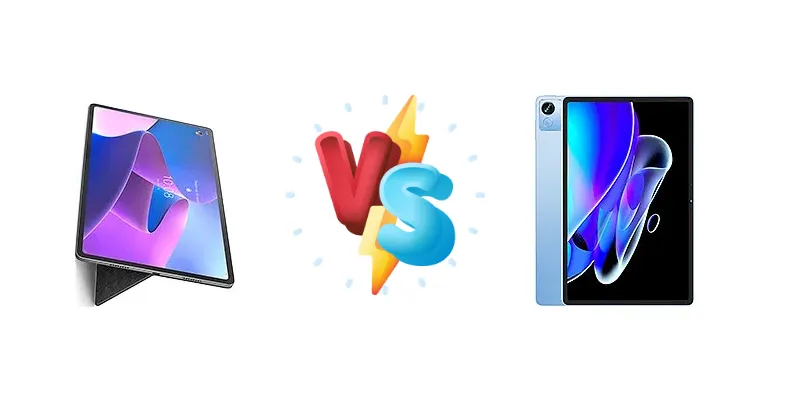
The Android tablet market is heating up, and two contenders vying for your attention are the Lenovo Tab P12 Pro and the Realme Pad X. Both offer compelling features, but cater to different needs and budgets. Let's dive into a detailed comparison to help you decide which one is right for you.
🏆 Quick Verdict
The Lenovo Tab P12 Pro takes the crown for raw performance thanks to its Snapdragon 870. However, the Realme Pad X offers excellent value with a vibrant display and solid features at a more accessible price point. Choose the P12 Pro for power, or the Pad X for budget-friendliness.
| Network |
|---|
| 2G bands | GSM 850 / 900 / 1800 / 1900 | GSM 850 / 900 / 1800 / 1900 |
| 3G bands | HSDPA 850 / 900 / 1900 / 2100 | HSDPA 850 / 900 / 2100 |
| 4G bands | 1, 2, 3, 4, 5, 7, 8, 19, 20, 26, 28, 34, 38, 39, 40, 41 | LTE |
| 5G bands | 1, 3, 7, 8, 20, 28, 38, 41, 77, 78 SA/NSA/Sub6 | SA/NSA |
| Speed | HSPA, LTE, 5G - cellular model only | HSPA, LTE, 5G - cellular model only |
| Technology | GSM / HSPA / LTE / 5G | GSM / HSPA / LTE / 5G |
| Launch |
|---|
| Announced | 2021, September 08 | 2022, May 25 |
| Status | Available. Released 2021, November 19 | Available. Released 2022, June 12 |
| Body |
|---|
| Build | - | Glass front, plastic frame, plastic back |
| Dimensions | 285.6 x 184.5 x 5.6 mm (11.24 x 7.26 x 0.22 in) | 256.5 x 161.1 x 7.1 mm (10.10 x 6.34 x 0.28 in) |
| SIM | Nano-SIM (cellular model only) | Nano-SIM + Nano-SIM (cellular model only) |
| Weight | 565 g (1.25 lb) | 499 g / 506 g (1.10 lb) |
| | Stylus support | Stylus support (magnetic charging) |
| Display |
|---|
| Resolution | 1600 x 2560 pixels, 16:10 ratio (~240 ppi density) | 1200 x 2000 pixels, 5:3 ratio (~213 ppi density) |
| Size | 12.6 inches, 460.3 cm2 (~87.4% screen-to-body ratio) | 10.95 inches, 341.3 cm2 (~82.6% screen-to-body ratio) |
| Type | AMOLED, 120Hz, HDR10+, Dolby Vision, 600 nits (HBM) | IPS LCD, 450 nits (peak) |
| Platform |
|---|
| CPU | Octa-core (1x3.2 GHz Kryo 585 & 3x2.42 GHz Kryo 585 & 4x1.80 GHz Kryo 585) | Octa-core (2x2.2 GHz Kryo 660 Gold & 6x1.7 GHz Kryo 660 Silver) |
| Chipset | Qualcomm SM8250-AC Snapdragon 870 5G (7 nm) | Qualcomm SM6375 Snapdragon 695 5G (6 nm) |
| GPU | Adreno 650 | Adreno 619 |
| OS | Android 11 | Android, Realme UI 3.0 |
| Memory |
|---|
| Card slot | microSDXC (dedicated slot) | microSDXC |
| Internal | 128GB 6GB RAM, 256GB 8GB RAM | 64GB 4GB RAM, 128GB 6GB RAM |
| Main Camera |
|---|
| Dual | 13 MP, (wide), AF
5 MP, (ultrawide) | - |
| Single | - | 13 MP, f/2.2, (wide), AF |
| Video | 4K@30fps, 1080p@30fps | 1080p@30fps |
| Selfie camera |
|---|
| Single | 8 MP, (wide)
8 MP, IR TOF 3D, (biometrics sensor only) | 8 MP, f/2.0, 105˚ (ultrawide) |
| Video | 1080p@30fps | 1080p@30fps |
| Sound |
|---|
| 3.5mm jack | No | No |
| 35mm jack | No | No |
| Loudspeaker | Yes, with stereo speakers (4 speakers) | Yes, with stereo speakers (4 speakers) |
| | JBL speakers | 24-bit/192kHz audio |
| Comms |
|---|
| Bluetooth | 5.2, A2DP, LE | 5.1, A2DP, LE |
| NFC | Yes (wireless charging and data transfer only) | No |
| Positioning | GPS, GLONASS, BDS - cellular model only | GPS, GLONASS, GALILEO, BDS - cellular model only |
| Radio | Unspecified | No |
| USB | USB Type-C 3.1 | USB Type-C 2.0, OTG |
| WLAN | Wi-Fi 802.11 a/b/g/n/ac/6, dual-band, Wi-Fi Direct | Wi-Fi 802.11 b/g/n/ac, hotspot |
| Features |
|---|
| Sensors | Fingerprint (side-mounted), accelerometer, gyro, proximity | Accelerometer, gyro, compass |
| Battery |
|---|
| Charging | 45W wired, QC4 | 33W wired, PD
5W reverse wired |
| Type | Li-Po 10200 mAh | 8340 mAh |
| Misc |
|---|
| Colors | Storm Grey | Glowing Gray, Glacier Blue, Green |
| Models | TB-Q706Z, TB-Q706F | RMP2107, RMP2108 |
| Price | About 520 EUR | About 250 EUR |
| Tests |
|---|
| Display | - |
Contrast ratio: 1664:1 |
| Loudspeaker | - |
-22.5 LUFS (Excellent)
|
| Performance | - |
AnTuTu: 395824 (v9)
GeekBench: 2026 (v5.1)
GFXBench: 18fps (ES 3.1 onscreen) |
Lenovo Tab P12 Pro
- Superior Performance (Snapdragon 870)
- Potentially Better Display (Color Accuracy, Resolution)
- Faster Charging (45W)
- Premium Build Quality
- Higher Price
- Potentially Less Value for Casual Users
Realme Pad X
- Excellent Value for Money
- Bright Display (496 nits)
- Reverse Wired Charging
- Good for Casual Use
- Lower Performance (Snapdragon 695)
- Potentially Less Refined Display
- Slower Charging (33W)
Display Comparison
Both tablets boast impressive displays. The Realme Pad X has a slightly higher contrast ratio (1664:1 vs 1655:1) and measured brightness of 496 nits, making it potentially brighter in outdoor conditions. The P12 Pro likely has better color accuracy and potentially a higher resolution, though specific numbers are needed for a definitive comparison. Both offer a great viewing experience.
Camera Comparison
Camera quality is often an afterthought on tablets. While neither is exceptional, the P12 Pro likely has a slightly better camera system due to its higher-end chipset and potentially better sensors. Expect decent image quality for video calls and casual snapshots on both devices.
Performance
This is where the Lenovo Tab P12 Pro shines. Its Snapdragon 870 chipset is significantly more powerful than the Realme Pad X's Snapdragon 695. Expect smoother multitasking, faster app loading times, and better gaming performance on the P12 Pro. The Pad X is still capable for everyday tasks, but struggles with more demanding workloads.
Battery Life
Battery life is expected to be comparable, with both devices offering all-day usage for moderate use. The P12 Pro's larger battery (likely around 10200 mAh) might give it a slight edge, but the Pad X's efficient Snapdragon 695 could help it compete. Charging speeds are also a factor, with the P12 Pro offering faster 45W charging compared to the Pad X's 33W.
Buying Guide
The Lenovo Tab P12 Pro is ideal for power users, creatives, and those who demand top-tier performance for gaming, multitasking, and demanding applications. The Realme Pad X is perfect for students, casual users, and those seeking a well-rounded tablet experience without breaking the bank.
Frequently Asked Questions
❓ Is the Lenovo Tab P12 Pro worth the extra money?
If you prioritize performance and a premium experience, then yes. However, if you're on a budget and primarily use your tablet for casual tasks, the Realme Pad X offers excellent value.
❓ Which tablet is better for gaming?
The Lenovo Tab P12 Pro is significantly better for gaming due to its more powerful Snapdragon 870 chipset. It will handle demanding games with higher frame rates and better graphics settings.