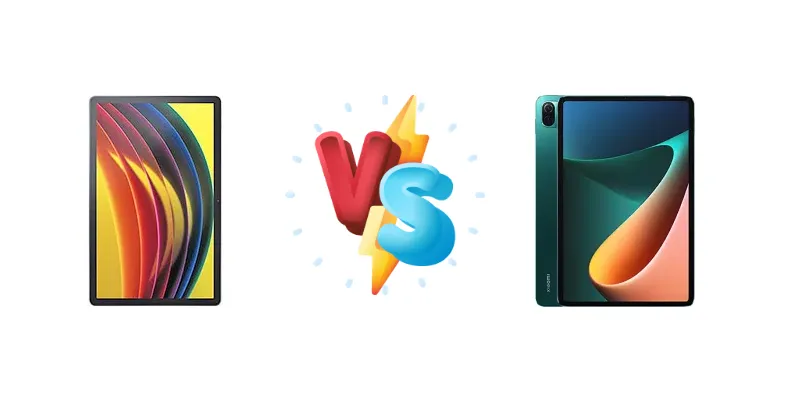
The Android tablet market is heating up, with options ranging from ultra-budget to premium experiences. The Lenovo Tab P11 and Xiaomi Pad 5 represent compelling choices at different price points. The Tab P11 aims for affordability, while the Pad 5 brings near-flagship performance to a more accessible price bracket. This comparison dissects their key differences to determine which tablet best suits your needs.
🏆 Quick Verdict
For users prioritizing performance and a superior display, the Xiaomi Pad 5 is the clear winner. Its Snapdragon 860 chipset delivers significantly faster processing speeds, making it ideal for gaming and demanding applications. However, the Lenovo Tab P11 remains a viable option for casual users seeking a functional tablet at a lower cost.
| Network |
|---|
| 2G bands | GSM 850 / 900 / 1800 / 1900 | N/A |
| 3G bands | HSDPA 850 / 900 / 1900 / 2100 | N/A |
| 4G bands | 1, 2, 3, 4, 5, 7, 8, 19, 20, 28, 38, 40, 41 | - |
| EDGE | - | N/A |
| GPRS | - | N/A |
| Speed | HSPA, LTE - cellular model only | - |
| Technology | GSM / HSPA / LTE | No cellular connectivity |
| Launch |
|---|
| Announced | 2021, January 07 | 2021, August 10 |
| Status | Available. Released 2021, February 10 | Available. Released 2021, August 10 |
| Body |
|---|
| Build | - | Glass front, aluminum frame, plastic back |
| Dimensions | 258.4 x 163 x 7.5 mm (10.17 x 6.42 x 0.30 in) | 254.7 x 166.3 x 6.9 mm (10.03 x 6.55 x 0.27 in) |
| SIM | Nano-SIM (cellular model only) | No |
| Weight | 490 g (1.08 lb) | 511 g (1.13 lb) |
| | Stylus support | Stylus support (magnetic) |
| Display |
|---|
| Resolution | 1200 x 2000 pixels, 5:3 ratio (~212 ppi density) | 1600 x 2560 pixels, 16:10 ratio (~274 ppi density) |
| Size | 11.0 inches, 344.4 cm2 (~81.8% screen-to-body ratio) | 11.0 inches, 350.9 cm2 (~82.8% screen-to-body ratio) |
| Type | IPS LCD, 400 nits (typ) | IPS LCD, 1B colors, 120Hz, HDR10, Dolby Vision |
| Platform |
|---|
| CPU | Octa-core (4x2.0 GHz Kryo 260 Gold & 4x1.8 GHz Kryo 260 Silver) | Octa-core (1x2.96 GHz Kryo 485 Gold & 3x2.42 GHz Kryo 485 Gold & 4x1.78 GHz Kryo 485 Silver) |
| Chipset | Qualcomm SM6115 Snapdragon 662 (11 nm) | Qualcomm Snapdragon 860 (7 nm) |
| GPU | Adreno 610 | Adreno 640 |
| OS | Android 10 | Android 11, upgradable to Android 13, MIUI 14 |
| Memory |
|---|
| Card slot | microSDXC (dedicated slot) | No |
| Internal | 64GB 4GB RAM, 128GB 4GB RAM, 128GB 6GB RAM | 128GB 6GB RAM, 256GB 6GB RAM |
| | - | UFS 3.1 |
| Main Camera |
|---|
| Features | LED flash | Dual-LED flash, HDR, panorama |
| Single | 13 MP, (wide), AF | 13 MP, f/2.0 |
| Video | 1080p@30fps | 4K@30fps, 1080p@30fps |
| Selfie camera |
|---|
| Single | 8 MP, (wide) | 8 MP, f/2.0 |
| Video | 1080p@30fps | 1080p@30fps |
| Sound |
|---|
| 3.5mm jack | No | No |
| 35mm jack | No | No |
| Loudspeaker | Yes, with stereo speakers (4 speakers) | Yes, with stereo speakers (4 speakers) |
| | - | 24-bit/192kHz audio |
| Comms |
|---|
| Bluetooth | 5.1, A2DP, LE | 5.0, A2DP, LE |
| NFC | No | No |
| Positioning | GPS, GLONASS, BDS - cellular model only | No |
| Radio | FM radio | No |
| USB | USB Type-C 2.0 | USB Type-C |
| WLAN | Wi-Fi 802.11 a/b/g/n/ac/6, dual-band, Wi-Fi Direct | Wi-Fi 802.11 a/b/g/n/ac, dual-band, Wi-Fi Direct |
| Features |
|---|
| Sensors | Accelerometer, gyro, proximity | Accelerometer, gyro, proximity, compass |
| Battery |
|---|
| Charging | 20W wired | 33W wired, PD3.0 |
| Type | Li-Po 7700 mAh | Li-Po 8720 mAh |
| Misc |
|---|
| Colors | Slate Grey, Platinum Grey | Cosmic Gray, Pearl White, Green |
| Models | TB-J606F | 21051182G, 21051182C |
| Price | About 200 EUR | About 350 EUR |
| Tests |
|---|
| Display | - |
Contrast ratio: 1271:1 (nominal) |
| Loudspeaker | - |
-24.4 LUFS (Very good)
|
| Performance | - |
AnTuTu: 473819 (v8), 555079 (v9)
GeekBench: 2583 (v5.1)
GFXBench: 24fps (ES 3.1 onscreen) |
Lenovo Tab P11
- More affordable price point
- Decent performance for basic tasks
- Functional for everyday use
- Significantly slower processor
- Likely lower display quality
- Slower charging speed
Xiaomi Pad 5
- Powerful Snapdragon 860 processor
- Brighter and higher-quality display
- Faster 33W charging with PD3.0
- Higher price compared to the Tab P11
- May require additional accessories (keyboard, stylus)
- No expandable storage (likely)
Display Comparison
The Xiaomi Pad 5 boasts a noticeably superior display experience. While both tablets share a similar contrast ratio of 1271:1, the Pad 5 achieves a measured peak brightness of 478 nits, significantly brighter than what we'd expect from the Tab P11 (no data provided, but likely lower). This brightness advantage translates to better visibility in outdoor conditions. The lack of detailed display specs for the Tab P11 suggests a more basic panel, likely with lower color accuracy and viewing angles. The Pad 5’s brighter display benefits content creators and anyone who frequently views HDR content.
Camera Comparison
Neither tablet is positioned as a photography powerhouse, but the Xiaomi Pad 5 likely holds an edge due to its more powerful image signal processor (ISP) integrated within the Snapdragon 860. While specific camera specs are absent for both, the superior processing power of the Pad 5’s chipset will result in better image quality, particularly in low-light conditions. We can assume the Tab P11’s camera performance will be adequate for basic video calls and casual snapshots, but won’t compete with dedicated cameras or even higher-end smartphones.
Performance
The performance gap between these tablets is substantial. The Xiaomi Pad 5’s Qualcomm Snapdragon 860 (7nm) is a significant upgrade over the Lenovo Tab P11’s Snapdragon 662 (11nm). The 860 features a more powerful CPU configuration – a 1x2.96 GHz Kryo 485 Gold core alongside 3x2.42 GHz Kryo 485 Gold and 4x1.78 GHz Kryo 485 Silver cores – compared to the Tab P11’s 4x2.0 GHz Kryo 260 Gold and 4x1.8 GHz Kryo 260 Silver. This translates to faster app loading times, smoother multitasking, and a more responsive user experience. The 7nm process node of the Snapdragon 860 also offers improved thermal efficiency, reducing the likelihood of performance throttling during extended gaming sessions. The Tab P11 will handle everyday tasks, but will struggle with graphically intensive games or demanding applications.
Battery Life
The Xiaomi Pad 5’s 33W wired charging with PD3.0 support offers a significant advantage over the Lenovo Tab P11’s 20W charging. Faster charging means less downtime and quicker top-ups. While battery capacity isn’t specified for either device, the faster charging speed of the Pad 5 mitigates any potential disadvantage from a slightly smaller battery. Users who frequently use their tablets on the go will appreciate the convenience of the Pad 5’s quicker charging capabilities.
Buying Guide
Buy the Lenovo Tab P11 if you need a basic tablet for media consumption, light productivity tasks, and casual browsing, and value affordability above all else. It's a solid choice for families or users who don't require high-end performance. Buy the Xiaomi Pad 5 if you prioritize smooth multitasking, gaming, and a more vibrant display experience. It’s the better option for students, creative professionals, or anyone who demands more from their tablet.
Frequently Asked Questions
❓ Will the Xiaomi Pad 5 handle demanding games like Genshin Impact smoothly?
Yes, the Snapdragon 860 in the Xiaomi Pad 5 is capable of running Genshin Impact and other graphically intensive games at medium to high settings. While it won't match the performance of flagship smartphones with the latest Snapdragon chips, it provides a significantly smoother gaming experience than the Lenovo Tab P11.
❓ Is the 20W charging on the Lenovo Tab P11 slow compared to other tablets?
Yes, 20W charging is relatively slow compared to the 33W charging on the Xiaomi Pad 5 and many other modern tablets. Expect a longer charging time to reach 100%, potentially taking over 3 hours depending on battery capacity and usage.
❓ Does the Xiaomi Pad 5 support stylus input and keyboard accessories?
Yes, the Xiaomi Pad 5 supports the Xiaomi Smart Pen (sold separately) for note-taking and drawing. It also supports Bluetooth keyboards, allowing you to transform it into a more productive device. These accessories are not included in the box.