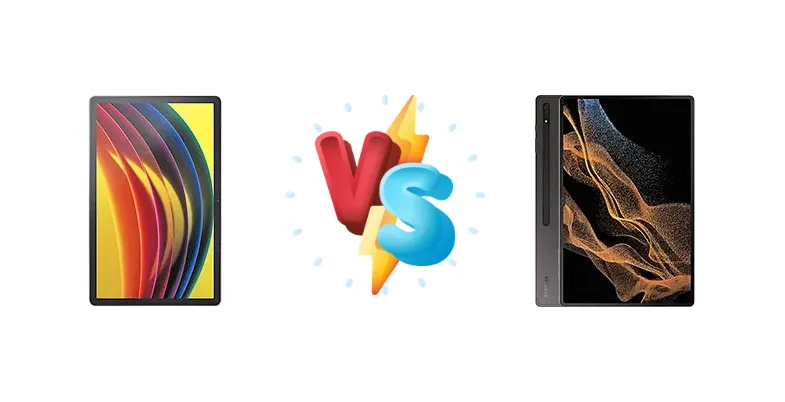
The Android tablet market offers a wide spectrum of choices, from affordable everyday devices to ultra-premium powerhouses. We pit the Lenovo Tab P11, a budget-friendly option, against the Samsung Galaxy Tab S8 Ultra, a flagship boasting cutting-edge technology, to determine which tablet best suits your needs and budget.
🏆 Quick Verdict
For the average user prioritizing affordability and basic functionality, the Lenovo Tab P11 offers a compelling value. However, the Samsung Galaxy Tab S8 Ultra is the clear winner for power users demanding top-tier performance, a stunning display, and rapid charging, justifying its significantly higher price tag.
| Network |
|---|
| 2G bands | GSM 850 / 900 / 1800 / 1900 | GSM 850 / 900 / 1800 / 1900 |
| 3G bands | HSDPA 850 / 900 / 1900 / 2100 | HSDPA 850 / 900 / 1700(AWS) / 1900 / 2100 |
| 4G bands | 1, 2, 3, 4, 5, 7, 8, 19, 20, 28, 38, 40, 41 | LTE |
| 5G bands | - | SA/NSA |
| Speed | HSPA, LTE - cellular model only | HSPA, LTE, 5G - cellular model only |
| Technology | GSM / HSPA / LTE | GSM / HSPA / LTE / 5G |
| Launch |
|---|
| Announced | 2021, January 07 | 2022, February 09 |
| Status | Available. Released 2021, February 10 | Available. Released 2022, April 30 |
| Body |
|---|
| Dimensions | 258.4 x 163 x 7.5 mm (10.17 x 6.42 x 0.30 in) | 326.4 x 208.6 x 5.5 mm (12.85 x 8.21 x 0.22 in) |
| SIM | Nano-SIM (cellular model only) | Nano-SIM (cellular model only) |
| Weight | 490 g (1.08 lb) | 726 g (Wi-Fi), 728 g (5G) (1.60 lb) |
| | Stylus support | Stylus, 2.8ms latency (Bluetooth integration, accelerometer, gyro) |
| Display |
|---|
| Protection | - | Corning Gorilla Glass 5 |
| Resolution | 1200 x 2000 pixels, 5:3 ratio (~212 ppi density) | 1848 x 2960 pixels, 16:10 ratio (~240 ppi density) |
| Size | 11.0 inches, 344.4 cm2 (~81.8% screen-to-body ratio) | 14.6 inches, 612.6 cm2 (~90.0% screen-to-body ratio) |
| Type | IPS LCD, 400 nits (typ) | Super AMOLED, 120Hz, HDR10+ |
| Platform |
|---|
| CPU | Octa-core (4x2.0 GHz Kryo 260 Gold & 4x1.8 GHz Kryo 260 Silver) | Octa-core (1x3.00 GHz Cortex-X2 & 3x2.50 GHz Cortex-A710 & 4x1.80 GHz Cortex-A510) |
| Chipset | Qualcomm SM6115 Snapdragon 662 (11 nm) | Qualcomm SM8450 Snapdragon 8 Gen 1 (4 nm) |
| GPU | Adreno 610 | Adreno 730 |
| OS | Android 10 | Android 12, up to 4 major Android upgrades, One UI 6.1.1 |
| Memory |
|---|
| Card slot | microSDXC (dedicated slot) | microSDXC (dedicated slot) |
| Internal | 64GB 4GB RAM, 128GB 4GB RAM, 128GB 6GB RAM | 128GB 8GB RAM, 256GB 8GB RAM, 256GB 12GB RAM, 256GB 16GB RAM, 512GB 12GB RAM, 512GB 16GB RAM |
| | - | UFS |
| Main Camera |
|---|
| Dual | - | 13 MP, f/2.0, 26mm (wide), 1/3.4", 1.0µm, AF
6 MP, f/2.2, (ultrawide) |
| Features | LED flash | LED flash, HDR, panorama |
| Single | 13 MP, (wide), AF | - |
| Video | 1080p@30fps | 4K@30/60fps, 1080p@30fps |
| Selfie camera |
|---|
| Dual | - | 12 MP, f/2.2, 26mm (wide)
12 MP, f/2.4, 120˚ (ultrawide) |
| Features | - | HDR |
| Single | 8 MP, (wide) | - |
| Video | 1080p@30fps | 4K@30/60fps, 1080p@30fps |
| Sound |
|---|
| 3.5mm jack | No | No |
| 35mm jack | No | No |
| Loudspeaker | Yes, with stereo speakers (4 speakers) | Yes, with stereo speakers (4 speakers) |
| | - | Tuned by AKG |
| Comms |
|---|
| Bluetooth | 5.1, A2DP, LE | 5.2, A2DP, LE |
| NFC | No | No |
| Positioning | GPS, GLONASS, BDS - cellular model only | GPS, GLONASS, BDS, GALILEO - cellular model only |
| Radio | FM radio | No |
| USB | USB Type-C 2.0 | USB Type-C 3.2, magnetic connector |
| WLAN | Wi-Fi 802.11 a/b/g/n/ac/6, dual-band, Wi-Fi Direct | Wi-Fi 802.11 a/b/g/n/ac/6e, dual-band, Wi-Fi Direct |
| Features |
|---|
| Sensors | Accelerometer, gyro, proximity | Fingerprint (under display, optical), accelerometer, gyro, proximity, compass |
| | - | Wireless Samsung DeX |
| Battery |
|---|
| Charging | 20W wired | 45W wired, 100% in 82 min |
| Type | Li-Po 7700 mAh | Li-Po 11200 mAh |
| Misc |
|---|
| Colors | Slate Grey, Platinum Grey | Graphite |
| Models | TB-J606F | SM-X900, SM-X906, SM-X906B, SM-X906U, SM-X906N |
| Price | About 200 EUR | About 1150 EUR |
| SAR EU | - | 0.69 W/kg (body) |
Lenovo Tab P11
- Significantly more affordable
- Suitable for basic tasks and media consumption
- Lightweight and portable
- Limited performance for demanding applications
- Slower charging speed
- Likely lower quality display
Samsung Galaxy Tab S8 Ultra
- Exceptional performance with Snapdragon 8 Gen 1
- Stunning Super AMOLED display
- Fast 45W charging
- Very expensive
- Large size may not be ideal for all users
- Higher power consumption
Display Comparison
While display specifications for the Lenovo Tab P11 are not provided, it's reasonable to assume a standard LCD panel given its price point. The Samsung Galaxy Tab S8 Ultra, however, features a massive 14.6-inch Super AMOLED display. This difference in panel technology translates to significantly richer colors, deeper blacks, and wider viewing angles on the Samsung. The Tab S8 Ultra’s larger size and higher resolution will be particularly beneficial for multitasking and media consumption. The Snapdragon 8 Gen 1’s processing power can fully utilize the display’s capabilities, while the Snapdragon 662 in the Tab P11 may struggle to deliver a consistently smooth experience with graphically intensive content.
Camera Comparison
Given the context data, a detailed camera comparison is limited. The Tab P11 likely features a standard camera setup for video calls and basic photography. The Samsung Galaxy Tab S8 Ultra, while not primarily a camera-focused device, benefits from the processing power of the Snapdragon 8 Gen 1, enabling better image processing and potentially higher-quality photos and videos. The Tab S8 Ultra’s camera system is likely to include features like auto-focus and potentially OIS, which are unlikely to be found on the Tab P11.
Performance
The core difference lies in the chipsets: the Lenovo Tab P11 utilizes the Qualcomm Snapdragon 662 (11nm), while the Samsung Galaxy Tab S8 Ultra is powered by the Snapdragon 8 Gen 1 (4nm). This is a generational leap. The 4nm process node of the Snapdragon 8 Gen 1 offers significantly improved power efficiency and thermal performance compared to the 11nm Snapdragon 662. The Tab S8 Ultra’s CPU, with its Cortex-X2 prime core, will deliver substantially faster performance in single-threaded tasks, while the combination of Cortex-A710 and A510 cores provides a robust foundation for multitasking. The Tab P11’s Kryo 260 cores are adequate for basic tasks, but will show their limitations when running demanding applications or games. The Tab S8 Ultra is likely to feature faster LPDDR5X RAM, further enhancing performance.
Battery Life
The Lenovo Tab P11 supports 20W wired charging, while the Samsung Galaxy Tab S8 Ultra boasts 45W wired charging, reaching 100% in just 82 minutes. While battery capacity isn’t specified for either device, the faster charging speed of the Tab S8 Ultra is a significant advantage for users who need to quickly top up their battery. The Snapdragon 8 Gen 1’s improved power efficiency, despite its higher performance, may partially offset the Tab S8 Ultra’s larger display and more demanding applications, resulting in comparable real-world battery life, but the Tab P11 will likely require more frequent charging for similar usage.
Buying Guide
Buy the Lenovo Tab P11 if you need a reliable tablet for casual browsing, video streaming, and light productivity tasks, and are on a tight budget. It’s ideal for families or users who don’t require the latest and greatest specs. Buy the Samsung Galaxy Tab S8 Ultra if you prioritize uncompromising performance for demanding applications like video editing, gaming, or multitasking, and value a large, high-resolution display with fast charging capabilities. This is the tablet for professionals and enthusiasts.
Frequently Asked Questions
❓ Is the Snapdragon 8 Gen 1 in the Tab S8 Ultra prone to overheating during extended gaming sessions?
While the Snapdragon 8 Gen 1 was known to have some thermal throttling issues in early smartphones, Samsung has implemented robust cooling solutions in the Tab S8 Ultra, including a large vapor chamber. This, combined with the tablet’s larger chassis, helps to mitigate overheating and maintain consistent performance during prolonged gaming.
❓ Can the Lenovo Tab P11 handle multitasking with several apps open simultaneously?
The Lenovo Tab P11’s Snapdragon 662 and likely 4GB or 6GB of RAM can handle moderate multitasking, such as browsing the web while listening to music. However, it may struggle with more demanding tasks like running multiple resource-intensive apps concurrently, leading to slowdowns and lag.
❓ Does the Samsung Galaxy Tab S8 Ultra support DeX mode for a desktop-like experience?
Yes, the Samsung Galaxy Tab S8 Ultra fully supports DeX mode, allowing you to connect it to an external monitor, keyboard, and mouse for a desktop-like experience. This is a significant advantage for productivity users who want to use their tablet as a portable workstation.
❓ What type of storage does the Lenovo Tab P11 use, and is it expandable?
While not specified, the Lenovo Tab P11 likely uses eMMC storage to keep costs down. It also features a microSD card slot for expandable storage, allowing you to add more space for your files and apps.