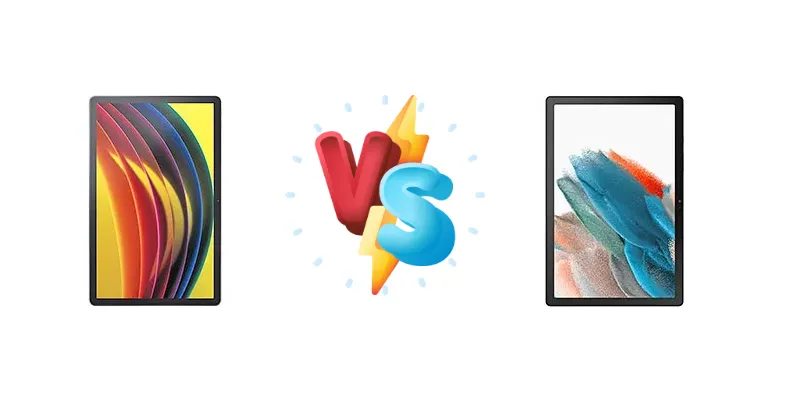
The Lenovo Tab P11 and Samsung Galaxy Tab A8 10.5 (2021) represent compelling options in the crowded budget tablet space. Both aim to deliver a versatile Android experience without breaking the bank, but they achieve this through different approaches to core components like the chipset and charging technology. This comparison dissects these differences to determine which tablet best suits your needs.
🏆 Quick Verdict
For users prioritizing consistent performance in everyday tasks and light gaming, the Lenovo Tab P11 emerges as the better choice. Its Qualcomm Snapdragon 662, built on an 11nm process, offers a more refined architecture than the Samsung’s Unisoc Tiger T618, despite the latter’s 12nm fabrication. While the Tab A8 is a capable device, the P11’s chipset provides a smoother overall experience.
| Network |
|---|
| 2G bands | GSM 850 / 900 / 1800 / 1900 | GSM 850 / 900 / 1800 / 1900 |
| 3G bands | HSDPA 850 / 900 / 1900 / 2100 | HSDPA 850 / 900 / 1700(AWS) / 1900 / 2100 |
| 4G bands | 1, 2, 3, 4, 5, 7, 8, 19, 20, 28, 38, 40, 41 | 1, 2, 3, 4, 5, 7, 8, 12, 17, 20, 28, 38, 40, 41, 66 |
| Speed | HSPA, LTE - cellular model only | HSPA, LTE - cellular model only |
| Technology | GSM / HSPA / LTE | GSM / HSPA / LTE |
| Launch |
|---|
| Announced | 2021, January 07 | 2021, December 15 |
| Status | Available. Released 2021, February 10 | Available. Released 2022, January 17 |
| Body |
|---|
| Dimensions | 258.4 x 163 x 7.5 mm (10.17 x 6.42 x 0.30 in) | 246.8 x 161.9 x 6.9 mm (9.72 x 6.37 x 0.27 in) |
| SIM | Nano-SIM (cellular model only) | Nano-SIM (cellular model only) |
| Weight | 490 g (1.08 lb) | 508 g (1.12 lb) |
| | Stylus support | - |
| Display |
|---|
| Resolution | 1200 x 2000 pixels, 5:3 ratio (~212 ppi density) | 1200 x 1920 pixels, 16:10 ratio (~216 ppi density) |
| Size | 11.0 inches, 344.4 cm2 (~81.8% screen-to-body ratio) | 10.5 inches, 319.7 cm2 (~80.0% screen-to-body ratio) |
| Type | IPS LCD, 400 nits (typ) | TFT LCD |
| Platform |
|---|
| CPU | Octa-core (4x2.0 GHz Kryo 260 Gold & 4x1.8 GHz Kryo 260 Silver) | Octa-core (2x2.0 GHz Cortex-A75 & 6x2.0 GHz Cortex-A55) |
| Chipset | Qualcomm SM6115 Snapdragon 662 (11 nm) | Unisoc Tiger T618 (12 nm) |
| GPU | Adreno 610 | Mali G52 MP2 |
| OS | Android 10 | Android 11, upgradable to Android 14, One UI 6 |
| Memory |
|---|
| Card slot | microSDXC (dedicated slot) | microSDXC (dedicated slot) |
| Internal | 64GB 4GB RAM, 128GB 4GB RAM, 128GB 6GB RAM | 32GB 2GB RAM, 32GB 3GB RAM, 64GB 2GB RAM, 64GB 3GB RAM, 64GB 4GB RAM, 128GB 3GB RAM, 128GB 4GB RAM |
| Main Camera |
|---|
| Features | LED flash | - |
| Single | 13 MP, (wide), AF | 8 MP, AF |
| Video | 1080p@30fps | 1080p@30fps |
| Selfie camera |
|---|
| Single | 8 MP, (wide) | 5 MP |
| Video | 1080p@30fps | 1080p@30fps |
| Sound |
|---|
| 3.5mm jack | No | Yes |
| 35mm jack | No | Yes |
| Loudspeaker | Yes, with stereo speakers (4 speakers) | Yes, with stereo speakers (4 speakers) |
| Comms |
|---|
| Bluetooth | 5.1, A2DP, LE | 5.0, A2DP, LE |
| NFC | No | No |
| Positioning | GPS, GLONASS, BDS - cellular model only | GPS, GLONASS, BDS, GALILEO, QZSS - cellular model only |
| Radio | FM radio | No |
| USB | USB Type-C 2.0 | USB Type-C 2.0 |
| WLAN | Wi-Fi 802.11 a/b/g/n/ac/6, dual-band, Wi-Fi Direct | Wi-Fi 802.11 a/b/g/n/ac, dual-band, Wi-Fi Direct |
| Features |
|---|
| Sensors | Accelerometer, gyro, proximity | Accelerometer, gyro, proximity, compass |
| Battery |
|---|
| Charging | 20W wired | 15W wired |
| Type | Li-Po 7700 mAh | Li-Po 7040 mAh |
| Misc |
|---|
| Colors | Slate Grey, Platinum Grey | Gray, Silver, Pink Gold |
| Models | TB-J606F | SM-X200, SM-X205 |
| Price | About 200 EUR | About 230 EUR |
| SAR EU | - | 0.92 W/kg (body) |
Lenovo Tab P11
- More powerful Snapdragon 662 chipset
- Faster 20W wired charging
- Potentially better sustained performance
- Brand recognition not as strong as Samsung
- Display specs are unknown
Samsung Galaxy Tab A8 10.5 (2021)
- Familiar Samsung One UI experience
- Potentially lower price point
- Samsung ecosystem integration
- Less powerful Unisoc Tiger T618 chipset
- Slower 15W wired charging
- Potential for more noticeable performance throttling
Display Comparison
Neither device boasts a particularly standout display, but details are lacking to make a definitive comparison. Both are 10.5-inch displays, but without information on panel type (IPS, TFT), resolution, or brightness, it's difficult to assess visual quality. However, the absence of high refresh rate support on either device suggests a focus on power efficiency over visual fluidity. Bezels are likely comparable given the price bracket.
Camera Comparison
Camera performance is unlikely to be a deciding factor for either tablet. Details are insufficient to make a meaningful comparison. Both tablets likely feature basic camera setups geared towards video calls and casual snapshots. Without sensor size or aperture information, it’s safe to assume image quality will be similar – adequate for basic use but not competitive with smartphones.
Performance
The core difference lies in the chipsets. The Lenovo Tab P11’s Qualcomm Snapdragon 662 utilizes a Kryo CPU architecture with a split core configuration (4x2.0 GHz Kryo 260 Gold & 4x1.8 GHz Kryo 260 Silver). This is a more mature design than the Unisoc Tiger T618 in the Samsung Tab A8, which employs a Cortex-A75/A55 configuration (2x2.0 GHz Cortex-A75 & 6x2.0 GHz Cortex-A55). While both are octa-core, the Snapdragon’s Kryo cores generally offer better single-core performance, crucial for responsive app launches and UI navigation. The 11nm process of the Snapdragon 662 also suggests better power efficiency compared to the 12nm Unisoc T618, potentially leading to longer sustained performance before throttling. The Tab P11 will likely exhibit smoother multitasking and less lag in demanding applications.
Battery Life
Battery capacity is not specified, making a direct comparison difficult. However, the Lenovo Tab P11’s 20W wired charging offers a clear advantage over the Samsung Galaxy Tab A8’s 15W charging. This translates to faster top-ups, reducing downtime. While a larger battery capacity on the Tab A8 could offset this, the faster charging speed of the P11 provides a more convenient user experience, especially for those who frequently use their tablet on the go.
Buying Guide
Buy the Lenovo Tab P11 if you need a tablet that can handle multitasking, streaming, and casual gaming with relative ease, and appreciate a slightly faster charging experience. Buy the Samsung Galaxy Tab A8 10.5 (2021) if you prioritize a familiar Samsung user interface, a potentially lower price point, and are primarily focused on media consumption and basic productivity tasks where sustained performance isn't critical.
Frequently Asked Questions
❓ Will the Unisoc Tiger T618 in the Tab A8 struggle with demanding games like PUBG Mobile?
The Unisoc Tiger T618 is capable of running PUBG Mobile, but you'll likely need to lower graphics settings to achieve a smooth frame rate. The Snapdragon 662 in the Tab P11 will provide a more consistent gaming experience at higher settings, thanks to its more efficient CPU architecture.
❓ How long will it take to fully charge each tablet from 0%?
With 20W charging, the Lenovo Tab P11 should fully charge in approximately 2-3 hours, assuming a typical battery capacity for this class of tablet. The Samsung Galaxy Tab A8’s 15W charging will likely take closer to 3-4 hours for a full charge, potentially longer depending on battery size.
❓ Is the performance difference between the Snapdragon 662 and Unisoc T618 noticeable in everyday tasks like browsing and video streaming?
Yes, the Snapdragon 662’s superior single-core performance will result in snappier app launches and smoother scrolling when browsing the web or navigating the user interface. While the Tab A8 is adequate for these tasks, the P11 offers a more responsive experience.