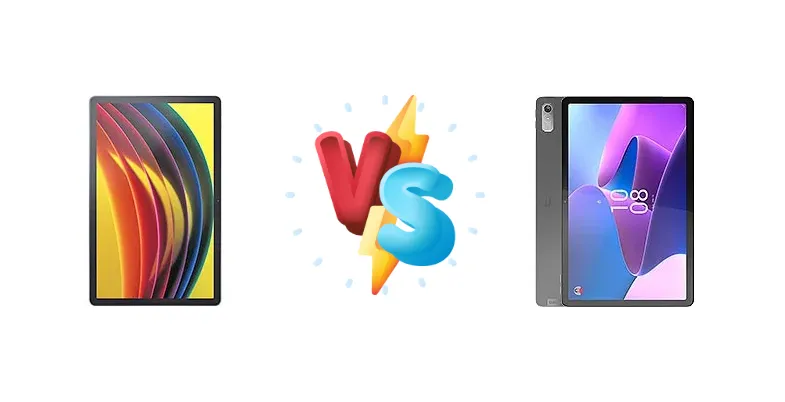
Lenovo's Tab P11 series offers a range of Android tablets catering to different budgets and needs. The original Tab P11 established a solid foundation, while the P11 Pro Gen 2 represents a significant upgrade focused on performance and efficiency. This comparison dissects the key differences between these two tablets, helping you determine which one best suits your usage.
🏆 Quick Verdict
For most users, the Lenovo Tab P11 Pro Gen 2 is the superior choice. Its Mediatek Kompanio 1300T chipset, built on a 6nm process, delivers a noticeable performance boost over the Snapdragon 662 in the P11, making it better suited for multitasking, gaming, and demanding applications. While both charge at 20W, the Pro Gen 2's QC3 support offers faster real-world charging.
| Network |
|---|
| 2G bands | GSM 850 / 900 / 1800 / 1900 | GSM 850 / 900 / 1800 / 1900 |
| 3G bands | HSDPA 850 / 900 / 1900 / 2100 | HSDPA 850 / 900 / 1900 / 2100 |
| 4G bands | 1, 2, 3, 4, 5, 7, 8, 19, 20, 28, 38, 40, 41 | LTE |
| Speed | HSPA, LTE - cellular model only | HSPA, LTE - cellular model only |
| Technology | GSM / HSPA / LTE | GSM / HSPA / LTE |
| Launch |
|---|
| Announced | 2021, January 07 | 2022, September 01 |
| Status | Available. Released 2021, February 10 | Available. Released 2022, September 01 |
| Body |
|---|
| Build | - | Glass front, plastic back, plastic frame |
| Dimensions | 258.4 x 163 x 7.5 mm (10.17 x 6.42 x 0.30 in) | 263.7 x 166.7 x 6.8 mm (10.38 x 6.56 x 0.27 in) |
| SIM | Nano-SIM (cellular model only) | Nano-SIM (cellular model only) |
| Weight | 490 g (1.08 lb) | 480 g (1.06 lb) |
| | Stylus support | Stylus support (magnetic) |
| Display |
|---|
| Resolution | 1200 x 2000 pixels, 5:3 ratio (~212 ppi density) | 1536 x 2560 pixels, 5:3 ratio (~267 ppi density) |
| Size | 11.0 inches, 344.4 cm2 (~81.8% screen-to-body ratio) | 11.2 inches, 357.0 cm2 (~81.2% screen-to-body ratio) |
| Type | IPS LCD, 400 nits (typ) | OLED, HDR10+, Dolby Vision, 120Hz, 420 nits (typ), 600 nits (peak) |
| Platform |
|---|
| CPU | Octa-core (4x2.0 GHz Kryo 260 Gold & 4x1.8 GHz Kryo 260 Silver) | Octa-core (4x2.6 GHz Cortex-A78 & 4x2.0 GHz Cortex-A55) |
| Chipset | Qualcomm SM6115 Snapdragon 662 (11 nm) | Mediatek MT8797 Kompanio 1300T (6 nm) |
| GPU | Adreno 610 | Mali-G77 MC9 |
| OS | Android 10 | Android 12, upgradable to Android 13 |
| Memory |
|---|
| Card slot | microSDXC (dedicated slot) | microSDXC (dedicated slot) |
| Internal | 64GB 4GB RAM, 128GB 4GB RAM, 128GB 6GB RAM | 128GB 4GB RAM, 128GB 6GB RAM, 256GB 8GB RAM |
| | - | UFS 3.1 |
| Main Camera |
|---|
| Features | LED flash | LED flash |
| Single | 13 MP, (wide), AF | 13 MP, f/2.4, (wide), AF |
| Video | 1080p@30fps | 1080p@30fps |
| Selfie camera |
|---|
| Single | 8 MP, (wide) | 8 MP |
| Video | 1080p@30fps | 1080p@30fps |
| Sound |
|---|
| 3.5mm jack | No | No |
| 35mm jack | No | No |
| Loudspeaker | Yes, with stereo speakers (4 speakers) | Yes, with stereo speakers (4 speakers) |
| | - | Tuned by JBL |
| Comms |
|---|
| Bluetooth | 5.1, A2DP, LE | 5.1, A2DP, LE |
| NFC | No | No |
| Positioning | GPS, GLONASS, BDS - cellular model only | GPS, GLONASS - cellular model only |
| Radio | FM radio | No |
| USB | USB Type-C 2.0 | USB Type-C 3.0, OTG, magnetic connector, video output |
| WLAN | Wi-Fi 802.11 a/b/g/n/ac/6, dual-band, Wi-Fi Direct | Wi-Fi 802.11 a/b/g/n/ac/6, dual-band, Wi-Fi Direct |
| Features |
|---|
| Sensors | Accelerometer, gyro, proximity | Accelerometer, gyro, proximity, compass |
| Battery |
|---|
| Charging | 20W wired | 20W wired, QC3 |
| Type | Li-Po 7700 mAh | Li-Po 8200 mAh |
| Misc |
|---|
| Colors | Slate Grey, Platinum Grey | Storm Grey, Oat |
| Models | TB-J606F | ZAB50194GB, ZAB50043SE |
| Price | About 200 EUR | About 500 EUR |
| Tests |
|---|
| Performance | - |
AnTuTu: 616573 (v9)
GeekBench: 2827 (v5.1) |
Lenovo Tab P11
- More affordable price point
- Sufficient for basic tasks like browsing and streaming
- Reputable brand with established software support
- Less powerful chipset limits multitasking and gaming
- Older 11nm process less energy efficient
- Lacks QC3 fast charging support
Lenovo Tab P11 Pro Gen 2
- Significantly faster performance with Kompanio 1300T
- More efficient 6nm process for improved battery life
- QC3 fast charging support for quicker top-ups
- Higher price compared to the Tab P11
- May be overkill for users with very basic needs
- Specific display specs (resolution, refresh rate) unknown
Display Comparison
While both tablets likely feature LCD panels (data not provided), the core difference lies in the processing power driving them. Display quality details like resolution and refresh rate are missing, but the chipset's ability to smoothly render content is crucial. The P11 Pro Gen 2's Kompanio 1300T will provide a more responsive and fluid visual experience, especially during scrolling and video playback. Without specific display specs, we can infer the Pro model benefits from the chipset's enhanced graphics capabilities.
Camera Comparison
Camera specifications are not provided, making a direct comparison difficult. However, given the P11 Pro Gen 2's positioning as a more premium device, it's reasonable to expect improvements in sensor quality and image processing. The chipset's ISP (Image Signal Processor) plays a vital role in image quality, and the Kompanio 1300T likely offers more advanced features and faster processing speeds compared to the Snapdragon 662's ISP. Without detailed specs, it's difficult to quantify the difference, but the Pro model likely delivers better photos and videos.
Performance
The performance gap is the most significant differentiator. The Lenovo Tab P11 utilizes the Qualcomm Snapdragon 662, an 11nm chipset with an octa-core CPU configuration. In contrast, the P11 Pro Gen 2 boasts the Mediatek Kompanio 1300T, fabricated on a more efficient 6nm process. This process node shrink, coupled with the Kompanio's Cortex-A78 cores (vs. the P11's Kryo 260 Gold), translates to a substantial performance advantage in CPU-intensive tasks. The A78 cores offer a significant architectural improvement over the Kryo 260, resulting in faster processing speeds and improved responsiveness. This difference is particularly noticeable when multitasking or running demanding applications.
Battery Life
Both tablets support 20W wired charging, but the P11 Pro Gen 2 adds Quick Charge 3.0 (QC3) compatibility. While the wattage is the same, QC3 allows for more dynamic voltage and current adjustments, potentially leading to faster 0-100% charging times in practice. Battery capacity is not specified, but the more efficient 6nm Kompanio 1300T in the P11 Pro Gen 2 should contribute to better battery life, even with similar capacity, due to reduced power consumption.
Buying Guide
Buy the Lenovo Tab P11 if you prioritize affordability and basic tablet functionality – browsing, streaming, and light productivity tasks. It's an excellent option for casual users or as a dedicated media consumption device. Buy the Lenovo Tab P11 Pro Gen 2 if you demand smoother performance for multitasking, enjoy mobile gaming, or require a tablet capable of handling more resource-intensive applications. The improved chipset and faster charging justify the price premium for power users.
Frequently Asked Questions
❓ Will the Mediatek Kompanio 1300T in the P11 Pro Gen 2 overheat during extended gaming sessions?
The Kompanio 1300T's 6nm process and efficient core design contribute to better thermal management compared to the Snapdragon 662. While sustained gaming will generate heat, the Pro Gen 2 is less likely to experience significant throttling, providing a more consistent gaming experience. However, prolonged use in hot environments may still lead to some performance reduction.
❓ Is the performance difference between the Snapdragon 662 and the Kompanio 1300T noticeable in everyday tasks like browsing and video streaming?
For basic tasks like web browsing and video streaming, the difference may not be immediately apparent. However, the Kompanio 1300T's faster CPU and GPU will result in smoother scrolling, quicker app loading times, and a more responsive overall experience. The benefit becomes more pronounced when multitasking or switching between apps.
❓ Does the Lenovo Tab P11 Pro Gen 2 support external displays or accessories?
While specific accessory compatibility isn't detailed, Lenovo tablets generally support basic USB-C connectivity for external displays and peripherals. The P11 Pro Gen 2's more powerful chipset may offer better support for demanding external displays and accessories compared to the P11.