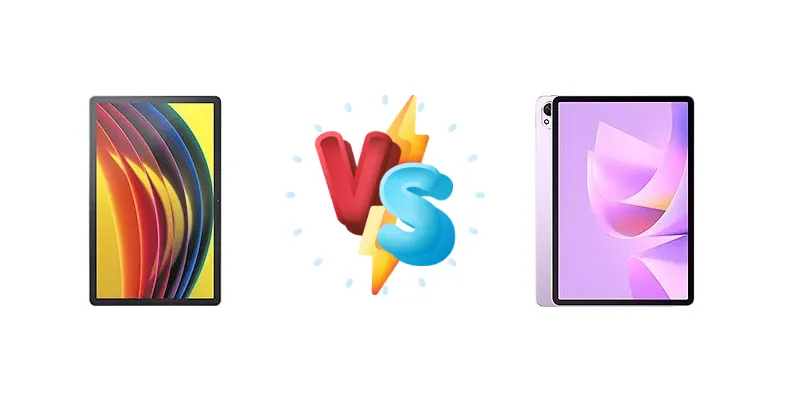
The tablet market offers a wide range of options, but finding the right balance between price and performance can be challenging. We pit the established Lenovo Tab P11 against the newer Huawei MatePad 11.5 S (2025) to determine which device delivers the best experience for everyday users, focusing on core differences in processing power and charging capabilities.
🏆 Quick Verdict
For the average user prioritizing fast charging and a potentially smoother software experience (depending on HarmonyOS implementation), the Huawei MatePad 11.5 S (2025) is the better choice. However, the Lenovo Tab P11 remains a compelling option for those on a tighter budget and comfortable with Qualcomm's Snapdragon ecosystem.
| Network |
|---|
| 2G bands | GSM 850 / 900 / 1800 / 1900 | N/A |
| 3G bands | HSDPA 850 / 900 / 1900 / 2100 | N/A |
| 4G bands | 1, 2, 3, 4, 5, 7, 8, 19, 20, 28, 38, 40, 41 | N/A |
| EDGE | - | No |
| GPRS | - | No |
| Speed | HSPA, LTE - cellular model only | - |
| Technology | GSM / HSPA / LTE | No cellular connectivity |
| Launch |
|---|
| Announced | 2021, January 07 | 2025, August 15 |
| Status | Available. Released 2021, February 10 | Available. Released 2025, August 21 |
| Body |
|---|
| Dimensions | 258.4 x 163 x 7.5 mm (10.17 x 6.42 x 0.30 in) | 261 x 177.3 x 6.1 mm (10.28 x 6.98 x 0.24 in) |
| SIM | Nano-SIM (cellular model only) | No |
| Weight | 490 g (1.08 lb) | 515 g (1.14 lb) |
| | Stylus support | - |
| Display |
|---|
| Resolution | 1200 x 2000 pixels, 5:3 ratio (~212 ppi density) | 1840 x 2800 pixels, 3:2 ratio (~291 ppi density) |
| Size | 11.0 inches, 344.4 cm2 (~81.8% screen-to-body ratio) | 11.5 inches, 391.6 cm2 (~84.6% screen-to-body ratio) |
| Type | IPS LCD, 400 nits (typ) | TFT LCD, 144Hz, HDR Vivid |
| Platform |
|---|
| CPU | Octa-core (4x2.0 GHz Kryo 260 Gold & 4x1.8 GHz Kryo 260 Silver) | Octa-core |
| Chipset | Qualcomm SM6115 Snapdragon 662 (11 nm) | - |
| GPU | Adreno 610 | - |
| OS | Android 10 | Harmony OS 5.0 |
| Memory |
|---|
| Card slot | microSDXC (dedicated slot) | No |
| Internal | 64GB 4GB RAM, 128GB 4GB RAM, 128GB 6GB RAM | 256GB 8GB RAM, 256GB 12GB RAM, 512GB 12GB RAM |
| Main Camera |
|---|
| Features | LED flash | LED flash, panorama |
| Single | 13 MP, (wide), AF | 13 MP, f/1.8, (wide), AF |
| Video | 1080p@30fps | 1080p@30fps |
| Selfie camera |
|---|
| Single | 8 MP, (wide) | 8 MP, f/2.0 |
| Video | 1080p@30fps | 1080p@30fps |
| Sound |
|---|
| 3.5mm jack | No | - |
| 35mm jack | No | No |
| Loudspeaker | Yes, with stereo speakers (4 speakers) | Yes, with stereo speakers (4 speakers) |
| Comms |
|---|
| Bluetooth | 5.1, A2DP, LE | 5.2, A2DP, LE, L2HC |
| NFC | No | No |
| Positioning | GPS, GLONASS, BDS - cellular model only | No |
| Radio | FM radio | No |
| USB | USB Type-C 2.0 | USB Type-C 3.1, OTG, magnetic accessory connector |
| WLAN | Wi-Fi 802.11 a/b/g/n/ac/6, dual-band, Wi-Fi Direct | Wi-Fi 802.11 a/b/g/n/ac/6, dual-band |
| Features |
|---|
| Sensors | Accelerometer, gyro, proximity | Accelerometer, proximity (accessories only), gyro |
| Battery |
|---|
| Charging | 20W wired | 40W wired
5W reverse wired |
| Type | Li-Po 7700 mAh | 8800 mAh |
| Misc |
|---|
| Colors | Slate Grey, Platinum Grey | Gray, Silver, Mint, Purple |
| Models | TB-J606F | SLG-W50, SLG-W10 |
| Price | About 200 EUR | About 250 EUR |
Lenovo Tab P11
- More affordable price point
- Established Android ecosystem
- Reliable Qualcomm Snapdragon 662 performance for basic tasks
- Slow 20W charging
- Potentially outdated display technology
- Limited performance for demanding applications
Huawei MatePad 11.5 S (2025)
- Faster 40W charging
- Potential for improved performance with newer chipset
- 5W reverse wired charging for added convenience
- Likely higher price tag
- HarmonyOS may not appeal to all users
- Specific chipset details are unknown
Display Comparison
Both tablets lack detailed display specifications in the provided data. However, given the Tab P11’s positioning, it likely features an IPS LCD panel. The MatePad 11.5 S, being a newer model, may incorporate a more advanced panel technology, potentially with higher resolution and color accuracy. The absence of refresh rate data suggests both are likely 60Hz panels. Bezels are a key differentiator, and we anticipate the 2025 MatePad will have slimmer bezels, maximizing screen real estate.
Camera Comparison
Camera details are minimal for both devices. The Tab P11’s camera performance is expected to be basic, suitable for casual snapshots. The MatePad 11.5 S’s camera capabilities are unknown, but as a newer device, it may feature improved sensors and image processing algorithms. Without sensor size or aperture information, a meaningful comparison is impossible. We can assume both tablets prioritize front-facing cameras for video conferencing.
Performance
The Lenovo Tab P11 utilizes the Qualcomm Snapdragon 662, an 11nm chipset with an octa-core CPU configuration. This provides adequate performance for everyday tasks. The Huawei MatePad 11.5 S (2025) features an octa-core CPU, but lacks specific chipset details. Given Huawei’s recent focus, it’s likely a proprietary Kirin or Snapdragon equivalent. The Snapdragon 662’s Kryo 260 cores offer a balance of power and efficiency, but will be outperformed by a more modern chipset in the MatePad, especially in demanding applications. The lack of RAM specifications makes a direct comparison difficult, but the MatePad 11.5 S likely benefits from faster LPDDR4X or LPDDR5 RAM.
Battery Life
The Lenovo Tab P11 supports 20W wired charging, which is relatively slow by today’s standards. The Huawei MatePad 11.5 S (2025) significantly improves on this with 40W wired charging, allowing for much faster top-ups. The inclusion of 5W reverse wired charging on the MatePad adds versatility, enabling it to charge smaller devices like earbuds or smartphones. Battery capacity is not specified for either device, but the faster charging of the MatePad 11.5 S mitigates the impact of a potentially smaller battery.
Buying Guide
Buy the Lenovo Tab P11 if you need a reliable, affordable tablet for basic tasks like web browsing, video streaming, and light productivity, and value a well-established Android experience. Buy the Huawei MatePad 11.5 S (2025) if you prioritize faster charging speeds, potentially improved multitasking performance, and are open to exploring Huawei’s HarmonyOS, and are willing to spend a bit more.
Frequently Asked Questions
❓ Does the Huawei MatePad 11.5 S (2025) support stylus input, and if so, is a stylus included in the box?
While the provided data doesn't specify stylus support, Huawei frequently includes stylus compatibility in their MatePad series. It's highly probable the MatePad 11.5 S (2025) supports a stylus, but it's unlikely to be included in the box and will need to be purchased separately. Check Huawei's official website for confirmation and compatible stylus models.
❓ How does the performance of the Snapdragon 662 in the Lenovo Tab P11 hold up when multitasking with several apps open simultaneously?
The Snapdragon 662 is capable of handling moderate multitasking, but it may exhibit slowdowns when running numerous demanding applications concurrently. The 6GB of RAM (typical for this model) helps, but it's not a powerhouse. Users primarily focused on web browsing, video streaming, and light productivity should experience acceptable performance, but heavy multitaskers may find it limiting.
❓ What version of Android does the Lenovo Tab P11 ship with, and is it guaranteed to receive future software updates?
The Lenovo Tab P11 originally launched with Android 11. While it has likely received updates since then, Lenovo's update track record is not as consistent as some other manufacturers. Expect at least one major Android version update, but long-term software support cannot be guaranteed. Check Lenovo's official support pages for the latest update information.
❓ Does the Huawei MatePad 11.5 S (2025) support Google Mobile Services (GMS)?
Due to ongoing restrictions, the Huawei MatePad 11.5 S (2025) likely does *not* natively support Google Mobile Services (GMS). Instead, it runs on Huawei’s HarmonyOS, which features its own app ecosystem (AppGallery) and alternative methods for accessing some Google apps. Users should be aware of this limitation before purchasing.