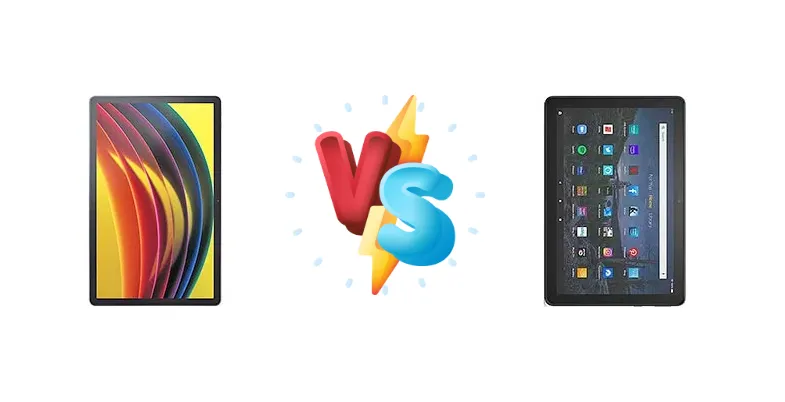
The budget tablet market is fiercely competitive, with the Lenovo Tab P11 and Amazon Fire HD 10 Plus (2021) vying for dominance. While both aim to deliver an affordable tablet experience, they take distinctly different approaches. The Lenovo Tab P11 prioritizes a more standard Android experience with a Qualcomm chipset, while the Fire HD 10 Plus leans into Amazon’s ecosystem and offers the convenience of wireless charging. This comparison dissects their core components to determine which tablet best suits your needs.
🏆 Quick Verdict
For users seeking a versatile Android tablet with smoother performance for everyday tasks and a more open ecosystem, the Lenovo Tab P11 is the better choice. Its Snapdragon 662 chipset provides a noticeable edge in responsiveness, despite the Fire HD 10 Plus’s wireless charging capability. However, Amazon’s tablet remains a compelling option for those deeply invested in Amazon services.
| Network |
|---|
| 2G bands | GSM 850 / 900 / 1800 / 1900 | N/A |
| 3G bands | HSDPA 850 / 900 / 1900 / 2100 | - |
| 4G bands | 1, 2, 3, 4, 5, 7, 8, 19, 20, 28, 38, 40, 41 | - |
| EDGE | - | No |
| GPRS | - | No |
| Speed | HSPA, LTE - cellular model only | - |
| Technology | GSM / HSPA / LTE | No cellular connectivity |
| Launch |
|---|
| Announced | 2021, January 07 | 2021, April 27. Released 2021, May 26 |
| Status | Available. Released 2021, February 10 | Discontinued |
| Body |
|---|
| Dimensions | 258.4 x 163 x 7.5 mm (10.17 x 6.42 x 0.30 in) | 247 x 166 x 9.2 mm (9.72 x 6.54 x 0.36 in) |
| SIM | Nano-SIM (cellular model only) | No |
| Weight | 490 g (1.08 lb) | 468 g (1.03 lb) |
| | Stylus support | - |
| Display |
|---|
| Protection | - | Aluminosilicate glass |
| Resolution | 1200 x 2000 pixels, 5:3 ratio (~212 ppi density) | 1920 x 1200 pixels, 16:10 ratio (~224 ppi density) |
| Size | 11.0 inches, 344.4 cm2 (~81.8% screen-to-body ratio) | 10.1 inches, 295.8 cm2 (~72.1% screen-to-body ratio) |
| Type | IPS LCD, 400 nits (typ) | IPS LCD |
| Platform |
|---|
| CPU | Octa-core (4x2.0 GHz Kryo 260 Gold & 4x1.8 GHz Kryo 260 Silver) | Octa-core (4x2.0 GHz Cortex-A73 & 4x2.0 GHz Cortex-A53) |
| Chipset | Qualcomm SM6115 Snapdragon 662 (11 nm) | Mediatek MT8183 Helio P60T (12 nm) |
| GPU | Adreno 610 | Mali-G72 MP3 |
| OS | Android 10 | Android 9.0 (Pie), Fire OS 7 |
| Memory |
|---|
| Card slot | microSDXC (dedicated slot) | microSDXC (dedicated slot) |
| Internal | 64GB 4GB RAM, 128GB 4GB RAM, 128GB 6GB RAM | 32GB 4GB RAM, 64GB 4GB RAM |
| | - | eMMC 5.1 |
| Main Camera |
|---|
| Features | LED flash | - |
| Single | 13 MP, (wide), AF | 5 MP |
| Video | 1080p@30fps | 720p |
| Selfie camera |
|---|
| Single | 8 MP, (wide) | 2 MP |
| Video | 1080p@30fps | 720p |
| Sound |
|---|
| 3.5mm jack | No | Yes |
| 35mm jack | No | Yes |
| Loudspeaker | Yes, with stereo speakers (4 speakers) | Yes, with stereo speakers |
| Comms |
|---|
| Bluetooth | 5.1, A2DP, LE | 5.0, A2DP, LE |
| NFC | No | No |
| Positioning | GPS, GLONASS, BDS - cellular model only | No |
| Radio | FM radio | No |
| USB | USB Type-C 2.0 | USB Type-C 2.0, OTG |
| WLAN | Wi-Fi 802.11 a/b/g/n/ac/6, dual-band, Wi-Fi Direct | Wi-Fi 802.11 a/b/g/n/ac, dual-band |
| Features |
|---|
| Sensors | Accelerometer, gyro, proximity | Accelerometer |
| | - | Text-to-Speech English-language content reader |
| Battery |
|---|
| Charging | 20W wired | Wireless |
| Type | Li-Po 7700 mAh | Li-Ion |
| Misc |
|---|
| Colors | Slate Grey, Platinum Grey | Slate |
| Models | TB-J606F | T76N2P |
| Price | About 200 EUR | About 150 EUR |
Lenovo Tab P11
- More powerful Snapdragon 662 chipset
- Standard Android experience with Google Play Store access
- Better multitasking and app performance
- No wireless charging
- Relies solely on wired 20W charging
Amazon Fire HD 10 Plus (2021)
- Wireless charging for added convenience
- Deep integration with Amazon’s ecosystem (Prime Video, Kindle)
- Generally lower price point
- Less powerful MediaTek Helio P60T chipset
- Fire OS is a customized Android experience with limitations
Display Comparison
Neither device boasts a particularly high-end display, but differences exist. While both likely feature IPS LCD panels (based on market positioning), the core difference lies in the processing power driving them. Display specs beyond panel type are unavailable, but the Snapdragon 662 in the Lenovo Tab P11 has a more capable ISP, potentially leading to slightly better image processing and color reproduction. The Fire HD 10 Plus’s Mediatek Helio P60T, while adequate, is less sophisticated in this regard. Bezels are expected to be similar on both, reflecting their budget nature.
Camera Comparison
Camera performance is unlikely to be a deciding factor for either tablet. Both are positioned as budget devices, and camera quality typically reflects that. Without specific sensor details, it’s safe to assume both feature modest camera setups. Focusing on the chipsets, the Snapdragon 662’s ISP (Image Signal Processor) is more advanced, potentially offering slightly better image processing capabilities, but the overall experience will likely be similar – adequate for casual snapshots but not for serious photography.
Performance
The performance gap is the most significant differentiator. The Lenovo Tab P11’s Qualcomm Snapdragon 662 (11nm) is architecturally superior to the Amazon Fire HD 10 Plus’s MediaTek Helio P60T (12nm). The Snapdragon 662 utilizes Kryo 260 cores – a mix of performance (Gold) and efficiency (Silver) – offering a more balanced and responsive experience. The Helio P60T, with its Cortex-A73 and A53 cores, is older and less efficient. While both are octa-core, the Snapdragon’s newer architecture and smaller manufacturing node translate to better sustained performance and thermal management. This means the Tab P11 will likely handle multitasking and demanding apps more smoothly.
Battery Life
Battery life will depend heavily on usage patterns. While specific mAh capacities are unavailable, the Fire HD 10 Plus gains a significant advantage with its wireless charging support. This adds convenience, allowing users to top up without needing a cable. The Lenovo Tab P11 relies solely on 20W wired charging. The Helio P60T’s 12nm process *could* offer slightly better power efficiency under light loads, but the Snapdragon 662’s superior performance will likely draw more power during intensive tasks. The convenience of wireless charging on the Fire HD 10 Plus may offset any potential battery life advantage the Lenovo Tab P11 might have.
Buying Guide
Buy the Lenovo Tab P11 if you need a tablet that runs a standard, customizable Android experience, prioritizes smoother multitasking, and offers broader app compatibility. It’s ideal for students, casual gamers, and users who want a tablet that functions more like a traditional Android device. Buy the Amazon Fire HD 10 Plus (2021) if you prefer a tablet tightly integrated with Amazon’s ecosystem – Prime Video, Kindle, Alexa – and value the convenience of wireless charging, even if it means sacrificing some performance and software flexibility.
Frequently Asked Questions
❓ Will the MediaTek Helio P60T in the Fire HD 10 Plus struggle with demanding games like Genshin Impact?
Yes, the Helio P60T is not a gaming powerhouse. While it can handle less demanding titles, Genshin Impact and similar graphically intensive games will likely experience significant frame rate drops and stuttering, even on the lowest settings. The Snapdragon 662 in the Lenovo Tab P11 will offer a noticeably smoother gaming experience, though it's still not a dedicated gaming tablet.
❓ How much does the Amazon ecosystem lock-in affect the Fire HD 10 Plus experience?
The Amazon Fire HD 10 Plus is heavily integrated with Amazon’s services. While you can sideload the Google Play Store, it’s not officially supported and can be cumbersome. The home screen prominently features Amazon content, and accessing core Android functions often requires navigating through Amazon’s interface. This is ideal for Amazon Prime subscribers but can be restrictive for users who prefer a more open Android experience.
❓ Can I easily install apps like Netflix and Disney+ on the Lenovo Tab P11?
Yes, the Lenovo Tab P11 runs a standard version of Android with full access to the Google Play Store. Installing popular streaming apps like Netflix, Disney+, and Hulu is as simple as searching for them in the Play Store and downloading them. This provides a much wider range of app compatibility compared to the Fire HD 10 Plus.