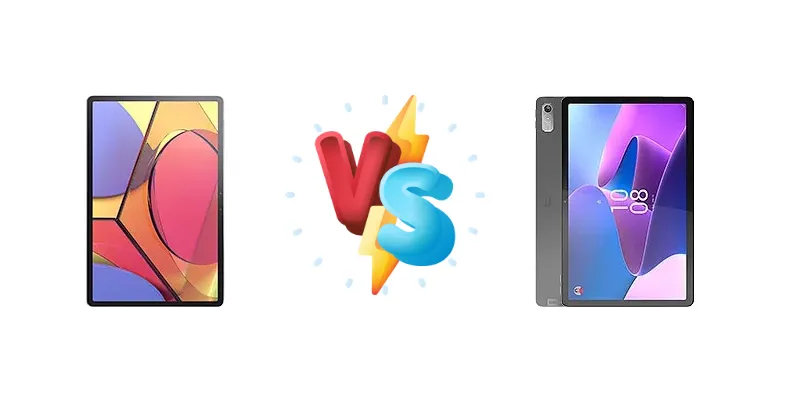
Lenovo's Tab P11 Pro established itself as a strong contender in the Android tablet space, offering a compelling blend of features and price. The P11 Pro Gen 2 arrives with a new chipset and refinements, but does it justify an upgrade or represent a significant leap forward? We break down the key differences to help you decide.
🏆 Quick Verdict
For most users, the Lenovo Tab P11 Pro Gen 2 is the superior choice. The Mediatek Kompanio 1300T chipset delivers a noticeable performance boost over the Snapdragon 730G, particularly in multi-tasking and demanding applications, while maintaining similar charging speeds. The Gen 2 offers a more future-proof experience.
| Network |
|---|
| 2G bands | GSM 850 / 900 / 1800 / 1900 | GSM 850 / 900 / 1800 / 1900 |
| 3G bands | HSDPA 850 / 900 / 1900 / 2100 | HSDPA 850 / 900 / 1900 / 2100 |
| 4G bands | 1, 2, 3, 4, 5, 7, 8, 18, 19, 20, 26, 28, 38, 39, 40, 41 | LTE |
| Speed | HSPA, LTE - cellular model only | HSPA, LTE - cellular model only |
| Technology | GSM / HSPA / LTE | GSM / HSPA / LTE |
| Launch |
|---|
| Announced | 2020, August 31. Released 2020, December 14 | 2022, September 01 |
| Status | Discontinued | Available. Released 2022, September 01 |
| Body |
|---|
| Build | Glass front, aluminum frame, aluminum back | Glass front, plastic back, plastic frame |
| Dimensions | 264.3 x 171.4 x 6.9 mm (10.41 x 6.75 x 0.27 in) | 263.7 x 166.7 x 6.8 mm (10.38 x 6.56 x 0.27 in) |
| SIM | Nano-SIM (cellular model only) | Nano-SIM (cellular model only) |
| Weight | 485 g (1.07 lb) | 480 g (1.06 lb) |
| | Stylus support | Stylus support (magnetic) |
| Display |
|---|
| Resolution | 1600 x 2560 pixels, 16:10 ratio (~263 ppi density) | 1536 x 2560 pixels, 5:3 ratio (~267 ppi density) |
| Size | 11.5 inches, 383.5 cm2 (~84.6% screen-to-body ratio) | 11.2 inches, 357.0 cm2 (~81.2% screen-to-body ratio) |
| Type | OLED, HDR10, Dolby Vision, 500 nits (typ) | OLED, HDR10+, Dolby Vision, 120Hz, 420 nits (typ), 600 nits (peak) |
| Platform |
|---|
| CPU | Octa-core (2x2.2 GHz Kryo 470 Gold & 6x1.8 GHz Kryo 470 Silver) | Octa-core (4x2.6 GHz Cortex-A78 & 4x2.0 GHz Cortex-A55) |
| Chipset | Qualcomm SDM730 Snapdragon 730G (8 nm) | Mediatek MT8797 Kompanio 1300T (6 nm) |
| GPU | Adreno 618 | Mali-G77 MC9 |
| OS | Android 10 | Android 12, upgradable to Android 13 |
| Memory |
|---|
| Card slot | microSDXC | microSDXC (dedicated slot) |
| Internal | 128GB 4GB RAM, 128GB 6GB RAM | 128GB 4GB RAM, 128GB 6GB RAM, 256GB 8GB RAM |
| | - | UFS 3.1 |
| Main Camera |
|---|
| Dual | 13 MP, (wide), AF
5 MP, (ultrawide) | - |
| Features | - | LED flash |
| Single | - | 13 MP, f/2.4, (wide), AF |
| Video | 1080p@30fps | 1080p@30fps |
| Selfie camera |
|---|
| Single | 8 MP, (wide)
8 MP, IR TOF 3D, (biometrics sensor only) | 8 MP |
| Video | - | 1080p@30fps |
| Sound |
|---|
| 3.5mm jack | No | No |
| 35mm jack | No | No |
| Loudspeaker | Yes, with stereo speakers (4 speakers) | Yes, with stereo speakers (4 speakers) |
| | - | Tuned by JBL |
| Comms |
|---|
| Bluetooth | 5.0, A2DP, LE | 5.1, A2DP, LE |
| NFC | No | No |
| Positioning | GPS, GLONASS, BDS - cellular model only | GPS, GLONASS - cellular model only |
| Radio | Unspecified | No |
| USB | USB Type-C 3.2 | USB Type-C 3.0, OTG, magnetic connector, video output |
| WLAN | Wi-Fi 802.11 a/b/g/n/ac, dual-band, Wi-Fi Direct | Wi-Fi 802.11 a/b/g/n/ac/6, dual-band, Wi-Fi Direct |
| Features |
|---|
| Sensors | Fingerprint (side-mounted), accelerometer, gyro, proximity | Accelerometer, gyro, proximity, compass |
| Battery |
|---|
| Charging | 20W wired | 20W wired, QC3 |
| Type | Li-Po 8600 mAh | Li-Po 8200 mAh |
| Misc |
|---|
| Colors | Slate Grey, Platinum Grey | Storm Grey, Oat |
| Models | TB-J706F | ZAB50194GB, ZAB50043SE |
| Price | About 550 EUR | About 500 EUR |
| Tests |
|---|
| Performance | - |
AnTuTu: 616573 (v9)
GeekBench: 2827 (v5.1) |
Lenovo Tab P11 Pro
- Potentially lower price point due to being an older model.
- Proven reliability of the Snapdragon 730G platform.
- Adequate performance for basic tasks.
- Less powerful chipset compared to the Gen 2.
- Less efficient 8nm process may lead to more heat.
- May not receive as many software updates.
Lenovo Tab P11 Pro Gen 2
- Significantly improved performance with the Kompanio 1300T.
- More efficient 6nm process for better battery life.
- QC3 support for potentially faster charging.
- More future-proof chipset architecture.
- Likely a higher price tag than the original P11 Pro.
- Potential for software bugs associated with a newer release.
Display Comparison
Both tablets share a similar 11.2-inch 2.5K (2560x1600) display, but detailed specs like peak brightness and color gamut coverage are not provided. However, the focus should be on the internal changes. The P11 Pro Gen 2 benefits from the more efficient Kompanio 1300T, potentially allowing for sustained brightness levels without significant thermal throttling. Bezels appear comparable between the two models, and without specific color accuracy data, it's difficult to definitively declare a winner in display quality.
Camera Comparison
Detailed camera specifications are absent, making a direct comparison challenging. However, given the tablet segment, camera performance is rarely a primary concern. Both tablets likely feature similar sensor setups focused on adequate image capture for video calls and casual photography. Without information on sensor size, aperture, or image processing algorithms, it's safe to assume the differences in camera quality will be minimal.
Performance
The core difference lies in the chipset. The original P11 Pro utilizes the Qualcomm Snapdragon 730G, built on an 8nm process, featuring an octa-core CPU with Kryo 470 cores. The Gen 2 switches to the Mediatek Kompanio 1300T, fabricated on a more efficient 6nm process. This translates to a CPU comprised of four 2.6 GHz Cortex-A78 cores and four 2.0 GHz Cortex-A55 cores. The Cortex-A78 cores represent a significant architectural upgrade over the Kryo 470, offering improved single-core and multi-core performance. This will be most noticeable in demanding tasks like video editing or running multiple apps simultaneously. While RAM configurations are not specified, the chipset upgrade suggests the Gen 2 will handle memory management more effectively.
Battery Life
Both tablets feature 20W wired charging, which is relatively standard for this class. The battery capacity is not specified, but the 6nm process of the Kompanio 1300T in the Gen 2 should result in improved power efficiency. This means the Gen 2 could potentially offer longer battery life despite a similar battery capacity, or achieve a full charge in a comparable timeframe. The addition of Quick Charge 3.0 (QC3) support on the Gen 2 may offer slightly faster charging speeds with compatible chargers, though the 20W limit remains.
Buying Guide
Buy the Lenovo Tab P11 Pro if you prioritize finding the lowest possible price for a capable Android tablet and your usage primarily revolves around media consumption and light productivity tasks. Buy the Lenovo Tab P11 Pro Gen 2 if you demand smoother performance for multitasking, gaming, or creative applications, and appreciate the benefits of a more modern and efficient chipset architecture.
Frequently Asked Questions
❓ Will the Mediatek Kompanio 1300T in the Gen 2 overheat during extended gaming sessions?
The 6nm process of the Kompanio 1300T is more thermally efficient than the 8nm Snapdragon 730G. While sustained gaming will inevitably generate heat, the Gen 2 is better equipped to manage it, reducing the likelihood of significant throttling and maintaining consistent performance for longer periods.
❓ Does the Lenovo Tab P11 Pro Gen 2 support faster charging than the original P11 Pro, despite both being rated at 20W?
The Gen 2 adds support for Quick Charge 3.0 (QC3), which, when used with a compatible charger, *may* result in slightly faster charging speeds compared to the original P11 Pro. However, the 20W power delivery limit remains the primary constraint.
❓ Is the performance difference between the Snapdragon 730G and Kompanio 1300T noticeable for everyday tasks like browsing and streaming?
For basic tasks like web browsing, video streaming, and email, the difference may not be immediately apparent. However, the Gen 2's more powerful CPU will provide a smoother and more responsive experience when multitasking or switching between apps.