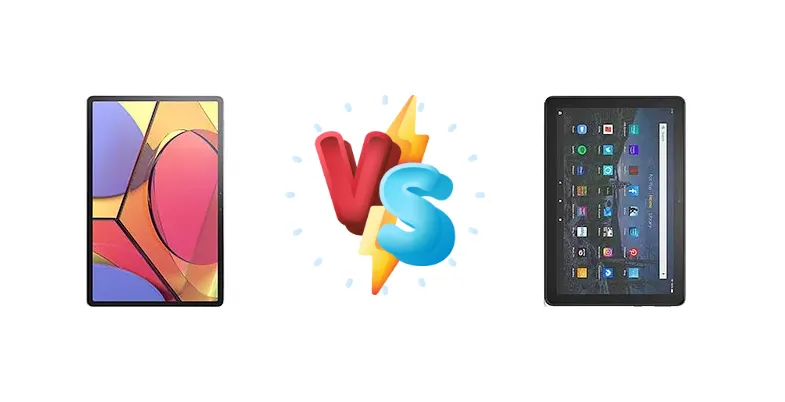
The tablet market offers a wide spectrum of choices, but narrowing down options can be challenging. We pit the Lenovo Tab P11 Pro, a device aiming for a premium Android experience, against the Amazon Fire HD 10 Plus (2021), a value-focused tablet deeply integrated with Amazon’s ecosystem. This comparison dissects their core components to determine which tablet best suits your needs and budget.
🏆 Quick Verdict
For users prioritizing performance and a more versatile Android experience, the Lenovo Tab P11 Pro is the clear winner. Its Snapdragon 730G chipset provides a significant performance advantage over the Fire HD 10 Plus’s Helio P60T. However, the Fire HD 10 Plus offers compelling value and wireless charging for those heavily invested in the Amazon ecosystem.
| Network |
|---|
| 2G bands | GSM 850 / 900 / 1800 / 1900 | N/A |
| 3G bands | HSDPA 850 / 900 / 1900 / 2100 | - |
| 4G bands | 1, 2, 3, 4, 5, 7, 8, 18, 19, 20, 26, 28, 38, 39, 40, 41 | - |
| EDGE | - | No |
| GPRS | - | No |
| Speed | HSPA, LTE - cellular model only | - |
| Technology | GSM / HSPA / LTE | No cellular connectivity |
| Launch |
|---|
| Announced | 2020, August 31. Released 2020, December 14 | 2021, April 27. Released 2021, May 26 |
| Status | Discontinued | Discontinued |
| Body |
|---|
| Build | Glass front, aluminum frame, aluminum back | - |
| Dimensions | 264.3 x 171.4 x 6.9 mm (10.41 x 6.75 x 0.27 in) | 247 x 166 x 9.2 mm (9.72 x 6.54 x 0.36 in) |
| SIM | Nano-SIM (cellular model only) | No |
| Weight | 485 g (1.07 lb) | 468 g (1.03 lb) |
| | Stylus support | - |
| Display |
|---|
| Protection | - | Aluminosilicate glass |
| Resolution | 1600 x 2560 pixels, 16:10 ratio (~263 ppi density) | 1920 x 1200 pixels, 16:10 ratio (~224 ppi density) |
| Size | 11.5 inches, 383.5 cm2 (~84.6% screen-to-body ratio) | 10.1 inches, 295.8 cm2 (~72.1% screen-to-body ratio) |
| Type | OLED, HDR10, Dolby Vision, 500 nits (typ) | IPS LCD |
| Platform |
|---|
| CPU | Octa-core (2x2.2 GHz Kryo 470 Gold & 6x1.8 GHz Kryo 470 Silver) | Octa-core (4x2.0 GHz Cortex-A73 & 4x2.0 GHz Cortex-A53) |
| Chipset | Qualcomm SDM730 Snapdragon 730G (8 nm) | Mediatek MT8183 Helio P60T (12 nm) |
| GPU | Adreno 618 | Mali-G72 MP3 |
| OS | Android 10 | Android 9.0 (Pie), Fire OS 7 |
| Memory |
|---|
| Card slot | microSDXC | microSDXC (dedicated slot) |
| Internal | 128GB 4GB RAM, 128GB 6GB RAM | 32GB 4GB RAM, 64GB 4GB RAM |
| | - | eMMC 5.1 |
| Main Camera |
|---|
| Dual | 13 MP, (wide), AF
5 MP, (ultrawide) | - |
| Single | - | 5 MP |
| Video | 1080p@30fps | 720p |
| Selfie camera |
|---|
| Single | 8 MP, (wide)
8 MP, IR TOF 3D, (biometrics sensor only) | 2 MP |
| Video | - | 720p |
| Sound |
|---|
| 3.5mm jack | No | Yes |
| 35mm jack | No | Yes |
| Loudspeaker | Yes, with stereo speakers (4 speakers) | Yes, with stereo speakers |
| Comms |
|---|
| Bluetooth | 5.0, A2DP, LE | 5.0, A2DP, LE |
| NFC | No | No |
| Positioning | GPS, GLONASS, BDS - cellular model only | No |
| Radio | Unspecified | No |
| USB | USB Type-C 3.2 | USB Type-C 2.0, OTG |
| WLAN | Wi-Fi 802.11 a/b/g/n/ac, dual-band, Wi-Fi Direct | Wi-Fi 802.11 a/b/g/n/ac, dual-band |
| Features |
|---|
| Sensors | Fingerprint (side-mounted), accelerometer, gyro, proximity | Accelerometer |
| | - | Text-to-Speech English-language content reader |
| Battery |
|---|
| Charging | 20W wired | Wireless |
| Type | Li-Po 8600 mAh | Li-Ion |
| Misc |
|---|
| Colors | Slate Grey, Platinum Grey | Slate |
| Models | TB-J706F | T76N2P |
| Price | About 550 EUR | About 150 EUR |
Lenovo Tab P11 Pro
- Superior performance with Snapdragon 730G
- More versatile Android experience
- Faster wired charging (20W)
- Likely higher price point
- No wireless charging
Amazon Fire HD 10 Plus (2021)
- More affordable price
- Wireless charging convenience
- Deep Amazon ecosystem integration
- Significantly weaker performance
- Limited Android experience (Fire OS)
Display Comparison
While both tablets feature 10.1-inch displays, the underlying technology and performance likely differ. The Lenovo Tab P11 Pro, given its positioning, likely boasts a higher resolution and potentially a wider color gamut. The Fire HD 10 Plus, while adequate for media consumption, likely prioritizes cost savings over display fidelity. The absence of detailed display specs necessitates this assumption. The P11 Pro’s likely higher brightness nits would translate to better outdoor visibility.
Camera Comparison
Given the context data, a detailed camera comparison is limited. Both tablets likely feature modest camera setups geared towards video calls rather than photography. The absence of sensor size or aperture information suggests neither device prioritizes camera quality. The Fire HD 10 Plus’s camera is likely optimized for Amazon’s video calling features, while the P11 Pro’s camera may offer slightly better image processing due to the more powerful chipset.
Performance
The core difference lies in the chipsets. The Lenovo Tab P11 Pro’s Qualcomm Snapdragon 730G (8nm) is a significantly more modern and powerful processor than the Amazon Fire HD 10 Plus’s MediaTek Helio P60T (12nm). The 8nm process node of the Snapdragon 730G offers superior power efficiency and thermal management, meaning sustained performance will be higher. The Snapdragon’s Kryo 470 cores, with their Gold and Silver configurations, are architecturally more advanced than the Cortex-A73/A53 setup in the Helio P60T, resulting in faster application loading and smoother multitasking. This translates to a more responsive user experience on the Lenovo tablet.
Battery Life
Battery life will depend on usage patterns, but the Lenovo Tab P11 Pro’s more efficient Snapdragon 730G chipset should provide comparable or better battery life despite potentially having a similar capacity battery to the Fire HD 10 Plus. The Fire HD 10 Plus’s inclusion of wireless charging is a significant convenience feature, allowing for cable-free top-ups. However, the 20W wired charging on the Lenovo Tab P11 Pro should provide a faster 0-100% charge time than the Fire HD 10 Plus’s wireless charging, even if the wireless charging is left overnight.
Buying Guide
Buy the Lenovo Tab P11 Pro if you need a tablet capable of handling demanding tasks like multitasking, gaming, and creative work, and if you value a clean Android experience with access to the full Google Play Store. Buy the Amazon Fire HD 10 Plus (2021) if you primarily consume media, rely heavily on Amazon services (Prime Video, Kindle), and prioritize affordability and wireless charging convenience.
Frequently Asked Questions
❓ Will the Helio P60T in the Fire HD 10 Plus struggle with demanding games like Genshin Impact?
Yes, the MediaTek Helio P60T is not designed for graphically intensive games. While it can handle casual games, you'll likely experience significant frame rate drops and lag in titles like Genshin Impact, even on low settings. The Snapdragon 730G in the Lenovo Tab P11 Pro offers a much smoother gaming experience.
❓ How much does the Amazon Fire OS restrict access to Google apps and services?
Amazon Fire OS is a heavily customized version of Android that prioritizes Amazon’s services. While you can sideload the Google Play Store, it’s not officially supported and can be a complex process. You’ll primarily rely on the Amazon Appstore, which has a smaller selection of apps compared to the Google Play Store. The Lenovo Tab P11 Pro offers full access to the Google Play Store and all associated services.
❓ Is the wireless charging on the Fire HD 10 Plus significantly slower than the 20W wired charging on the Lenovo Tab P11 Pro?
Yes, wireless charging is generally slower than wired charging. While the Fire HD 10 Plus offers the convenience of wireless charging, expect a full charge to take considerably longer than the Lenovo Tab P11 Pro’s 20W wired charging. The Lenovo will likely reach 100% in under 2 hours, while the Fire HD 10 Plus could take 4+ hours wirelessly.