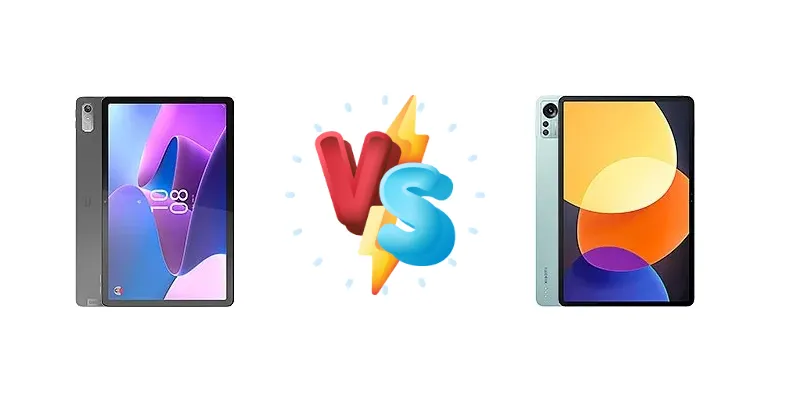
The tablet market is heating up, and two contenders are vying for your attention: the Lenovo Tab P11 Pro Gen 2 and the Xiaomi Pad 5 Pro 12.4. Both offer premium features and impressive performance, but cater to slightly different needs. Let's dive into a detailed comparison to help you decide which one is right for you.
🏆 Quick Verdict
The Xiaomi Pad 5 Pro 12.4 takes the crown thanks to its significantly faster Snapdragon 870 chipset, blazing-fast 67W charging, and larger, higher-resolution display. While the Lenovo offers a compelling package, the Xiaomi delivers a more premium and powerful experience overall.
| Network |
|---|
| 2G bands | GSM 850 / 900 / 1800 / 1900 | N/A |
| 3G bands | HSDPA 850 / 900 / 1900 / 2100 | N/A |
| 4G bands | LTE | N/A |
| EDGE | - | No |
| GPRS | - | No |
| Speed | HSPA, LTE - cellular model only | - |
| Technology | GSM / HSPA / LTE | No cellular connectivity |
| Launch |
|---|
| Announced | 2022, September 01 | 2022, August 11 |
| Status | Available. Released 2022, September 01 | Available. Released 2022, August 24 |
| Body |
|---|
| Build | Glass front, plastic back, plastic frame | Glass front (Gorilla Glass 3), aluminum frame, aluminum back |
| Dimensions | 263.7 x 166.7 x 6.8 mm (10.38 x 6.56 x 0.27 in) | 285 x 185.2 x 6.7 mm (11.22 x 7.29 x 0.26 in) |
| SIM | Nano-SIM (cellular model only) | No |
| Weight | 480 g (1.06 lb) | 620 g (1.37 lb) |
| | Stylus support (magnetic) | Stylus support (magnetic) |
| Display |
|---|
| Protection | - | Corning Gorilla Glass 3 |
| Resolution | 1536 x 2560 pixels, 5:3 ratio (~267 ppi density) | 1600 x 2560 pixels, 16:10 ratio (~243 ppi density) |
| Size | 11.2 inches, 357.0 cm2 (~81.2% screen-to-body ratio) | 12.4 inches, 445.8 cm2 (~84.5% screen-to-body ratio) |
| Type | OLED, HDR10+, Dolby Vision, 120Hz, 420 nits (typ), 600 nits (peak) | IPS LCD, 120Hz, HDR10, Dolby Vision, 500 nits |
| Platform |
|---|
| CPU | Octa-core (4x2.6 GHz Cortex-A78 & 4x2.0 GHz Cortex-A55) | Octa-core (1x3.2 GHz Kryo 585 & 3x2.42 GHz Kryo 585 & 4x1.80 GHz Kryo 585) |
| Chipset | Mediatek MT8797 Kompanio 1300T (6 nm) | Qualcomm SM8250-AC Snapdragon 870 5G (7 nm) |
| GPU | Mali-G77 MC9 | Adreno 650 |
| OS | Android 12, upgradable to Android 13 | Android 12, MIUI Pad 13 |
| Memory |
|---|
| Card slot | microSDXC (dedicated slot) | No |
| Internal | 128GB 4GB RAM, 128GB 6GB RAM, 256GB 8GB RAM | 128GB 6GB RAM, 256GB 8GB RAM, 512GB 12GB RAM |
| | UFS 3.1 | UFS 3.1 |
| Main Camera |
|---|
| Dual | - | 50 MP, f/1.8, 1/2.76", 0.64µm, PDAF
Auxiliary lens |
| Features | LED flash | Color spectrum sensor, LED flash, panorama, HDR |
| Single | 13 MP, f/2.4, (wide), AF | - |
| Video | 1080p@30fps | 4K@30fps, 1080p@30/60fps |
| Selfie camera |
|---|
| Single | 8 MP | 20 MP, f/2.2, 1/3.4", 0.8µm |
| Video | 1080p@30fps | 1080p@30/60fps |
| Sound |
|---|
| 3.5mm jack | No | No |
| 35mm jack | No | No |
| Loudspeaker | Yes, with stereo speakers (4 speakers) | Yes, with stereo speakers (4 speakers) |
| | Tuned by JBL | - |
| Comms |
|---|
| Bluetooth | 5.1, A2DP, LE | 5.2, A2DP, LE |
| NFC | No | No |
| Positioning | GPS, GLONASS - cellular model only | No |
| Radio | No | No |
| USB | USB Type-C 3.0, OTG, magnetic connector, video output | USB Type-C 3.2 video output |
| WLAN | Wi-Fi 802.11 a/b/g/n/ac/6, dual-band, Wi-Fi Direct | Wi-Fi 802.11 a/b/g/n/ac/6, dual-band, Wi-Fi Direct |
| Features |
|---|
| Sensors | Accelerometer, gyro, proximity, compass | Accelerometer, gyro, proximity, compass |
| Battery |
|---|
| Charging | 20W wired, QC3 | 67W wired, PD3.0, QC4, 60% in 36 min, 100% in 68 min |
| Type | Li-Po 8200 mAh | Li-Po 10000 mAh |
| Misc |
|---|
| Colors | Storm Grey, Oat | Black, Silver, Green |
| Models | ZAB50194GB, ZAB50043SE | - |
| Price | About 500 EUR | About 400 EUR |
| Tests |
|---|
| Performance |
AnTuTu: 616573 (v9)
GeekBench: 2827 (v5.1) | - |
Lenovo Tab P11 Pro Gen 2
- Excellent OLED display
- Sleek and premium design
- Good audio quality
- Competitive price
- Slower charging speed
- Less powerful processor
- Average camera performance
Xiaomi Pad 5 Pro 12.4
- Powerful Snapdragon 870 processor
- Blazing-fast 67W charging
- Large, high-resolution display
- Excellent value for money
- LCD display (not OLED)
- Design less premium than Lenovo
- Camera performance is average
Display Comparison
The Xiaomi Pad 5 Pro 12.4 boasts a larger 12.4-inch 2560x1600 LCD display with a 120Hz refresh rate, offering more screen real estate and smoother visuals. The Lenovo Tab P11 Pro Gen 2 features an 11-inch 2560x1600 OLED display, known for its vibrant colors and deep blacks. While the Xiaomi has the size advantage, the Lenovo's OLED provides a superior viewing experience for movies and photos.
Camera Comparison
Both tablets feature decent cameras, but neither excels in this area. The Xiaomi Pad 5 Pro 12.4 generally produces slightly better images in well-lit conditions. Expect average camera performance suitable for video calls and casual snapshots, but not for serious photography.
Performance
Here's where the Xiaomi Pad 5 Pro 12.4 truly shines. Its Snapdragon 870 chipset is significantly more powerful than the Lenovo's Kompanio 1300T, resulting in noticeably faster app loading times, smoother multitasking, and better gaming performance. The Lenovo is still capable, but the Xiaomi offers a more premium and responsive experience.
Battery Life
The Xiaomi Pad 5 Pro 12.4's 67W charging is a game-changer, allowing it to charge from 0% to 60% in just 36 minutes and 100% in 68 minutes. The Lenovo Tab P11 Pro Gen 2's 20W charging is considerably slower. Both tablets offer all-day battery life with moderate usage, but the Xiaomi's charging speed provides a significant advantage.
Buying Guide
The Lenovo Tab P11 Pro Gen 2 is ideal for users prioritizing a sleek design, excellent OLED display for media consumption, and a more budget-friendly price point. The Xiaomi Pad 5 Pro 12.4 is perfect for power users, gamers, and those who demand top-tier performance, a larger screen for productivity, and incredibly fast charging.
Frequently Asked Questions
❓ Which tablet is better for gaming?
The Xiaomi Pad 5 Pro 12.4 is significantly better for gaming due to its more powerful Snapdragon 870 processor.
❓ Is the Lenovo Tab P11 Pro Gen 2 worth buying if I prioritize display quality?
Yes, the Lenovo's OLED display offers superior color accuracy and contrast, making it a great choice for media consumption.
❓ Does the Xiaomi Pad 5 Pro 12.4 support 5G?
Yes, the Xiaomi Pad 5 Pro 12.4 supports 5G connectivity.
❓ What accessories are available for each tablet?
Both tablets have a range of accessories available, including keyboard covers, styluses, and protective cases. Check the manufacturer's websites for the latest options.