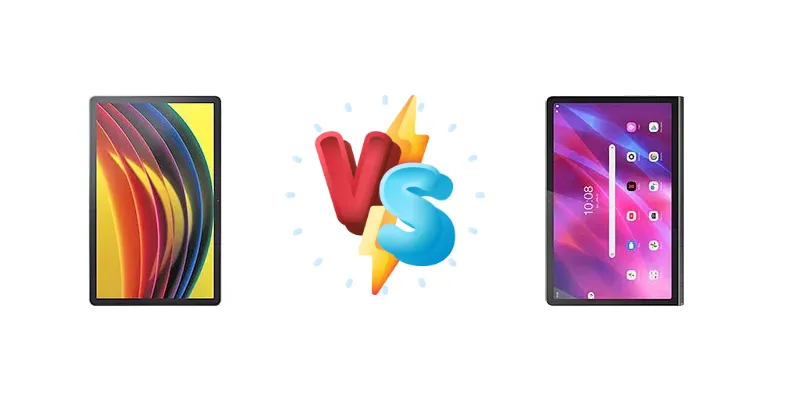
Lenovo has carved a niche in the affordable Android tablet space, and the Tab P11 Plus and Yoga Tab 11 represent compelling options. While both devices are powered by the same MediaTek Helio G90T chipset, their differing designs and intended use cases create a surprisingly nuanced comparison. This deep dive will dissect their strengths and weaknesses to help you choose the right tablet for your needs.
🏆 Quick Verdict
For the average user prioritizing portability and hands-free viewing, the Lenovo Yoga Tab 11 is the better choice thanks to its integrated kickstand. However, if a more traditional tablet form factor is preferred, the Tab P11 Plus delivers similar performance at a potentially lower price point.
| Network |
|---|
| 2G bands | GSM 850 / 900 / 1800 / 1900 | GSM 850 / 900 / 1800 / 1900 |
| 3G bands | HSDPA 850 / 900 / 1900 / 2100 | HSDPA 850 / 900 / 1700(AWS) / 1900 / 2100 |
| 4G bands | 1, 2, 3, 4, 5, 7, 8, 20, 28, 38, 40, 41 | LTE |
| Speed | HSPA, LTE - cellular model only | HSPA, LTE - cellular model only |
| Technology | GSM / HSPA / LTE | GSM / HSPA / LTE |
| Launch |
|---|
| Announced | 2021, June 28 | 2021, June 28 |
| Status | Available. Released 2021, July 29 | Available. Released 2021, June 31 |
| Body |
|---|
| Build | - | Glass front, aluminum frame, aluminum back |
| Dimensions | 258.4 x 163 x 7.5 mm (10.17 x 6.42 x 0.30 in) | 256.8 mm x 169 mm x 7.9-8.3 mm |
| SIM | Nano-SIM (cellular model only) | Nano-SIM (cellular model only) |
| Weight | 490 g (1.08 lb) | 655 g (1.44 lb) |
| | Stylus support | Built-in stainless steel kickstand
Stylus support |
| Display |
|---|
| Resolution | 1200 x 2000 pixels, 5:3 ratio (~212 ppi density) | 1200 x 2000 pixels, 5:3 ratio (~212 ppi density) |
| Size | 11.0 inches, 344.4 cm2 (~81.8% screen-to-body ratio) | 11.0 inches, 344.4 cm2 (~79.4% screen-to-body ratio) |
| Type | IPS LCD, 400 nits (typ) | IPS LCD, Dolby Vision, 400 nits |
| Platform |
|---|
| CPU | Octa-core (2x2.05 GHz Cortex-A76 & 6x2.0 GHz Cortex-A55) | Octa-core (2x2.05 GHz Cortex-A76 & 6x2.0 GHz Cortex-A55) |
| Chipset | Mediatek MT6785 Helio G90T (12 nm) | Mediatek MT6785 Helio G90T (12 nm) |
| GPU | Mali-G76 MC4 | Mali-G76 MC4 |
| OS | Android 11 | Android 11 |
| Memory |
|---|
| Card slot | microSDXC (dedicated slot) | microSDXC |
| Internal | 64GB 4GB RAM, 128GB 4GB RAM, 128GB 6GB RAM | 128GB 4GB RAM, 256GB 8GB RAM |
| Main Camera |
|---|
| Features | LED flash | - |
| Single | 13 MP, (wide), AF | 8 MP, AF |
| Video | 1080p@30fps | 1080p@30fps |
| Selfie camera |
|---|
| Single | 8 MP, (wide) | 8 MP
TOF 3D, (biometrics sensor) |
| Video | 1080p@30fps | 1080p@30fps |
| Sound |
|---|
| 3.5mm jack | No | No |
| 35mm jack | No | No |
| Loudspeaker | Yes, with stereo speakers (4 speakers) | Yes, with stereo speakers (4 speakers) |
| | - | Tuned by JBL |
| Comms |
|---|
| Bluetooth | 5.1, A2DP, LE | 5.0, A2DP, LE |
| NFC | No | No |
| Positioning | GPS, GLONASS, BDS - cellular model only | GPS, GLONASS - cellular model only |
| Radio | FM radio | No |
| USB | USB Type-C 2.0 | USB Type-C 2.0 |
| WLAN | Wi-Fi 802.11 a/b/g/n/ac, dual-band, Wi-Fi Direct | Wi-Fi 802.11 a/b/g/n/ac, dual-band, Wi-Fi Direct |
| Features |
|---|
| Sensors | Accelerometer, gyro, proximity | Face recognition, accelerometer, gyro |
| Battery |
|---|
| Charging | 20W wired | 20W wired |
| Type | Li-Po 7700 mAh | Li-Po 7700 mAh |
| Misc |
|---|
| Colors | Slate Grey, Platinum Grey, Modernist teal | Storm Gray |
| Models | ZA940124SE | - |
| Price | About 300 EUR | About 350 EUR |
Lenovo Tab P11 Plus
- Traditional tablet form factor
- Potentially lower price point
- Slightly better thermal dissipation (potentially)
- Lacks built-in kickstand
- Less versatile for hands-free viewing
Lenovo Yoga Tab 11
- Integrated kickstand for hands-free viewing
- More portable and versatile form factor
- Unique viewing angles
- Wider aspect ratio may cause letterboxing
- Potentially higher price point
Display Comparison
Both tablets likely feature similar LCD panels, given their price points and chipset. The key difference lies in the form factor. The Yoga Tab 11’s design necessitates a wider aspect ratio to accommodate the kickstand, potentially impacting video playback with letterboxing. While neither Lenovo specifies peak brightness, the LCD technology suggests they will perform best in indoor environments. Bezels are expected to be comparable, focusing on cost-effectiveness rather than minimizing borders. Color accuracy is likely standard for this price range, suitable for casual viewing but not professional color work.
Camera Comparison
Camera performance is unlikely to be a deciding factor for either tablet. Given the context data, we can assume both devices feature similar camera setups focused on basic functionality. Expect a primary sensor for daylight photography and a secondary sensor for depth information. The absence of detailed camera specifications suggests neither tablet prioritizes photography. Image processing will likely be standard, aiming for acceptable results in good lighting conditions but struggling in low light. The focus should be on video conferencing rather than high-quality photography.
Performance
The core of both tablets is the MediaTek Helio G90T (12 nm) chipset, featuring an octa-core CPU configuration with 2x2.05 GHz Cortex-A76 and 6x2.0 GHz Cortex-A55 cores. This means CPU performance will be virtually identical between the two devices. Gaming performance will also be nearly indistinguishable, capable of handling most Android titles at medium settings. The G90T’s Mali-G76 MC4 GPU is a capable performer, but demanding games may require reduced graphics settings. Thermal management will be crucial; sustained loads could lead to throttling, but the larger surface area of the Tab P11 Plus *might* offer slightly better heat dissipation. Both devices likely utilize LPDDR4X RAM, further minimizing performance differences.
Battery Life
Both tablets feature 20W wired charging, suggesting similar charging speeds – approximately 2-3 hours for a full charge. Battery capacity is not specified, but given the similar form factors and target price points, they likely house batteries of comparable size (around 7500-8000 mAh). Real-world battery life will depend heavily on usage patterns, but both tablets should comfortably last a full day of moderate use (web browsing, video streaming, and light gaming). The Yoga Tab 11’s kickstand usage *could* slightly reduce battery life due to the altered viewing angle and potential for increased screen brightness.
Buying Guide
Buy the Lenovo Tab P11 Plus if you need a standard tablet experience for media consumption, light productivity, and occasional gaming, and value a potentially lower price. Buy the Lenovo Yoga Tab 11 if you prioritize portability, hands-free viewing with its built-in kickstand, and a more versatile form factor for travel or on-the-go use. The kickstand fundamentally changes how you interact with the device.
Frequently Asked Questions
❓ Will the Helio G90T in the Yoga Tab 11 overheat during extended gaming sessions?
The Helio G90T is known to throttle under sustained load. While the Yoga Tab 11’s wider form factor might offer slightly better heat dissipation than a traditional tablet, expect some performance reduction during prolonged gaming. Lowering graphics settings will mitigate this issue.
❓ Is the kickstand on the Yoga Tab 11 durable enough for frequent travel?
Lenovo has designed the Yoga Tab 11’s kickstand to be robust, but it’s still a mechanical component. While it’s unlikely to break under normal use, avoid applying excessive force or bending it beyond its intended range. Consider a protective case for added security during travel.
❓ Can either tablet be used with a stylus?
Neither Lenovo officially supports stylus input for these models. While you might be able to use a generic capacitive stylus, it won't offer the pressure sensitivity or advanced features found on tablets designed for stylus use.