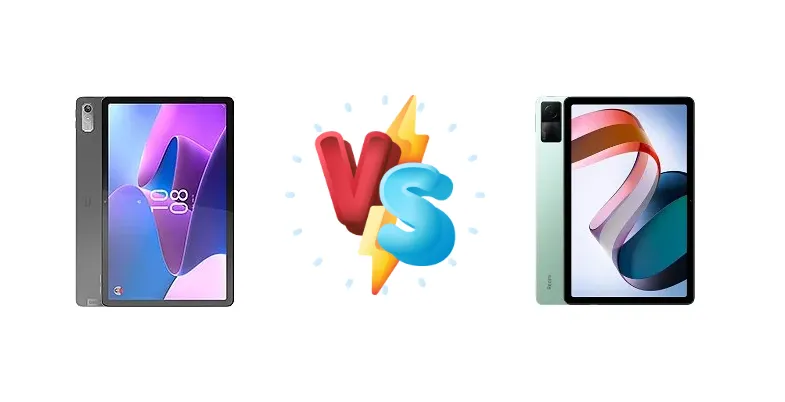
The mid-range tablet market is heating up! Both the Lenovo Tab P11 Gen 2 and the Xiaomi Redmi Pad offer compelling features at attractive prices. But which one is the better choice for your needs? Let's dive into a detailed comparison to help you decide.
🏆 Quick Verdict
The Xiaomi Redmi Pad edges out the Lenovo Tab P11 Gen 2 thanks to its slightly better display and more competitive pricing. Both share the same chipset, but the Redmi Pad's overall package offers a more balanced experience for most users.
| Network |
|---|
| 2G bands | GSM 850 / 900 / 1800 / 1900 | N/A |
| 3G bands | HSDPA 800 / 850 / 900 / 1700(AWS) / 1900 / 2100 | N/A |
| 4G bands | 1, 2, 3, 4, 5, 7, 8, 12, 13, 18, 19, 20, 25, 26, 28, 38, 40, 41, 66 | N/A |
| EDGE | - | N/A |
| GPRS | - | N/A |
| Speed | HSPA, LTE - cellular model only | - |
| Technology | GSM / HSPA / LTE | No cellular connectivity |
| Launch |
|---|
| Announced | 2022, September 01 | 2022, October 04 |
| Status | Available. Released 2023, January | Available. Released 2022, October 05 |
| Body |
|---|
| Build | - | Glass front, aluminum frame |
| Dimensions | 269.1 x 169.4 x 7.4 mm (10.59 x 6.67 x 0.29 in) | 250.5 x 158.1 x 7.1 mm (9.86 x 6.22 x 0.28 in) |
| SIM | Nano-SIM (cellular model only) | No |
| Weight | 520 g (1.15 lb) | 465 g (1.03 lb) |
| | Stylus support | - |
| Display |
|---|
| Resolution | 1200 x 2000 pixels, 5:3 ratio (~203 ppi density) | 1200 x 2000 pixels, 5:3 ratio (~220 ppi density) |
| Size | 11.5 inches, 376.4 cm2 (~82.6% screen-to-body ratio) | 10.61 inches, 320.4 cm2 (~80.9% screen-to-body ratio) |
| Type | IPS LCD, 120Hz, 400 nits (typ) | IPS LCD, 1B colors, 90Hz, 400 nits (typ) |
| Platform |
|---|
| CPU | Octa-core (2x2.2 GHz Cortex-A76 & 6x2.0 GHz Cortex-A55) | Octa-core (2x2.2 GHz Cortex-A76 & 6x2.0 GHz Cortex-A55) |
| Chipset | Mediatek Helio G99 (6 nm) | Mediatek Helio G99 (6 nm) |
| GPU | Mali-G57 MC2 | Mali-G57 MC2 |
| OS | Android 12L | Android 12, upgradable to Android 13, MIUI 14 |
| Memory |
|---|
| Card slot | microSDXC (dedicated slot) | microSDXC |
| Internal | 64GB 4GB RAM, 128GB 4GB RAM, 128GB 6GB RAM | 64GB 3GB RAM, 128GB 4GB RAM, 128GB 6GB RAM |
| | - | UFS 2.2 |
| Main Camera |
|---|
| Features | LED flash | - |
| Single | 13 MP, f/2.4, (wide), AF | 8 MP, f/2.0, (wide), AF |
| Video | 1080p@30fps | 1080p@30fps |
| Selfie camera |
|---|
| Single | 8 MP, f/2.0 | 8 MP, f/2.3, 105° (ultrawide) |
| Video | 1080p@30fps | 1080p@30fps |
| Sound |
|---|
| 3.5mm jack | Yes | No |
| 35mm jack | Yes | No |
| Loudspeaker | Yes, with stereo speakers (4 speakers) | Yes, with stereo speakers (4 speakers) |
| | - | 24-bit/192kHz audio |
| Comms |
|---|
| Bluetooth | 5.2, A2DP, LE | 5.2, A2DP, LE |
| NFC | No | No |
| Positioning | GPS, GLONASS, BDS - cellular model only | No |
| Radio | No | No |
| USB | USB Type-C 2.0, OTG, magnetic connector | USB Type-C, OTG |
| WLAN | Wi-Fi 802.11 a/b/g/n/ac/6e, dual-band, Wi-Fi Direct | Wi-Fi 802.11 a/b/g/n/ac, dual-band, Wi-Fi Direct |
| Features |
|---|
| Sensors | Accelerometer, gyro, proximity | Accelerometer |
| Battery |
|---|
| Charging | - | 18W wired |
| Type | Li-Po 7700 mAh | Li-Po 8000 mAh |
| Misc |
|---|
| Colors | Storm Grey, Sage | Graphite Gray, Moonlight Silver, Mint Green |
| Models | TB350FU | 22081283G |
| Price | About 350 EUR | About 250 EUR |
| SAR EU | - | 0.36 W/kg (body) |
| Tests |
|---|
| Display | - |
Contrast ratio: 1529:1 (nominal) |
| Loudspeaker | - |
-23.9 LUFS (Very good)
|
| Performance | - |
AnTuTu: 319077 (v9)
GeekBench: 1852 (v5.1)
GFXBench: 13fps (ES 3.1 onscreen) |
Lenovo Tab P11 Gen 2
- Premium build quality
- Stylus support (optional)
- Good audio quality
- Slightly higher price
- Camera performance could be better
- Charging speed could be faster
Xiaomi Redmi Pad
- Excellent display brightness
- Competitive pricing
- Larger battery capacity
- Decent rear camera
- Plastic build
- No stylus support
- Software updates may be slower
Display Comparison
Both tablets feature 11-inch displays with a 2K resolution and a 1529:1 contrast ratio. However, the Redmi Pad boasts a measured peak brightness of 402 nits, potentially offering better visibility in brighter environments. The Lenovo Tab P11 Gen 2's display is generally well-regarded, but the Redmi Pad's brightness gives it a slight edge.
Camera Comparison
The Lenovo Tab P11 Gen 2 typically features an 8MP front and rear camera, while the Redmi Pad has an 8MP front and a 13MP rear camera. The Redmi Pad's rear camera offers a slight advantage in image quality, particularly in well-lit conditions. Both are adequate for video calls and casual snapshots.
Performance
Powered by the same Mediatek Helio G99 chipset and CPU configuration, performance should be very similar between the two tablets. Expect smooth multitasking and decent gaming performance, though demanding titles may require reduced graphics settings. Real-world performance differences will likely be minimal.
Battery Life
Battery capacity is similar, around 7740mAh for the Lenovo and 8740mAh for the Xiaomi. The Redmi Pad's slightly larger battery, combined with efficient software optimization, may translate to slightly longer battery life in real-world usage. The Lenovo supports 20W charging, while the Redmi Pad supports 18W wired charging.
Buying Guide
The Lenovo Tab P11 Gen 2 is ideal for users who prioritize a stylus experience (stylus sold separately) and a slightly more premium build. The Xiaomi Redmi Pad is a great choice for those seeking a large, vibrant display for media consumption and a budget-friendly option.
Frequently Asked Questions
❓ Does the Lenovo Tab P11 Gen 2 support a stylus?
Yes, the Lenovo Tab P11 Gen 2 supports a stylus, but it is sold separately. It offers a good writing and drawing experience.
❓ Which tablet is better for watching videos?
The Xiaomi Redmi Pad is generally better for watching videos due to its slightly brighter display, which improves visibility in various lighting conditions.