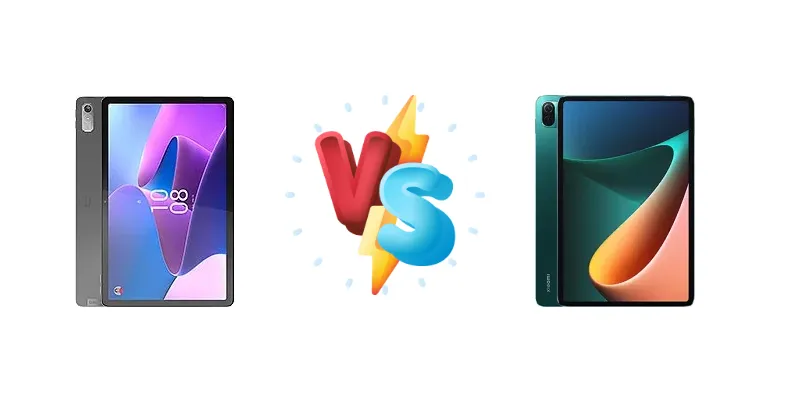
The Android tablet market is heating up, and two strong contenders are the Lenovo Tab P11 Gen 2 and the Xiaomi Pad 5. Both offer compelling features at competitive prices, but which one is the better choice for your needs? This comprehensive comparison will break down every aspect, from display quality to performance and battery life.
🏆 Quick Verdict
The Xiaomi Pad 5 generally edges out the Lenovo Tab P11 Gen 2 thanks to its superior Snapdragon 860 chipset, brighter display, and faster charging. However, the Lenovo offers a more budget-friendly option with a decent display and respectable performance for everyday tasks.
| Network |
|---|
| 2G bands | GSM 850 / 900 / 1800 / 1900 | N/A |
| 3G bands | HSDPA 800 / 850 / 900 / 1700(AWS) / 1900 / 2100 | N/A |
| 4G bands | 1, 2, 3, 4, 5, 7, 8, 12, 13, 18, 19, 20, 25, 26, 28, 38, 40, 41, 66 | - |
| EDGE | - | N/A |
| GPRS | - | N/A |
| Speed | HSPA, LTE - cellular model only | - |
| Technology | GSM / HSPA / LTE | No cellular connectivity |
| Launch |
|---|
| Announced | 2022, September 01 | 2021, August 10 |
| Status | Available. Released 2023, January | Available. Released 2021, August 10 |
| Body |
|---|
| Build | - | Glass front, aluminum frame, plastic back |
| Dimensions | 269.1 x 169.4 x 7.4 mm (10.59 x 6.67 x 0.29 in) | 254.7 x 166.3 x 6.9 mm (10.03 x 6.55 x 0.27 in) |
| SIM | Nano-SIM (cellular model only) | No |
| Weight | 520 g (1.15 lb) | 511 g (1.13 lb) |
| | Stylus support | Stylus support (magnetic) |
| Display |
|---|
| Resolution | 1200 x 2000 pixels, 5:3 ratio (~203 ppi density) | 1600 x 2560 pixels, 16:10 ratio (~274 ppi density) |
| Size | 11.5 inches, 376.4 cm2 (~82.6% screen-to-body ratio) | 11.0 inches, 350.9 cm2 (~82.8% screen-to-body ratio) |
| Type | IPS LCD, 120Hz, 400 nits (typ) | IPS LCD, 1B colors, 120Hz, HDR10, Dolby Vision |
| Platform |
|---|
| CPU | Octa-core (2x2.2 GHz Cortex-A76 & 6x2.0 GHz Cortex-A55) | Octa-core (1x2.96 GHz Kryo 485 Gold & 3x2.42 GHz Kryo 485 Gold & 4x1.78 GHz Kryo 485 Silver) |
| Chipset | Mediatek Helio G99 (6 nm) | Qualcomm Snapdragon 860 (7 nm) |
| GPU | Mali-G57 MC2 | Adreno 640 |
| OS | Android 12L | Android 11, upgradable to Android 13, MIUI 14 |
| Memory |
|---|
| Card slot | microSDXC (dedicated slot) | No |
| Internal | 64GB 4GB RAM, 128GB 4GB RAM, 128GB 6GB RAM | 128GB 6GB RAM, 256GB 6GB RAM |
| | - | UFS 3.1 |
| Main Camera |
|---|
| Features | LED flash | Dual-LED flash, HDR, panorama |
| Single | 13 MP, f/2.4, (wide), AF | 13 MP, f/2.0 |
| Video | 1080p@30fps | 4K@30fps, 1080p@30fps |
| Selfie camera |
|---|
| Single | 8 MP, f/2.0 | 8 MP, f/2.0 |
| Video | 1080p@30fps | 1080p@30fps |
| Sound |
|---|
| 3.5mm jack | Yes | No |
| 35mm jack | Yes | No |
| Loudspeaker | Yes, with stereo speakers (4 speakers) | Yes, with stereo speakers (4 speakers) |
| | - | 24-bit/192kHz audio |
| Comms |
|---|
| Bluetooth | 5.2, A2DP, LE | 5.0, A2DP, LE |
| NFC | No | No |
| Positioning | GPS, GLONASS, BDS - cellular model only | No |
| Radio | No | No |
| USB | USB Type-C 2.0, OTG, magnetic connector | USB Type-C |
| WLAN | Wi-Fi 802.11 a/b/g/n/ac/6e, dual-band, Wi-Fi Direct | Wi-Fi 802.11 a/b/g/n/ac, dual-band, Wi-Fi Direct |
| Features |
|---|
| Sensors | Accelerometer, gyro, proximity | Accelerometer, gyro, proximity, compass |
| Battery |
|---|
| Charging | - | 33W wired, PD3.0 |
| Type | Li-Po 7700 mAh | Li-Po 8720 mAh |
| Misc |
|---|
| Colors | Storm Grey, Sage | Cosmic Gray, Pearl White, Green |
| Models | TB350FU | 21051182G, 21051182C |
| Price | About 350 EUR | About 350 EUR |
| Tests |
|---|
| Display | - |
Contrast ratio: 1271:1 (nominal) |
| Loudspeaker | - |
-24.4 LUFS (Very good)
|
| Performance | - |
AnTuTu: 473819 (v8), 555079 (v9)
GeekBench: 2583 (v5.1)
GFXBench: 24fps (ES 3.1 onscreen) |
Lenovo Tab P11 Gen 2
- More affordable
- Decent display
- Good for everyday tasks
- Solid build quality
- Less powerful chipset
- Slower charging
- Lower brightness display
- Mediocre camera
Xiaomi Pad 5
- Powerful Snapdragon 860 chipset
- Brighter and better display
- Faster charging (33W)
- Better camera performance
- More expensive
- Software updates can be inconsistent
- No included stylus (sold separately)
Display Comparison
The Xiaomi Pad 5 boasts a brighter display (478 nits vs Lenovo's likely around 350-400 nits) and a slightly better contrast ratio, resulting in more vibrant colors and deeper blacks. Both have 120Hz refresh rates for smooth scrolling, but the Xiaomi's overall visual experience is noticeably superior. Both feature 2K resolution displays, offering sharp visuals.
Camera Comparison
Camera quality is generally not a primary concern for tablets, but the Xiaomi Pad 5 typically offers slightly better image quality in both its front and rear cameras. Both feature 8MP front cameras and 13MP rear cameras. Expect decent, but not exceptional, results from either device.
Performance
Here, the Xiaomi Pad 5 takes a clear lead. The Snapdragon 860 is significantly more powerful than the Mediatek Helio G99, providing smoother multitasking, faster app loading times, and better gaming performance. The Lenovo is still capable for everyday tasks, but struggles with demanding games.
Battery Life
Both tablets offer respectable battery life, typically lasting a full day of moderate use. The Xiaomi Pad 5's 33W fast charging provides a significant advantage, allowing for quicker top-ups compared to the Lenovo's likely slower charging speeds.
Buying Guide
The Lenovo Tab P11 Gen 2 is ideal for students, casual users, and those on a tighter budget who need a reliable tablet for browsing, streaming, and light productivity. The Xiaomi Pad 5 is a better choice for gamers, power users, and anyone who values a premium display, faster performance, and quicker charging.
Frequently Asked Questions
❓ Which tablet is better for gaming?
The Xiaomi Pad 5 is significantly better for gaming due to its more powerful Snapdragon 860 chipset and smoother performance.
❓ Does the Lenovo Tab P11 Gen 2 support a stylus?
Yes, the Lenovo Tab P11 Gen 2 supports a stylus, but it's sold separately. The Xiaomi Pad 5 also supports a stylus, which is also sold separately.
❓ What is the resolution of both tablets’ screens?
Both tablets feature 2K resolution displays, offering sharp and detailed visuals.