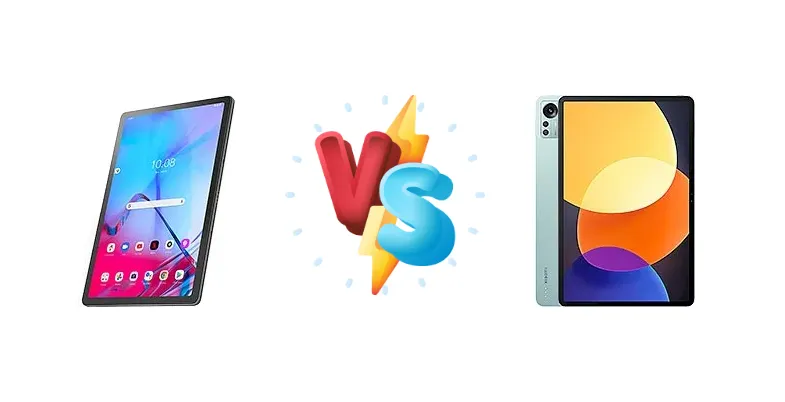
The Android tablet market is heating up, with options ranging from budget-friendly to premium. We pit the Lenovo Tab P11 5G, a solid mid-range contender with integrated 5G, against the Xiaomi Pad 5 Pro 12.4, a performance-focused tablet boasting the Snapdragon 870. This comparison dives deep into the core differences, helping you determine which tablet best suits your needs.
🏆 Quick Verdict
For most users, the Xiaomi Pad 5 Pro 12.4 is the clear winner. Its Snapdragon 870 chipset provides a substantial performance advantage over the Lenovo Tab P11 5G’s Snapdragon 750G, coupled with significantly faster 67W charging. The Lenovo Tab P11 5G remains a viable option for those prioritizing 5G connectivity on a tighter budget.
| Network |
|---|
| 2G bands | GSM 850 / 900 / 1800 / 1900 | N/A |
| 3G bands | HSDPA 850 / 900 / 1900 / 2100 | N/A |
| 4G bands | 1, 2, 3, 4, 5, 7, 8, 19, 20, 26, 28, 34, 38, 39, 40, 41 | N/A |
| 5G bands | 1, 3, 7, 8, 20, 28, 38, 41, 77, 78, 79 SA/NSA | - |
| EDGE | - | No |
| GPRS | - | No |
| Speed | HSPA, LTE, 5G | - |
| Technology | GSM / HSPA / LTE / 5G | No cellular connectivity |
| Launch |
|---|
| Announced | 2021, September 08 | 2022, August 11 |
| Status | Available. Released 2021, December 15 | Available. Released 2022, August 24 |
| Body |
|---|
| Build | - | Glass front (Gorilla Glass 3), aluminum frame, aluminum back |
| Dimensions | 258 x 163 x 7.9 mm (10.16 x 6.42 x 0.31 in) | 285 x 185.2 x 6.7 mm (11.22 x 7.29 x 0.26 in) |
| SIM | Nano-SIM | No |
| Weight | 520 g (1.15 lb) | 620 g (1.37 lb) |
| | Stylus support | Stylus support (magnetic) |
| Display |
|---|
| Protection | - | Corning Gorilla Glass 3 |
| Resolution | 1200 x 2000 pixels, 5:3 ratio (~212 ppi density) | 1600 x 2560 pixels, 16:10 ratio (~243 ppi density) |
| Size | 11.0 inches, 344.4 cm2 (~81.9% screen-to-body ratio) | 12.4 inches, 445.8 cm2 (~84.5% screen-to-body ratio) |
| Type | IPS LCD, Dolby Vision, 400 nits (typ) | IPS LCD, 120Hz, HDR10, Dolby Vision, 500 nits |
| Platform |
|---|
| CPU | Octa-core (2x2.2 GHz Kryo 570 & 6x1.8 GHz Kryo 570) | Octa-core (1x3.2 GHz Kryo 585 & 3x2.42 GHz Kryo 585 & 4x1.80 GHz Kryo 585) |
| Chipset | Qualcomm SM7225 Snapdragon 750G 5G (8 nm) | Qualcomm SM8250-AC Snapdragon 870 5G (7 nm) |
| GPU | Adreno 619 | Adreno 650 |
| OS | Android 11 | Android 12, MIUI Pad 13 |
| Memory |
|---|
| Card slot | microSDXC (dedicated slot) | No |
| Internal | 128GB 6GB RAM, 256GB 8GB RAM | 128GB 6GB RAM, 256GB 8GB RAM, 512GB 12GB RAM |
| | - | UFS 3.1 |
| Main Camera |
|---|
| Dual | - | 50 MP, f/1.8, 1/2.76", 0.64µm, PDAF
Auxiliary lens |
| Features | LED flash | Color spectrum sensor, LED flash, panorama, HDR |
| Single | 13 MP, (wide), AF | - |
| Video | 1080p@30fps | 4K@30fps, 1080p@30/60fps |
| Selfie camera |
|---|
| Single | 8 MP, (wide)
IR TOF 3D, (biometrics sensor only) | 20 MP, f/2.2, 1/3.4", 0.8µm |
| Video | 1080p@30fps | 1080p@30/60fps |
| Sound |
|---|
| 3.5mm jack | No | No |
| 35mm jack | No | No |
| Loudspeaker | Yes, with stereo speakers (4 speakers) | Yes, with stereo speakers (4 speakers) |
| | JBL speakers | - |
| Comms |
|---|
| Bluetooth | 5.1, A2DP, LE | 5.2, A2DP, LE |
| NFC | No | No |
| Positioning | GPS, GLONASS, BDS | No |
| Radio | No | No |
| USB | USB Type-C 3.2, DisplayPort | USB Type-C 3.2 video output |
| WLAN | Wi-Fi 802.11 a/b/g/n/ac/6, dual-band, Wi-Fi Direct | Wi-Fi 802.11 a/b/g/n/ac/6, dual-band, Wi-Fi Direct |
| Features |
|---|
| Sensors | Accelerometer, gyro, proximity | Accelerometer, gyro, proximity, compass |
| Battery |
|---|
| Charging | 20W wired | 67W wired, PD3.0, QC4, 60% in 36 min, 100% in 68 min |
| Type | Li-Po 7700 mAh | Li-Po 10000 mAh |
| Misc |
|---|
| Colors | Moon White, Storm Grey, Modernist Teal | Black, Silver, Green |
| Price | About 500 EUR | About 400 EUR |
Lenovo Tab P11 5G
- Integrated 5G connectivity for on-the-go access.
- More affordable price point.
- Potentially longer battery life due to less demanding chipset.
- Significantly slower performance compared to the Xiaomi.
- Much slower 20W charging.
- Likely lower quality display.
Xiaomi Pad 5 Pro 12.4
- Superior performance with the Snapdragon 870.
- Ultra-fast 67W charging.
- Likely higher quality display with better color accuracy.
- Higher price tag.
- May not have integrated 5G (depending on model).
- Potentially shorter battery life under heavy load.
Display Comparison
While both tablets feature a 12.4-inch display, the specifics are not provided. However, given Xiaomi’s track record, the Pad 5 Pro 12.4 likely boasts a higher resolution and potentially a higher refresh rate. The Lenovo Tab P11 5G, positioned as a mid-range device, likely utilizes a standard LCD panel. The Xiaomi’s potential for a higher peak brightness and wider color gamut would be beneficial for content creators and media consumers. Bezels are also likely slimmer on the Xiaomi, contributing to a more immersive experience.
Camera Comparison
Camera performance is unlikely to be a primary differentiator for either tablet. Details are not provided, but given the market segment, both will likely feature modest camera setups. The Xiaomi Pad 5 Pro 12.4 may have a slightly more advanced sensor, but the real-world difference will be minimal. Image processing will likely be the key factor, with Xiaomi potentially offering more refined algorithms.
Performance
The core difference lies in the chipsets. The Xiaomi Pad 5 Pro 12.4’s Snapdragon 870 5G (7nm) is a significant upgrade over the Lenovo Tab P11 5G’s Snapdragon 750G 5G (8nm). The 870 features a Kryo 585 core clocked at 3.2 GHz, compared to the 750G’s 2.2 GHz Kryo 570. This translates to a roughly 30-40% performance increase in CPU-intensive tasks and a substantial boost in GPU performance. The 7nm process node of the 870 also offers better power efficiency, potentially leading to longer sustained performance under load. The Xiaomi’s likely use of faster LPDDR5 RAM further enhances its performance capabilities.
Battery Life
Battery capacity is not specified for either device. However, the Xiaomi Pad 5 Pro 12.4’s 67W wired charging is a game-changer. It can reach 60% charge in 36 minutes and 100% in 68 minutes. The Lenovo Tab P11 5G’s 20W charging is considerably slower. While a larger battery on the Lenovo could offset the slower charging, the convenience and speed of the Xiaomi’s charging are undeniable. The Snapdragon 870’s improved power efficiency may also contribute to comparable real-world battery life despite potentially having a smaller capacity.
Buying Guide
Buy the Lenovo Tab P11 5G if you need a portable tablet with 5G connectivity for basic tasks like browsing, video streaming, and light productivity, and are unwilling to spend more than $300. Buy the Xiaomi Pad 5 Pro 12.4 if you prioritize performance for gaming, demanding applications, and fast charging, and are willing to invest in a more premium experience.
Frequently Asked Questions
❓ Will the Snapdragon 750G in the Lenovo Tab P11 5G struggle with demanding games like Genshin Impact?
Yes, the Snapdragon 750G is a mid-range chipset and will likely require significant graphics settings reductions to achieve playable frame rates in demanding titles like Genshin Impact. The Xiaomi Pad 5 Pro 12.4’s Snapdragon 870 will provide a much smoother gaming experience.
❓ How much faster is the 67W charging on the Xiaomi Pad 5 Pro 12.4 compared to the 20W charging on the Lenovo Tab P11 5G in real-world use?
The 67W charging on the Xiaomi Pad 5 Pro 12.4 can fully charge the device in approximately 68 minutes, while the Lenovo Tab P11 5G will take considerably longer – likely over 2 hours. This means you can quickly top up the Xiaomi during short breaks, whereas the Lenovo requires a more substantial charging period.
❓ Does the Xiaomi Pad 5 Pro 12.4 support stylus input and keyboard accessories?
Yes, the Xiaomi Pad 5 Pro 12.4 is designed to work with the Xiaomi Smart Pen and the Xiaomi Pad Keyboard. These accessories are sold separately and enhance the tablet’s productivity capabilities, transforming it into a more versatile device.