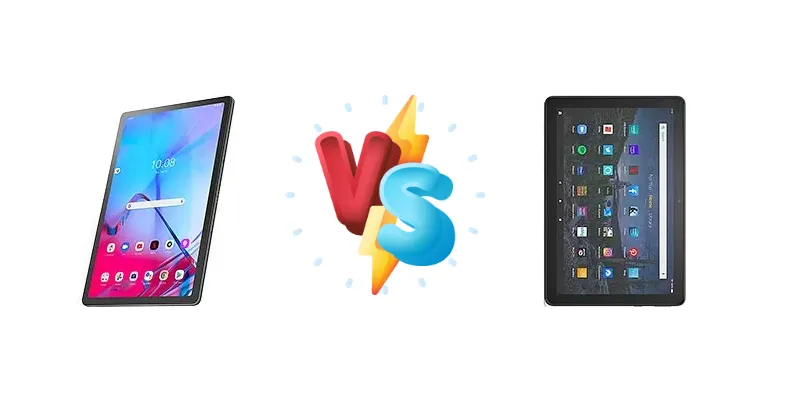
The tablet market offers a wide range of options, but narrowing down the field can be challenging. We're pitting the Lenovo Tab P11 5G, a connectivity-focused Android tablet, against the Amazon Fire HD 10 Plus (2021), a media consumption powerhouse running Fire OS. This comparison dives deep into their hardware and software to determine which tablet best suits your needs and budget.
🏆 Quick Verdict
For users prioritizing performance and future-proofing, the Lenovo Tab P11 5G emerges as the stronger choice. Its Snapdragon 750G chipset offers a significant performance advantage over the Fire HD 10 Plus’s Helio P60T, coupled with the benefit of 5G connectivity. However, the Fire HD 10 Plus’s wireless charging and lower price point make it a compelling option for casual users.
| Network |
|---|
| 2G bands | GSM 850 / 900 / 1800 / 1900 | N/A |
| 3G bands | HSDPA 850 / 900 / 1900 / 2100 | - |
| 4G bands | 1, 2, 3, 4, 5, 7, 8, 19, 20, 26, 28, 34, 38, 39, 40, 41 | - |
| 5G bands | 1, 3, 7, 8, 20, 28, 38, 41, 77, 78, 79 SA/NSA | - |
| EDGE | - | No |
| GPRS | - | No |
| Speed | HSPA, LTE, 5G | - |
| Technology | GSM / HSPA / LTE / 5G | No cellular connectivity |
| Launch |
|---|
| Announced | 2021, September 08 | 2021, April 27. Released 2021, May 26 |
| Status | Available. Released 2021, December 15 | Discontinued |
| Body |
|---|
| Dimensions | 258 x 163 x 7.9 mm (10.16 x 6.42 x 0.31 in) | 247 x 166 x 9.2 mm (9.72 x 6.54 x 0.36 in) |
| SIM | Nano-SIM | No |
| Weight | 520 g (1.15 lb) | 468 g (1.03 lb) |
| | Stylus support | - |
| Display |
|---|
| Protection | - | Aluminosilicate glass |
| Resolution | 1200 x 2000 pixels, 5:3 ratio (~212 ppi density) | 1920 x 1200 pixels, 16:10 ratio (~224 ppi density) |
| Size | 11.0 inches, 344.4 cm2 (~81.9% screen-to-body ratio) | 10.1 inches, 295.8 cm2 (~72.1% screen-to-body ratio) |
| Type | IPS LCD, Dolby Vision, 400 nits (typ) | IPS LCD |
| Platform |
|---|
| CPU | Octa-core (2x2.2 GHz Kryo 570 & 6x1.8 GHz Kryo 570) | Octa-core (4x2.0 GHz Cortex-A73 & 4x2.0 GHz Cortex-A53) |
| Chipset | Qualcomm SM7225 Snapdragon 750G 5G (8 nm) | Mediatek MT8183 Helio P60T (12 nm) |
| GPU | Adreno 619 | Mali-G72 MP3 |
| OS | Android 11 | Android 9.0 (Pie), Fire OS 7 |
| Memory |
|---|
| Card slot | microSDXC (dedicated slot) | microSDXC (dedicated slot) |
| Internal | 128GB 6GB RAM, 256GB 8GB RAM | 32GB 4GB RAM, 64GB 4GB RAM |
| | - | eMMC 5.1 |
| Main Camera |
|---|
| Features | LED flash | - |
| Single | 13 MP, (wide), AF | 5 MP |
| Video | 1080p@30fps | 720p |
| Selfie camera |
|---|
| Single | 8 MP, (wide)
IR TOF 3D, (biometrics sensor only) | 2 MP |
| Video | 1080p@30fps | 720p |
| Sound |
|---|
| 3.5mm jack | No | Yes |
| 35mm jack | No | Yes |
| Loudspeaker | Yes, with stereo speakers (4 speakers) | Yes, with stereo speakers |
| | JBL speakers | - |
| Comms |
|---|
| Bluetooth | 5.1, A2DP, LE | 5.0, A2DP, LE |
| NFC | No | No |
| Positioning | GPS, GLONASS, BDS | No |
| Radio | No | No |
| USB | USB Type-C 3.2, DisplayPort | USB Type-C 2.0, OTG |
| WLAN | Wi-Fi 802.11 a/b/g/n/ac/6, dual-band, Wi-Fi Direct | Wi-Fi 802.11 a/b/g/n/ac, dual-band |
| Features |
|---|
| Sensors | Accelerometer, gyro, proximity | Accelerometer |
| | - | Text-to-Speech English-language content reader |
| Battery |
|---|
| Charging | 20W wired | Wireless |
| Type | Li-Po 7700 mAh | Li-Ion |
| Misc |
|---|
| Colors | Moon White, Storm Grey, Modernist Teal | Slate |
| Models | - | T76N2P |
| Price | About 500 EUR | About 150 EUR |
Lenovo Tab P11 5G
- Significantly faster processor for smoother multitasking and gaming.
- 5G connectivity for faster download and streaming speeds.
- More efficient chipset for potentially longer battery life.
- Lacks wireless charging.
- Potentially higher price point.
Amazon Fire HD 10 Plus (2021)
- Wireless charging for added convenience.
- Lower price point, making it more accessible.
- Deep integration with Amazon’s ecosystem.
- Less powerful processor, resulting in slower performance.
- Limited app availability compared to the Google Play Store.
Display Comparison
While both tablets feature 10.1-inch displays, the underlying technology and performance differ. The Fire HD 10 Plus’s display details (resolution, brightness) are not provided, but given its market positioning, it likely utilizes an IPS LCD panel. The Lenovo Tab P11 5G’s display specs are also missing, but the Snapdragon 750G supports higher resolution panels and refresh rates. The key differentiator here is likely the processing power driving the display; the 750G’s ISP can handle more complex image processing, potentially resulting in more vibrant colors and smoother visuals. The Fire HD 10 Plus’s wireless charging is a convenience feature absent on the Lenovo, but display quality is a potential trade-off.
Camera Comparison
Camera performance is unlikely to be a primary concern for most tablet users, but the Lenovo Tab P11 5G likely holds an advantage due to its more modern chipset and image signal processor. Details on camera sensors are missing for both devices. However, the Snapdragon 750G’s ISP is capable of more advanced image processing, potentially resulting in better dynamic range and low-light performance. The Fire HD 10 Plus’s camera is likely adequate for basic video calls and casual snapshots, but won’t compete with even mid-range smartphone cameras.
Performance
The performance gap is the most significant difference between these tablets. The Lenovo Tab P11 5G’s Qualcomm Snapdragon 750G (8nm) is a considerably more modern and powerful chipset than the Amazon Fire HD 10 Plus’s MediaTek Helio P60T (12nm). The Snapdragon 750G’s Kryo 570 cores, with their 2.2 GHz clock speed, offer a substantial uplift in CPU performance compared to the Helio P60T’s Cortex-A73 cores clocked at 2.0 GHz. Furthermore, the 8nm manufacturing process of the Snapdragon 750G results in better power efficiency and thermal management, meaning sustained performance is less likely to be throttled during extended use. The 5G modem integrated into the Snapdragon 750G is a major advantage for users needing mobile connectivity.
Battery Life
Battery life will depend heavily on usage patterns. The Lenovo Tab P11 5G supports 20W wired charging, while the Amazon Fire HD 10 Plus offers wireless charging. While the wattage difference is notable, the more efficient Snapdragon 750G chipset in the Lenovo may offset some of the charging speed advantage. The Fire HD 10 Plus’s wireless charging provides convenience, but typically charges at a slower rate than wired charging. Without knowing the battery capacities of each device, it’s difficult to definitively declare a winner, but the Lenovo’s chipset efficiency gives it a potential edge in overall endurance.
Buying Guide
Buy the Lenovo Tab P11 5G if you need a tablet capable of handling demanding apps, streaming high-resolution video, and benefiting from 5G connectivity for on-the-go productivity. Buy the Amazon Fire HD 10 Plus (2021) if you prioritize affordability, wireless charging convenience, and are heavily invested in the Amazon ecosystem for media consumption.
Frequently Asked Questions
❓ Does the Snapdragon 750G in the Lenovo Tab P11 5G handle demanding games like Genshin Impact?
The Snapdragon 750G is capable of running Genshin Impact, but you'll likely need to lower the graphics settings to medium or low to achieve a smooth frame rate. It's not a flagship-level gaming chip, but it offers a significantly better gaming experience than the Helio P60T in the Fire HD 10 Plus.
❓ How much does the Amazon Fire OS limit app availability compared to standard Android?
Amazon Fire OS is based on Android, but it lacks access to the Google Play Store. Instead, you rely on the Amazon Appstore, which has a smaller selection of apps. While many popular apps are available, you may find some apps are missing or outdated. Sideloading apps is possible, but requires technical knowledge.
❓ Is the 5G connectivity on the Lenovo Tab P11 5G worth the extra cost if I primarily use Wi-Fi?
If you consistently have access to reliable Wi-Fi, the 5G connectivity may not be essential. However, 5G provides a valuable backup option for connectivity on the go, and can be significantly faster than Wi-Fi in certain areas. It also future-proofs the tablet for wider 5G availability.