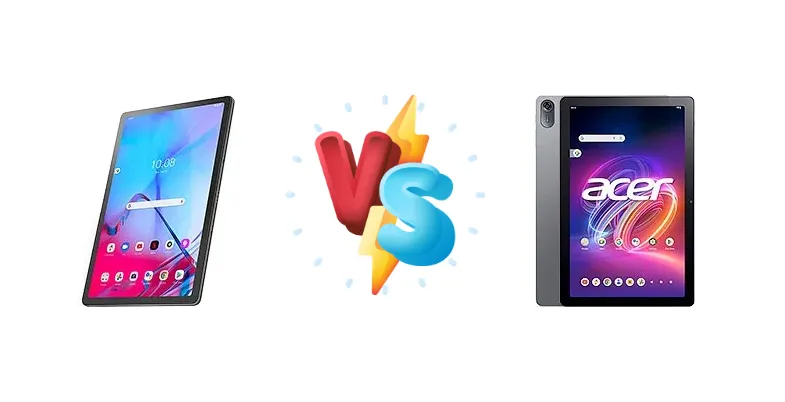
The tablet market is heating up with compelling options at various price points. We're pitting the Lenovo Tab P11 5G, a well-established 5G-enabled tablet, against the newer Acer Iconia Tab P10 (2025), which aims to deliver solid performance with the Mediatek Helio G99. This comparison dives deep into the core differences to help you determine which tablet best suits your needs.
🏆 Quick Verdict
For the average user prioritizing 5G connectivity and a slightly more mature software experience, the Lenovo Tab P11 5G is the better choice. While the Acer Iconia Tab P10 (2025) boasts a more efficient 6nm process, the Snapdragon 750G's integrated 5G modem and established performance profile give the Lenovo tablet a slight edge.
| Network |
|---|
| 2G bands | GSM 850 / 900 / 1800 / 1900 | N/A |
| 3G bands | HSDPA 850 / 900 / 1900 / 2100 | N/A |
| 4G bands | 1, 2, 3, 4, 5, 7, 8, 19, 20, 26, 28, 34, 38, 39, 40, 41 | N/A |
| 5G bands | 1, 3, 7, 8, 20, 28, 38, 41, 77, 78, 79 SA/NSA | - |
| EDGE | - | No |
| GPRS | - | No |
| Speed | HSPA, LTE, 5G | - |
| Technology | GSM / HSPA / LTE / 5G | No cellular connectivity |
| Launch |
|---|
| Announced | 2021, September 08 | 2025, Q4 |
| Status | Available. Released 2021, December 15 | Available. Released 2025, Q4 |
| Body |
|---|
| Build | - | Glass front, aluminum alloy frame |
| Dimensions | 258 x 163 x 7.9 mm (10.16 x 6.42 x 0.31 in) | 8.1 mm thickness |
| SIM | Nano-SIM | No |
| Weight | 520 g (1.15 lb) | 495 g (1.09 lb) |
| | Stylus support | - |
| Display |
|---|
| Resolution | 1200 x 2000 pixels, 5:3 ratio (~212 ppi density) | 1200 x 2000 pixels, 5:3 ratio (~224 ppi density) |
| Size | 11.0 inches, 344.4 cm2 (~81.9% screen-to-body ratio) | 10.4 inches, 307.9 cm2 |
| Type | IPS LCD, Dolby Vision, 400 nits (typ) | IPS LCD, 90Hz |
| Platform |
|---|
| CPU | Octa-core (2x2.2 GHz Kryo 570 & 6x1.8 GHz Kryo 570) | Octa-core (2x2.2 GHz Cortex-A76 & 6x2.0 GHz Cortex-A55) |
| Chipset | Qualcomm SM7225 Snapdragon 750G 5G (8 nm) | Mediatek Helio G99 (6 nm) |
| GPU | Adreno 619 | Mali-G57 MC2 |
| OS | Android 11 | Android 14 |
| Memory |
|---|
| Card slot | microSDXC (dedicated slot) | microSDXC (dedicated slot) |
| Internal | 128GB 6GB RAM, 256GB 8GB RAM | 128GB 6GB RAM, 256GB 6GB RAM |
| Main Camera |
|---|
| Features | LED flash | - |
| Single | 13 MP, (wide), AF | 13 MP |
| Video | 1080p@30fps | 1080p@30fps |
| Selfie camera |
|---|
| Single | 8 MP, (wide)
IR TOF 3D, (biometrics sensor only) | 5 MP |
| Video | 1080p@30fps | Yes |
| Sound |
|---|
| 3.5mm jack | No | - |
| 35mm jack | No | Yes |
| Loudspeaker | Yes, with stereo speakers (4 speakers) | Yes, with stereo speakers |
| | JBL speakers | - |
| Comms |
|---|
| Bluetooth | 5.1, A2DP, LE | 5.0, A2DP, LE |
| NFC | No | No |
| Positioning | GPS, GLONASS, BDS | GPS |
| Radio | No | No |
| USB | USB Type-C 3.2, DisplayPort | USB Type-C 2.0 |
| WLAN | Wi-Fi 802.11 a/b/g/n/ac/6, dual-band, Wi-Fi Direct | Wi-Fi 802.11 a/b/g/n/ac, dual-band |
| Features |
|---|
| Sensors | Accelerometer, gyro, proximity | Gyro |
| Battery |
|---|
| Charging | 20W wired | 10W wired |
| Type | Li-Po 7700 mAh | Li-Ion 8000 mAh |
| Misc |
|---|
| Colors | Moon White, Storm Grey, Modernist Teal | Iron Gray |
| Models | - | P10-21Q-870Q, NT.LHBAA.001 |
| Price | About 500 EUR | About 220 EUR |
Lenovo Tab P11 5G
- Integrated 5G connectivity for fast data speeds.
- Faster 20W wired charging.
- Proven Snapdragon 750G performance and stability.
- Older chipset architecture compared to the Helio G99.
- Potentially less battery efficiency due to 5G and 8nm process.
Acer Iconia Tab P10 (2025)
- More power-efficient 6nm Mediatek Helio G99 chipset.
- Potentially longer battery life under light to moderate use.
- Likely more affordable price point.
- Slower 10W wired charging.
- Lacks integrated 5G connectivity.
- Performance may lag behind the Snapdragon 750G in demanding tasks.
Display Comparison
Neither device's display specifications are provided, so a direct comparison is limited. However, considering the price bracket, both likely utilize IPS LCD panels. The Acer Iconia Tab P10 (2025) benefits from the newer Helio G99 chipset, which *could* allow for more advanced display features like higher refresh rates, though this isn't confirmed. The Lenovo Tab P11 5G, being an older model, may have slightly larger bezels, impacting the screen-to-body ratio.
Camera Comparison
Without detailed camera specifications, a meaningful comparison is difficult. Both tablets likely feature modest camera setups geared towards video calls and casual snapshots. The absence of information regarding sensor size or optical image stabilization suggests neither device will excel in low-light photography. Any included macro cameras are likely to be low resolution and offer limited practical benefit.
Performance
The core of the difference lies in the chipsets. The Lenovo Tab P11 5G’s Qualcomm Snapdragon 750G 5G (8nm) features a Kryo 570 CPU architecture, offering a balance of performance and efficiency. The Acer Iconia Tab P10 (2025) utilizes the Mediatek Helio G99 (6nm). While the G99’s 6nm process is more efficient, potentially leading to better battery life under sustained loads, the Snapdragon 750G benefits from Qualcomm’s optimizations and integrated 5G modem. The Snapdragon’s CPU configuration (2x2.2 GHz Kryo 570 & 6x1.8 GHz Kryo 570) is comparable to the Helio G99’s (2x2.2 GHz Cortex-A76 & 6x2.0 GHz Cortex-A55), but Qualcomm’s architecture generally delivers superior single-core performance, important for responsive UI and app loading. The 5G modem in the Lenovo tablet is a significant advantage for users needing constant connectivity.
Battery Life
The Lenovo Tab P11 5G supports 20W wired charging, while the Acer Iconia Tab P10 (2025) is limited to 10W. This difference in charging speed is substantial; the Lenovo tablet will likely reach a full charge significantly faster. While battery capacity isn't specified, the more efficient 6nm process of the Helio G99 in the Acer tablet *could* offset the slower charging, providing comparable real-world battery life despite potentially having a smaller battery capacity. However, the 5G connectivity of the Lenovo tablet will inherently consume more power when actively used.
Buying Guide
Buy the Lenovo Tab P11 5G if you need reliable 5G connectivity for on-the-go productivity or entertainment, and value a proven chipset with good software support. Buy the Acer Iconia Tab P10 (2025) if you prioritize power efficiency and are primarily using the tablet for less demanding tasks like media consumption and light web browsing, and don't require 5G.
Frequently Asked Questions
❓ Will the Mediatek Helio G99 in the Acer Iconia Tab P10 (2025) struggle with graphically intensive games?
The Helio G99 is a capable processor for casual gaming, but demanding titles at high settings may experience frame drops. It's best suited for less graphically intensive games or playing at lower settings to maintain a smooth experience. The Snapdragon 750G in the Lenovo Tab P11 5G offers slightly better GPU performance, potentially handling more demanding games more effectively.
❓ How much faster is the 20W charging on the Lenovo Tab P11 5G compared to the 10W charging on the Acer Iconia Tab P10 (2025)?
The difference is significant. 20W charging will substantially reduce the time it takes to fully charge the Lenovo Tab P11 5G. Expect a 0-100% charge to take roughly 1.5-2 hours, while the Acer Iconia Tab P10 (2025) could take 3-4 hours or longer with its 10W charger. This makes the Lenovo a better choice for users who frequently need to quickly top up their battery.
❓ Is the 5G connectivity on the Lenovo Tab P11 5G worth the extra cost if I primarily use Wi-Fi?
If you consistently have access to reliable Wi-Fi, the 5G connectivity may not be essential. However, 5G provides a valuable backup for situations where Wi-Fi is unavailable or unreliable, such as during travel or in areas with poor Wi-Fi coverage. It also offers faster speeds than typical Wi-Fi connections in certain scenarios.