
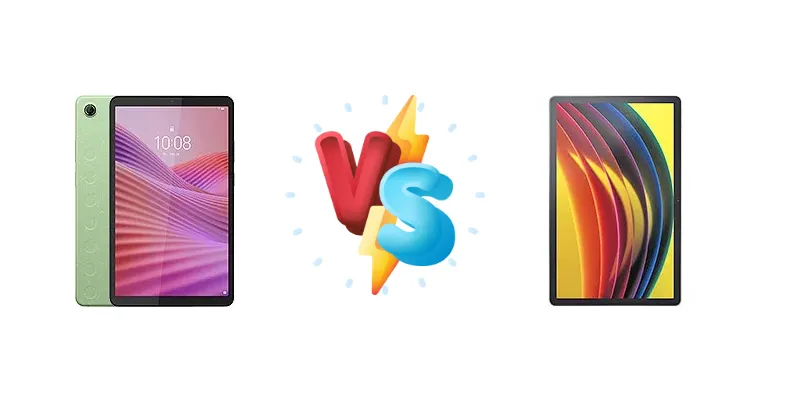
Lenovo Tab One vs. Lenovo Tab P11 Plus: A Deep Dive into Performance and Value
| Phones Images | |||||
|---|---|---|---|---|---|
|
🏆 Quick Verdict
For most users, the Lenovo Tab P11 Plus is the better choice. Its Helio G90T chipset, featuring Cortex-A76 cores, provides a noticeable performance boost over the Tab One’s Helio G85, making it more responsive for multitasking and gaming. While both offer 20W charging, the P11 Plus’s improved processing power justifies the slight price premium.
| PHONES | ||
|---|---|---|
| Phone Names | Lenovo Tab One | Lenovo Tab P11 Plus |
| Network | ||
|---|---|---|
| 2G bands | GSM 850 / 900 / 1800 / 1900 - cellular model only | GSM 850 / 900 / 1800 / 1900 |
| 3G bands | HSDPA 850 / 900 / 1700(AWS) / 1900 / 2100 - cellular model only | HSDPA 850 / 900 / 1900 / 2100 |
| 4G bands | 1, 2, 3, 4, 5, 7, 8, 12, 13, 17, 18, 19, 20, 26, 28, 38, 40, 41, 66 - cellular model only | 1, 2, 3, 4, 5, 7, 8, 20, 28, 38, 40, 41 |
| Speed | HSPA, LTE - cellular model only | HSPA, LTE - cellular model only |
| Technology | GSM / HSPA / LTE | GSM / HSPA / LTE |
| Launch | ||
|---|---|---|
| Announced | 2025, March | 2021, June 28 |
| Status | Available. Released 2025, March | Available. Released 2021, July 29 |
| Body | ||
|---|---|---|
| Build | Glass front, plastic frame, plastic back | - |
| Dimensions | 211 x 124.8 x 8.5 mm (8.31 x 4.91 x 0.33 in) | 258.4 x 163 x 7.5 mm (10.17 x 6.42 x 0.30 in) |
| SIM | Nano-SIM (cellular model only) | Nano-SIM (cellular model only) |
| Weight | 320 g (11.29 oz) | 490 g (1.08 lb) |
| - | Stylus support | |
| Display | ||
|---|---|---|
| Protection | Mohs level 4 | - |
| Resolution | 800 x 1340 pixels, 5:3 ratio (~179 ppi density) | 1200 x 2000 pixels, 5:3 ratio (~212 ppi density) |
| Size | 8.7 inches, 214.9 cm2 (~81.6% screen-to-body ratio) | 11.0 inches, 344.4 cm2 (~81.8% screen-to-body ratio) |
| Type | TFT LCD, 480 nits (typ) | IPS LCD, 400 nits (typ) |
| Platform | ||
|---|---|---|
| CPU | Octa-core (2x2.0 GHz Cortex-A75 & 6x1.8 GHz Cortex-A55) | Octa-core (2x2.05 GHz Cortex-A76 & 6x2.0 GHz Cortex-A55) |
| Chipset | Mediatek Helio G85 (12 nm) | Mediatek MT6785 Helio G90T (12 nm) |
| GPU | Mali-G52 MC2 | Mali-G76 MC4 |
| OS | Android 14 | Android 11 |
| Memory | ||
|---|---|---|
| Card slot | microSDXC (dedicated slot) | microSDXC (dedicated slot) |
| Internal | 64GB 4GB RAM, 128GB 4GB RAM | 64GB 4GB RAM, 128GB 4GB RAM, 128GB 6GB RAM |
| Main Camera | ||
|---|---|---|
| Features | - | LED flash |
| Single | 8 MP, AF | 13 MP, (wide), AF |
| Video | 1080p | 1080p@30fps |
| Selfie camera | ||
|---|---|---|
| Single | 2 MP | 8 MP, (wide) |
| Video | 720p | 1080p@30fps |
| Sound | ||
|---|---|---|
| 3.5mm jack | - | No |
| 35mm jack | Yes | No |
| Loudspeaker | Yes, with stereo speakers (with Dolby Atmos) | Yes, with stereo speakers (4 speakers) |
| Comms | ||
|---|---|---|
| Bluetooth | 5.3, A2DP, LE | 5.1, A2DP, LE |
| NFC | No | No |
| Positioning | GPS, GLONASS, GALILEO, BDS - cellular model only | GPS, GLONASS, BDS - cellular model only |
| Radio | FM radio | FM radio |
| USB | USB Type-C 2.0 | USB Type-C 2.0 |
| WLAN | Wi-Fi 802.11 a/b/g/n/ac, dual-band, Wi-Fi Direct | Wi-Fi 802.11 a/b/g/n/ac, dual-band, Wi-Fi Direct |
| Features | ||
|---|---|---|
| Sensors | Accelerometer, proximity (accessories only) | Accelerometer, gyro, proximity |
| Battery | ||
|---|---|---|
| Charging | 20W wired | 20W wired |
| Type | Li-Ion 5100 mAh | Li-Po 7700 mAh |
| Misc | ||
|---|---|---|
| Colors | Luna grey, Seafoam green | Slate Grey, Platinum Grey, Modernist teal |
| Models | TB305FU | ZA940124SE |
| Price | $ 99.99 | About 300 EUR |
| EU LABEL | ||
|---|---|---|
| Battery | 80:53h endurance, 1000 cycles | - |
| Energy | Class D | - |
| Free fall | Class E (3 falls) | - |
| Repairability | Class A | - |
Lenovo Tab One
- Exceptional battery endurance (80:53h)
- Long-lasting battery health (1000 cycles)
- More affordable price point
- Less powerful processor
- Slower performance in demanding tasks
- Potentially noticeable lag during multitasking
Lenovo Tab P11 Plus
- Faster and more responsive performance
- Improved CPU architecture (Cortex-A76)
- Better suited for gaming and multitasking
- Likely shorter battery life compared to Tab One
- Potentially higher price
- May run slightly warmer under heavy load
Display Comparison
Both tablets are assumed to feature similar LCD panels, given their market positioning. However, detailed display specs (resolution, brightness, color gamut) are not provided. The focus here is on performance. The absence of high refresh rate panels on either device suggests a focus on power efficiency rather than visual fluidity. Bezels are likely comparable, typical of tablets in this price bracket.
Camera Comparison
Camera specifications are not provided, making a direct comparison impossible. However, given the price points, it’s safe to assume both tablets feature modest camera setups geared towards casual use. Image quality will likely be similar, with performance heavily reliant on software processing. The absence of detailed camera specs suggests neither tablet is a primary choice for photography enthusiasts.
Performance
The core difference lies in the chipsets. The Tab P11 Plus boasts the Mediatek Helio G90T (12nm) with an octa-core CPU configuration of 2x2.05 GHz Cortex-A76 and 6x2.0 GHz Cortex-A55 cores. This is a step up from the Tab One’s Helio G85 (12nm) which utilizes 2x2.0 GHz Cortex-A75 and 6x1.8 GHz Cortex-A55 cores. The Cortex-A76 cores in the G90T offer a significant architectural improvement over the A75 cores in the G85, resulting in faster single-core and multi-core performance. This translates to quicker app loading times, smoother scrolling, and a more responsive overall experience. While both use the same 12nm process, the G90T’s more efficient core design likely results in comparable, if not better, thermal management despite the increased performance.
Battery Life
The Lenovo Tab One claims an impressive 80:53h endurance and 1000 charge cycles, indicating a strong emphasis on battery longevity. While the Tab P11 Plus’s battery capacity isn’t specified, the more powerful Helio G90T chipset will likely consume more power. Both tablets support 20W wired charging, meaning 0-100% charge times will be comparable, likely around 2-3 hours. The Tab One’s superior endurance rating suggests it will last longer on a single charge, making it ideal for extended use away from a power outlet.
Buying Guide
Buy the Lenovo Tab One if you prioritize exceptional battery life and a consistently stable experience for basic tasks like reading, web browsing, and video playback. It’s ideal for users who value longevity over raw power. Buy the Lenovo Tab P11 Plus if you need a tablet capable of handling more demanding applications, light gaming, and smoother multitasking. The upgraded chipset delivers a more fluid user experience for those who push their tablet beyond simple content consumption.