
Asus ROG Phone 7 Ultimate vs. Lenovo Tab One: A Deep Dive into Performance and Endurance
| Phones Images | |||||
|---|---|---|---|---|---|
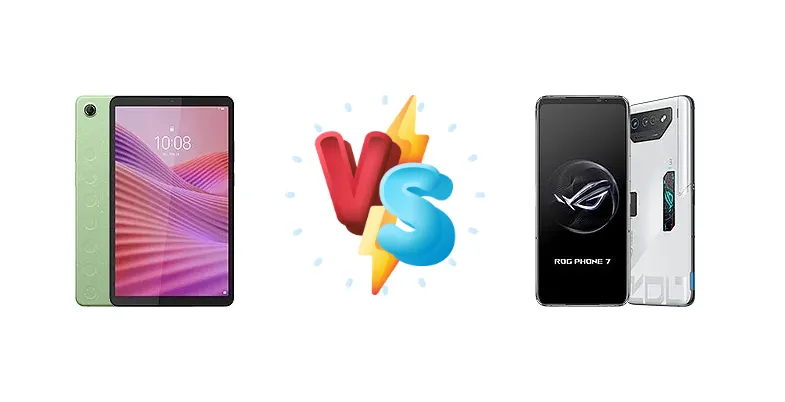
|
🏆 Quick Verdict
For dedicated mobile gamers, the Asus ROG Phone 7 Ultimate is the clear winner, offering a Snapdragon 8 Gen 2 and a stunning display. However, the Lenovo Tab One provides significantly longer battery life and a lower price point, making it ideal for casual users and media consumers.
| PHONES | ||
|---|---|---|
| Phone Names | Lenovo Tab One | Asus ROG Phone 7 Ultimate |
| Network | ||
|---|---|---|
| 2G bands | GSM 850 / 900 / 1800 / 1900 - cellular model only | GSM 850 / 900 / 1800 / 1900 |
| 3G bands | HSDPA 850 / 900 / 1700(AWS) / 1900 / 2100 - cellular model only | HSDPA 800 / 850 / 900 / 1700(AWS) / 1900 / 2100 |
| 4G bands | 1, 2, 3, 4, 5, 7, 8, 12, 13, 17, 18, 19, 20, 26, 28, 38, 40, 41, 66 - cellular model only | 1, 2, 3, 4, 5, 7, 8, 12, 17, 18, 19, 20, 25, 26, 28, 32, 34, 38, 39, 40, 41, 42, 43, 48, 66 - International |
| 5G bands | - | 1, 2, 3, 5, 7, 8, 12, 18, 20, 25, 26, 28, 38, 40, 41, 48, 66, 77, 78, 79 SA/NSA/Sub6 - International |
| Speed | HSPA, LTE - cellular model only | HSPA, LTE (Up to 7CA), 5G |
| Technology | GSM / HSPA / LTE | GSM / CDMA / HSPA / LTE / 5G |
| - | 1, 3, 5, 8, 28, 41, 77, 78, 79 SA/NSA/Sub6 - China | |
| Launch | ||
|---|---|---|
| Announced | 2025, March | 2023, April 13 |
| Status | Available. Released 2025, March | Available. Released 2023, May |
| Body | ||
|---|---|---|
| Build | Glass front, plastic frame, plastic back | Glass front (Gorilla Glass Victus), glass back (Gorilla Glass 3), aluminum frame |
| Dimensions | 211 x 124.8 x 8.5 mm (8.31 x 4.91 x 0.33 in) | 173 x 77 x 10.3 mm (6.81 x 3.03 x 0.41 in) |
| SIM | Nano-SIM (cellular model only) | Nano-SIM + Nano-SIM |
| Weight | 320 g (11.29 oz) | 239 g (8.43 oz) |
| - | Built-in motorized cooling air vent (AeroActive Portal) IP54 water resistant 2" OLED display (on the back) Pressure sensitive zones (Gaming triggers) | |
| Display | ||
|---|---|---|
| Protection | Mohs level 4 | Corning Gorilla Glass Victus |
| Resolution | 800 x 1340 pixels, 5:3 ratio (~179 ppi density) | 1080 x 2448 pixels (~395 ppi density) |
| Size | 8.7 inches, 214.9 cm2 (~81.6% screen-to-body ratio) | 6.78 inches, 109.5 cm2 (~82.2% screen-to-body ratio) |
| Type | TFT LCD, 480 nits (typ) | AMOLED, 1B colors, 165Hz, HDR10+, 1000 nits (HBM), 1500 nits (peak) |
| Platform | ||
|---|---|---|
| CPU | Octa-core (2x2.0 GHz Cortex-A75 & 6x1.8 GHz Cortex-A55) | Octa-core (1x3.2 GHz Cortex-X3 & 2x2.8 GHz Cortex-A715 & 2x2.8 GHz Cortex-A710 & 3x2.0 GHz Cortex-A510) |
| Chipset | Mediatek Helio G85 (12 nm) | Qualcomm SM8550-AB Snapdragon 8 Gen 2 (4 nm) |
| GPU | Mali-G52 MC2 | Adreno 740 |
| OS | Android 14 | Android 13, up to 2 major Android upgrades |
| Memory | ||
|---|---|---|
| Card slot | microSDXC (dedicated slot) | No |
| Internal | 64GB 4GB RAM, 128GB 4GB RAM | 512GB 16GB RAM |
| - | UFS 4.0 NTFS support for external storage | |
| Main Camera | ||
|---|---|---|
| Features | - | LED flash, HDR, panorama |
| Single | 8 MP, AF | - |
| Triple | - | 50 MP, f/1.9, 24mm (wide), 1/1.56", 1.0µm, PDAF 13 MP, f/2.2, 13mm, 120˚ (ultrawide) 5 MP (macro) |
| Video | 1080p | 8K@24fps, 4K@30/60fps, 1080p@30/60/120/240fps, 720p@480fps; gyro-EIS, HDR10+ |
| Selfie camera | ||
|---|---|---|
| Features | - | Panorama, HDR |
| Single | 2 MP | 32 MP, f/2.5, 29mm (wide), 1/3.2", 0.7µm |
| Video | 720p | 1080p@30fps |
| Sound | ||
|---|---|---|
| 3.5mm jack | - | Yes |
| 35mm jack | Yes | Yes |
| Loudspeaker | Yes, with stereo speakers (with Dolby Atmos) | Yes, with stereo speakers (2 amplifiers) |
| - | 32-bit/384kHz audio | |
| Comms | ||
|---|---|---|
| Bluetooth | 5.3, A2DP, LE | 5.3, A2DP, LE, aptX HD, aptX Adaptive, aptX Lossless |
| NFC | No | Yes |
| Positioning | GPS, GLONASS, GALILEO, BDS - cellular model only | GPS (L1+L5), GLONASS (L1), BDS (B1I+B1c+B2a), GALILEO (E1+E5a), QZSS (L1+L5), NavIC (L5) |
| Radio | FM radio | No |
| USB | USB Type-C 2.0 | USB Type-C 3.1 (side), DisplayPort 1.4; USB Type-C 2.0 (bottom), OTG, accessory connector |
| WLAN | Wi-Fi 802.11 a/b/g/n/ac, dual-band, Wi-Fi Direct | Wi-Fi 802.11 a/b/g/n/ac/6e/7, tri-band, Wi-Fi Direct |
| Features | ||
|---|---|---|
| Sensors | Accelerometer, proximity (accessories only) | Fingerprint (under display, optical), accelerometer, gyro, proximity, compass |
| Battery | ||
|---|---|---|
| Charging | 20W wired | 65W wired, PD3.0, QC5, 100% in 42 min 10W reverse wired |
| Type | Li-Ion 5100 mAh | Li-Po 6000 mAh |
| Misc | ||
|---|---|---|
| Colors | Luna grey, Seafoam green | Storm White |
| Models | TB305FU | - |
| Price | $ 99.99 | About 780 EUR |
| Tests | ||
|---|---|---|
| Battery life | - | Endurance rating 131h |
| Camera | - | Photo / Video |
| Display | - | Contrast ratio: Infinite (nominal) |
| Loudspeaker | - | -25.5 LUFS (Very good) |
| Performance | - | AnTuTu: 1325105 (v9) GeekBench: 5139 (v5.5), 5567 (v6) GFXBench: 107fps (ES 3.1 onscreen) |
| EU LABEL | ||
|---|---|---|
| Battery | 80:53h endurance, 1000 cycles | - |
| Energy | Class D | - |
| Free fall | Class E (3 falls) | - |
| Repairability | Class A | - |
Lenovo Tab One
- Exceptional battery life (80:53h endurance)
- Affordable price point
- Suitable for media consumption and casual use
- Limited processing power for demanding tasks
- Basic camera system
- Slower charging speed (20W)
Asus ROG Phone 7 Ultimate
- Flagship Snapdragon 8 Gen 2 performance
- Bright and high-quality display (1095 nits)
- Ultra-fast 65W charging
- Higher price tag
- Shorter battery life compared to Tab One (131h endurance)
- May require external cooling for sustained gaming
Display Comparison
The Asus ROG Phone 7 Ultimate boasts a significantly brighter display, reaching a measured 1095 nits, compared to an unspecified brightness for the Lenovo Tab One. This brightness advantage, coupled with an assumed high contrast ratio (infinite, nominal), translates to superior visibility in direct sunlight. While the Tab One's display specs are limited, its larger form factor may offer a more immersive viewing experience for videos. The ROG Phone's focus on gaming likely includes a higher refresh rate and lower response time, crucial for competitive play, features absent from the Tab One's specification.
Camera Comparison
Both devices feature photo and video capabilities, but detailed camera specifications are lacking for both. The ROG Phone 7 Ultimate, being a flagship, likely incorporates a more advanced camera system with larger sensors, optical image stabilization (OIS), and sophisticated image processing algorithms. The Tab One’s camera is likely a basic setup suitable for casual snapshots. Without specific sensor details, it’s difficult to make a precise comparison, but the ROG Phone’s higher price point suggests a superior imaging experience.
Performance
The performance gap is substantial. The Asus ROG Phone 7 Ultimate’s Qualcomm Snapdragon 8 Gen 2 (4nm) is a flagship chipset featuring an octa-core configuration with a Cortex-X3 prime core clocked at 3.2 GHz. This contrasts sharply with the Lenovo Tab One’s Mediatek Helio G85 (12nm), an octa-core processor geared towards efficiency rather than raw power. The 4nm process node of the Snapdragon 8 Gen 2 delivers superior thermal efficiency, minimizing throttling during extended gaming sessions. The ROG Phone’s LPDDR5x RAM (speculation based on ROG phone standards) further enhances performance, while the Tab One likely utilizes slower LPDDR4x memory. This translates to significantly faster app loading times, smoother multitasking, and a far more capable gaming experience on the ROG Phone.
Battery Life
The Asus ROG Phone 7 Ultimate offers an endurance rating of 131 hours, while the Lenovo Tab One achieves an impressive 80:53 hours. Despite the ROG Phone’s more power-hungry chipset, its endurance is still excellent, likely due to a larger battery capacity (not specified) and efficient power management. However, the Tab One’s longer endurance is a significant advantage for users who prioritize all-day battery life. The ROG Phone supports 65W wired charging with PD3.0 and QC5, achieving a 100% charge in just 42 minutes, while the Tab One is limited to 20W wired charging. The ROG Phone also offers 10W reverse wired charging, a feature absent on the Tab One.
Buying Guide
Buy the Lenovo Tab One if you need a long-lasting device for media consumption, light productivity, and casual gaming, and value affordability above all else. Its 80:53h endurance rating ensures all-day use. Buy the Asus ROG Phone 7 Ultimate if you prioritize maximum gaming performance, a high refresh rate display, and rapid charging, and are willing to pay a premium for those features. It's built for demanding mobile titles and competitive play.