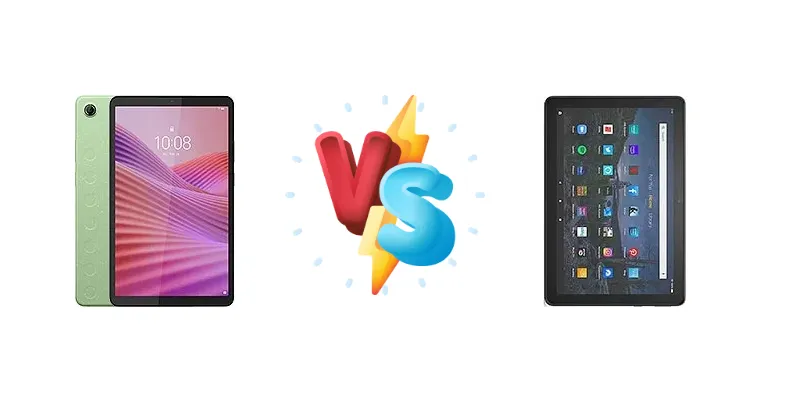
The budget tablet market is fiercely competitive, and the Lenovo Tab One and Amazon Fire HD 10 Plus (2021) represent compelling options for users seeking affordable entertainment and productivity. While both tablets aim for accessibility, they diverge significantly in their core hardware and software approaches. This comparison dissects these differences, focusing on performance, battery endurance, and charging capabilities to determine which tablet best suits your needs.
🏆 Quick Verdict
For users prioritizing sustained performance and longevity, the Lenovo Tab One emerges as the stronger choice. Its Mediatek Helio G85 chipset, coupled with an impressive 80:53h battery endurance, provides a smoother experience for demanding tasks. However, the Fire HD 10 Plus’s wireless charging offers a convenience factor the Tab One lacks.
| Network |
|---|
| 2G bands | GSM 850 / 900 / 1800 / 1900 - cellular model only | N/A |
| 3G bands | HSDPA 850 / 900 / 1700(AWS) / 1900 / 2100 - cellular model only | - |
| 4G bands | 1, 2, 3, 4, 5, 7, 8, 12, 13, 17, 18, 19, 20, 26, 28, 38, 40, 41, 66 - cellular model only | - |
| EDGE | - | No |
| GPRS | - | No |
| Speed | HSPA, LTE - cellular model only | - |
| Technology | GSM / HSPA / LTE | No cellular connectivity |
| Launch |
|---|
| Announced | 2025, March | 2021, April 27. Released 2021, May 26 |
| Status | Available. Released 2025, March | Discontinued |
| Body |
|---|
| Build | Glass front, plastic frame, plastic back | - |
| Dimensions | 211 x 124.8 x 8.5 mm (8.31 x 4.91 x 0.33 in) | 247 x 166 x 9.2 mm (9.72 x 6.54 x 0.36 in) |
| SIM | Nano-SIM (cellular model only) | No |
| Weight | 320 g (11.29 oz) | 468 g (1.03 lb) |
| Display |
|---|
| Protection | Mohs level 4 | Aluminosilicate glass |
| Resolution | 800 x 1340 pixels, 5:3 ratio (~179 ppi density) | 1920 x 1200 pixels, 16:10 ratio (~224 ppi density) |
| Size | 8.7 inches, 214.9 cm2 (~81.6% screen-to-body ratio) | 10.1 inches, 295.8 cm2 (~72.1% screen-to-body ratio) |
| Type | TFT LCD, 480 nits (typ) | IPS LCD |
| Platform |
|---|
| CPU | Octa-core (2x2.0 GHz Cortex-A75 & 6x1.8 GHz Cortex-A55) | Octa-core (4x2.0 GHz Cortex-A73 & 4x2.0 GHz Cortex-A53) |
| Chipset | Mediatek Helio G85 (12 nm) | Mediatek MT8183 Helio P60T (12 nm) |
| GPU | Mali-G52 MC2 | Mali-G72 MP3 |
| OS | Android 14 | Android 9.0 (Pie), Fire OS 7 |
| Memory |
|---|
| Card slot | microSDXC (dedicated slot) | microSDXC (dedicated slot) |
| Internal | 64GB 4GB RAM, 128GB 4GB RAM | 32GB 4GB RAM, 64GB 4GB RAM |
| | - | eMMC 5.1 |
| Main Camera |
|---|
| Single | 8 MP, AF | 5 MP |
| Video | 1080p | 720p |
| Selfie camera |
|---|
| Single | 2 MP | 2 MP |
| Video | 720p | 720p |
| Sound |
|---|
| 3.5mm jack | - | Yes |
| 35mm jack | Yes | Yes |
| Loudspeaker | Yes, with stereo speakers (with Dolby Atmos) | Yes, with stereo speakers |
| Comms |
|---|
| Bluetooth | 5.3, A2DP, LE | 5.0, A2DP, LE |
| NFC | No | No |
| Positioning | GPS, GLONASS, GALILEO, BDS - cellular model only | No |
| Radio | FM radio | No |
| USB | USB Type-C 2.0 | USB Type-C 2.0, OTG |
| WLAN | Wi-Fi 802.11 a/b/g/n/ac, dual-band, Wi-Fi Direct | Wi-Fi 802.11 a/b/g/n/ac, dual-band |
| Features |
|---|
| Sensors | Accelerometer, proximity (accessories only) | Accelerometer |
| | - | Text-to-Speech English-language content reader |
| Battery |
|---|
| Charging | 20W wired | Wireless |
| Type | Li-Ion 5100 mAh | Li-Ion |
| Misc |
|---|
| Colors | Luna grey, Seafoam green | Slate |
| Models | TB305FU | T76N2P |
| Price | $ 99.99 | About 150 EUR |
| EU LABEL |
|---|
| Battery | 80:53h endurance, 1000 cycles | - |
| Energy | Class D | - |
| Free fall | Class E (3 falls) | - |
| Repairability | Class A | - |
Lenovo Tab One
- Superior CPU performance with the Helio G85
- Exceptional battery life (80:53h endurance)
- Faster overall system responsiveness
- Lacks wireless charging
- Display specifications are unknown
Amazon Fire HD 10 Plus (2021)
- Convenient wireless charging
- Integration with the Amazon ecosystem
- Potentially lower price point
- Less powerful processor (Helio P60T)
- Likely shorter battery life
- Performance may struggle with demanding apps
Display Comparison
Neither device’s display specifications are provided, so a direct comparison is limited. However, given the price points, both likely utilize IPS LCD panels. The Fire HD 10 Plus’s focus on media consumption suggests a potentially brighter display, while the Tab One’s overall hardware suggests a more balanced approach. Bezels are likely comparable, typical of this market segment. Color accuracy will likely be standard for budget tablets, prioritizing vibrancy over absolute fidelity.
Camera Comparison
Camera performance is unlikely to be a deciding factor for either tablet, given their target market. Without specific sensor details, it’s safe to assume both feature basic camera setups geared towards casual snapshots. The absence of information suggests neither device prioritizes photography. Focusing on the chipset, the Tab One’s more powerful processor could potentially offer slightly faster image processing, but the difference will likely be minimal.
Performance
The Lenovo Tab One’s Mediatek Helio G85 chipset, featuring a combination of 2x2.0 GHz Cortex-A75 and 6x1.8 GHz Cortex-A55 cores, offers a clear architectural advantage over the Amazon Fire HD 10 Plus’s Mediatek MT8183 Helio P60T (4x2.0 GHz Cortex-A73 & 4x2.0 GHz Cortex-A53). The Cortex-A75 cores in the Tab One are more efficient and powerful than the A73 cores in the Fire HD 10 Plus, resulting in snappier app launches and smoother multitasking. While both chipsets are built on a 12nm process, the newer architecture of the G85 translates to better overall performance. The Tab One is likely to exhibit less throttling under sustained load, making it better suited for gaming.
Battery Life
The Lenovo Tab One’s 80:53h battery endurance is a standout feature, significantly exceeding what’s typically found in this price range. This longevity is likely due to a combination of the efficient Helio G85 chipset and optimized software. The Amazon Fire HD 10 Plus lacks this endurance figure, but compensates with wireless charging, a convenience feature absent on the Tab One. The Tab One’s 20W wired charging is standard, while the Fire HD 10 Plus’s wireless charging speed is unknown, but generally slower than wired alternatives. For users prioritizing all-day use and minimizing charging frequency, the Tab One is the clear winner.
Buying Guide
Buy the Lenovo Tab One if you need a tablet capable of handling everyday tasks and light gaming with consistent performance and exceptional battery life. It’s ideal for students, commuters, or anyone who values a responsive user experience. Buy the Amazon Fire HD 10 Plus (2021) if you prioritize content consumption within the Amazon ecosystem, value wireless charging convenience, and are willing to accept slightly less processing power for a lower price point.
Frequently Asked Questions
❓ Will the Mediatek Helio P60T in the Fire HD 10 Plus struggle with multitasking or demanding apps?
The Helio P60T is a capable chipset for basic tasks like web browsing and video playback, but its older architecture and less powerful cores compared to the Helio G85 in the Tab One mean it will likely exhibit slowdowns when running multiple apps simultaneously or playing graphically intensive games. Users who frequently multitask or enjoy gaming should strongly consider the Tab One.
❓ How does the 1000-cycle battery claim of the Lenovo Tab One translate to real-world longevity?
The 1000-cycle claim suggests the Tab One’s battery is designed to retain a significant portion of its original capacity even after being fully charged and discharged 1000 times. This indicates a higher-quality battery and more robust battery management, potentially extending the tablet’s usable lifespan compared to devices with lower cycle counts. However, actual battery degradation will also depend on usage patterns and charging habits.
❓ Is wireless charging on the Fire HD 10 Plus significantly slower than the 20W wired charging on the Tab One?
Yes, wireless charging is generally slower than wired charging. While the exact wattage of the Fire HD 10 Plus’s wireless charging isn’t specified, it’s unlikely to match the speed of the Tab One’s 20W wired charging. Expect a considerably longer charging time when using wireless charging, making it more suitable for overnight or convenience charging rather than quick top-ups.